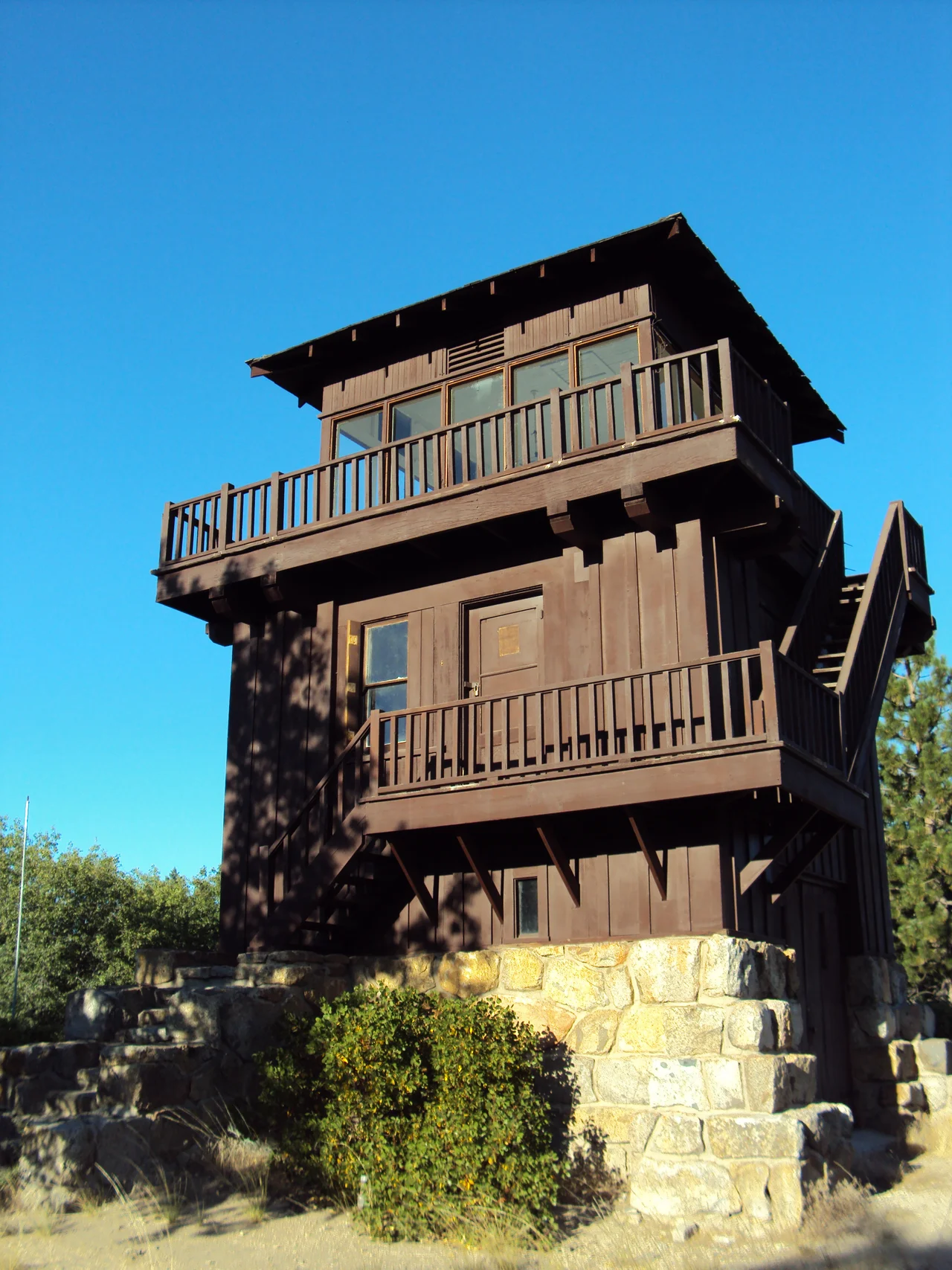

Henness Ridge Fire Lookout
Most fire lookouts in the American West are metal towers - functional, ugly, and utterly indifferent to their surroundings. The Henness Ridge Fire Lookout is none of these things. Built in 1934 by the Civilian Conservation Corps, it is a three-story structure made of wood and stone that was designed, deliberately and painstakingly, to look like it belongs here. The National Park Service called this approach "rustic style" - an architectural philosophy that treated buildings in wilderness areas as guests rather than occupants. Of the four rustic-style lookouts originally constructed in California, only two survive. This is one of them. It stands at 6,300 feet on a ridge thick with black oak and manzanita, looking out over a 360-degree panorama of Yosemite and the surrounding Sierra National Forest, doing exactly what it was built to do: watch for smoke.
Young Men and Hard Work
The men who built the Henness Ridge Fire Lookout were between eighteen and twenty-four years old. They were members of the Civilian Conservation Corps, Franklin Roosevelt's Depression-era program that put unemployed young men to work on conservation projects across the country. The CCC operated like a civilian army: the men lived in camps, wore uniforms, and sent most of their pay home to their families. In Yosemite, they built trails, cleared brush, fought fires, and constructed buildings - including this lookout and its prototype at Crane Flat. The work was physically demanding and the conditions remote, but the program gave hundreds of thousands of young men skills, purpose, and income during the worst economic crisis in American history. The Henness Ridge lookout is their legacy in stone and timber, a structure that has outlasted the program that created it by nearly a century.
A Building That Disappears
The National Park Service Rustic style was born from a simple conviction: a building in a national park should not look like a building in a city. Architects designed structures using local materials - native stone, rough-hewn timber, earth-toned finishes - and proportions that echoed the landscape rather than dominating it. The Henness Ridge lookout follows this philosophy from its garage-level base to its overhanging roof. The lowest floor holds a single-vehicle garage. Above that, an office and bunk area provides living space and a complete 360-degree view of the surrounding terrain. The top floor is an observation platform, slightly smaller than the level below to create a peripheral walkway where a lookout could scan every direction without obstruction. The Forest Service, by contrast, favored metal towers - cheaper, faster to build, and visible for miles. The Park Service towers were meant to be found only by those who knew where to look. This philosophical split between visibility and camouflage defined how two federal agencies approached the same problem of fire detection in the same forests.
Watching for Smoke
Fire lookouts are the simplest technology imaginable: a person with good eyes, standing above the trees, scanning the horizon for columns of smoke. The Henness Ridge lookout served this function for the National Park Service during the 1960s and 1970s, when human spotters were still the primary method of fire detection in remote wilderness areas. A lookout would spend days or weeks at a time in the tower, sleeping in the bunk area, cooking on a small stove, and maintaining constant vigilance during the dry months when a single lightning strike could set thousands of acres ablaze. The job demanded patience, solitude, and an intimate knowledge of the terrain - which ridge was which, how far away a plume of smoke might be, which drainages would carry fire fastest. Aircraft and satellite technology eventually made most lookout towers obsolete, but the structures that survive have become valued for a different reason: as artifacts of an era when watching the wilderness was a human occupation, not a digital one.
The Trail Through the Oaks
Reaching the Henness Ridge Fire Lookout today requires a short hike from an unmarked trailhead at the end of Azalea Lane in Yosemite West. The trail follows an asphalt access road past water towers, then continues seven-tenths of a mile through montane hardwood forest to the lookout. The forest here is dominated by black oaks with an understory of Greenleaf manzanita, and the canopy includes layers of mixed conifer species along with white and red fir. It is a quiet walk, and the lookout appears gradually through the trees rather than announcing itself from a distance - exactly as its designers intended. The structure is listed as historic structure number 5300 in the National Park Service's records and was recommended for evaluation under the National Register criteria in a 1979 case study. For hikers who know it exists, the lookout is a small reward at the end of a short trail: a building that was meant to see everything while being seen by nothing.
From the Air
Located at 37.6389°N, 119.7217°W on Henness Ridge in the western portion of Yosemite National Park at approximately 6,300 feet elevation. The three-story rustic-style structure is designed to blend with its forested surroundings and may be difficult to spot from high altitude. The ridge is south of the Yosemite West community. Nearest airports: Fresno Yosemite International (KFAT), approximately 55 miles south; Mariposa-Yosemite Airport (MPI), approximately 20 miles west. Best viewed at 2,000-3,000 ft AGL. Badger Pass Ski Area lies to the northeast; Glacier Point Road is visible running east toward the valley rim.
Nearby Stories
- Lake McClure 8.1 km away
- Mono Lake 16 km away
- Bass Lake 18 km away
- Fifteen Minutes at UC Merced 19 km away
- Mono Lake: Where Salt Towers Rise From Dying Water 36 km away
- Indian Grinding Rock State Historic Park 62 km away
- Bodie Ghost Town 67 km away
- The Bristlecone Pines: The Oldest Living Things on Earth 89 km away