
Heraklion
The siege lasted twenty-one years. From 1648 to 1669, Ottoman forces ringed the walled city of Candia - what Heraklion was called when Venice ruled it - while inside the bastions, Cretan defenders, Italian mercenaries, and increasingly desperate citizens held out behind walls in places forty meters thick. By the end, 70,000 Turks were dead, along with 38,000 Cretans and slaves, and 29,088 of the city's Christian defenders. It was the longest siege in recorded history at that point. When the Albanian grand vizier Köprülü Fazıl Ahmed Pasha finally walked through the gates, he found a hollow shell. The Venetian walls he had spent two decades trying to break still stand today, ringing the old city, with their seven bastions intact - the most complete Venetian fortifications anywhere outside Italy.
A City of Many Names
Few cities have changed names as often as this one. In Minoan times the harbor served as the port for Knossos, three kilometers inland. In Roman and early Byzantine centuries it shrank to a coastal village. Then in 824, Andalusian Arabs expelled from Iberia by the Emir of Cordoba sailed east, conquered Crete, and built a fortified base they called rabd al-khandaq - 'castle of the moat' - because they dug a deep ditch around their walls. Greeks turned the Arabic into Chandax. Italians turned Chandax into Candia. The Ottomans called it Kandiye. Locals during Turkish rule called it Megalo Kastro, 'Big Castle', and called themselves Kastrinoi - castle-dwellers. Only in 1898, when an autonomous Cretan State emerged, did anyone start calling it Heraklion again, reviving the ancient name of the harbor that had served Knossos.
Knossos on the Outskirts
Five kilometers south of the modern city center sits Knossos, the largest center of Minoan civilization and, by many counts, the oldest city in Europe. People have lived continuously around Heraklion since at least 7000 BC, which makes the wider region one of the deepest layers of human occupation anywhere on the continent. The palace at Knossos was built around 1900 BC, expanded for five centuries, destroyed by fire around 1350 BC, and never rebuilt as it had been. But the surrounding city kept going. By 1000 BC Knossos was again one of the most important centers in Crete. By the time the Romans turned it into a colony, it had absorbed almost everyone of consequence on the island - including, the geographer Strabo claimed, the founders of Brundisium in southern Italy.
Venetian Stones, Cretan Renaissance
Venice bought Crete in 1204 as part of the messy aftermath of the Fourth Crusade, and held it for more than four hundred years. The walls you see in Heraklion today are largely their work. So is the Koules Fortress guarding the harbor entrance, the Loggia where Venetian nobles conducted business, and the Morosini Fountain in Lions Square with its four marble lions still spilling water. The Venetians settled families from Italy on Crete, and the meeting of two cultures sparked something extraordinary - the Cretan Renaissance, which produced the painter Domenikos Theotokopoulos before he left for Spain and became known as El Greco. He was born in this city, probably in 1541, and learned Byzantine icon painting in workshops here before moving to Venice and Toledo. The fierce, elongated faces in his Spanish paintings began with the Cretan icons of his youth.
Earthquakes and War
Crete sits on a tectonic boundary, and Heraklion has paid the price more than once. An earthquake on October 12, 1856, destroyed all but eighteen of the city's 3,600 homes and killed 538 people. Then in May 1941, German paratroopers dropped on Crete in the largest airborne invasion of the war so far. The bombing of Heraklion gutted neighborhoods and damaged the Archaeological Museum, though the Minoan collection survived inside its earthquake-proof Bauhaus building. Cretan civilians fought back fiercely - the Battle of Crete cost the Germans so many elite paratroopers that Hitler abandoned major airborne operations for the rest of the war. Occupation followed until 1945, marked by reprisals and resistance in the mountains south of the city. Heraklion did not formally regain its capital status until 1971.
Kazantzakis and the Modern City
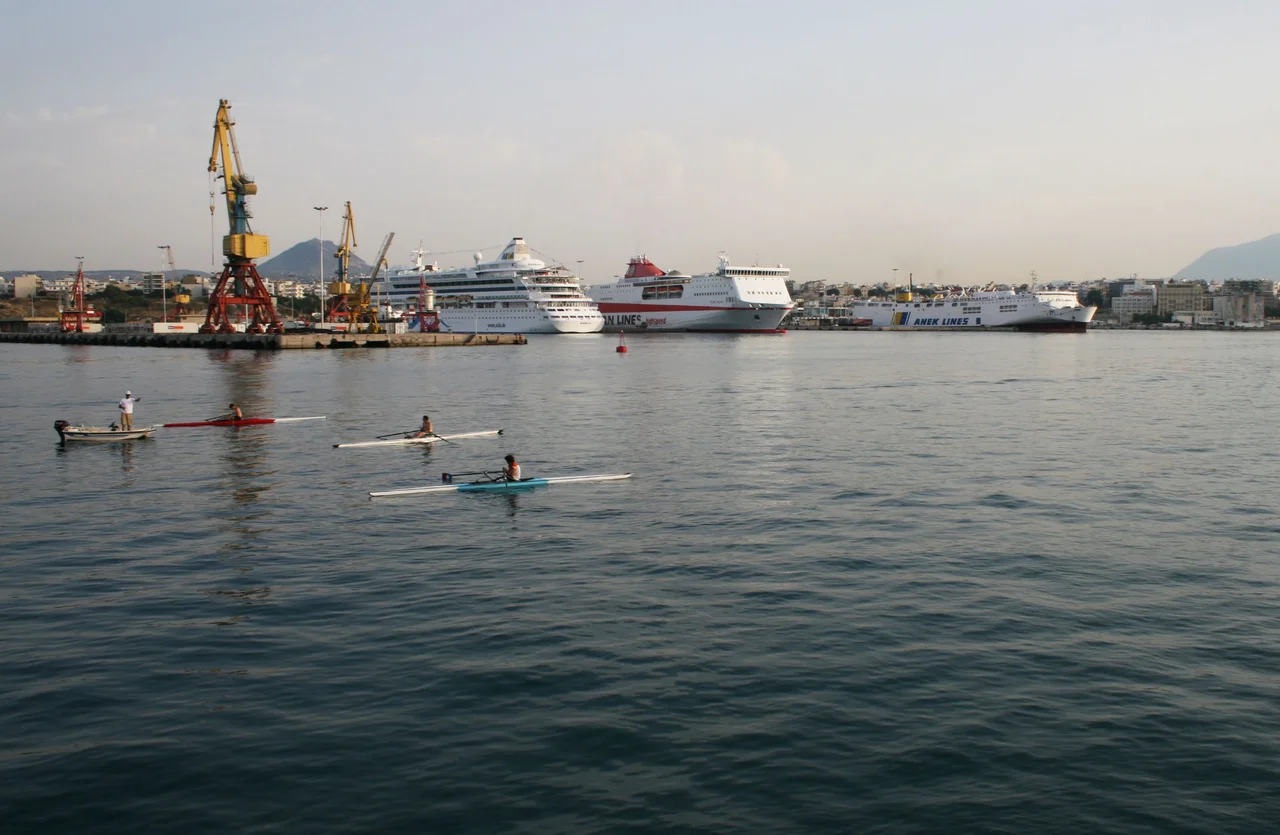
Up on the Martinengo bastion, looking south over the city, sits the grave of Nikos Kazantzakis. The simple wooden cross marks the resting place of the man who wrote Zorba the Greek and The Last Temptation of Christ. The epitaph he chose for himself is one of the most quoted lines in modern Greek: 'I hope for nothing. I fear nothing. I am free.' The Greek Orthodox Church refused him a consecrated burial because of his fiction's theological provocations, so the city buried him on the ramparts instead, with the sea on one side and the mountains on the other. Today Heraklion is Greece's fourth-largest city - 179,000 people, a thriving university, an airport that handled eight million passengers in 2022, and a constant flow of cruise ships and ferries pulling into the harbor where galleys once unloaded grain for besieged defenders.
From the Air
Heraklion sits on the north coast of Crete at 35.3387°N, 25.1442°E. The Venetian walls form a recognizable seven-bastion ring around the old town, with the Koules Fortress jutting into the harbor. Nearest airport: Heraklion Nikos Kazantzakis Airport (LGIR) on the eastern edge of the city. Cruising 6,000-10,000 ft offers views of the harbor, Mount Juktas to the south, and the Aegean to the north. Strong meltemi winds blow from the north in summer afternoons.
Nearby Stories
- Battle of Rethymno 9.8 km away
- Archaeological Museum of Agios Nikolaos 26 km away
- Battle of Cape Spada 80 km away
- Santorini: The Volcano That May Have Destroyed Atlantis 84 km away
- 1956 Amorgos Earthquake 112 km away
- Battle of Derna (1805) 322 km away
- Siege of Derna 352 km away
- Battle of Sidi Barrani 395 km away