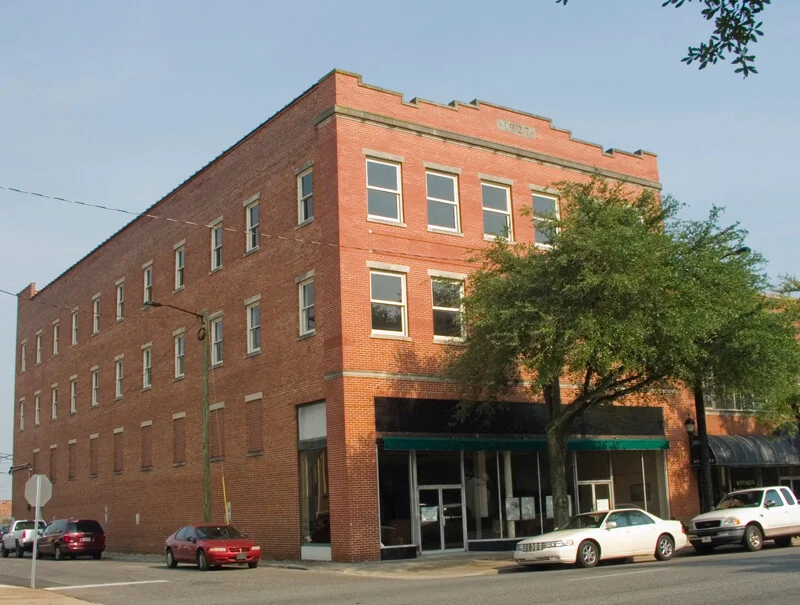

Historic Campbell Building
Reuben Edgar Campbell came out of a monazite mine and built a general store. That was the first one, somewhere in Cleveland County, North Carolina. The second was in Shelby, where he and his wife Ester Yelton lived above the retail floor in 1916. The third opened on November 9, 1923, in the booming textile town of Lawndale. By 1927, Campbell and his partner J. Ogburn Lutz were ready to consolidate. They built a fourth and final Campbell's Department Store, five stories of local brick and locally rolled steel, and they closed the other three to put everything into it.
Made in Cleveland County
The grand opening fell on March 9, 1928. The Cleveland Star ran a celebratory piece two days earlier, listing the local suppliers with the pride of a small town watching itself succeed. The bricks came from the Bostic Brick Company in Bostic, North Carolina, a few miles east. Eighty tons of structural steel was rolled by J.C. Weathers of Shelby. The millwork for the floors, the staircases, the show windows came from A.J. Thompson, also of Shelby. The 30,000 square feet of finished retail space carried groceries, bedding, hats, yard goods, footwear, furniture, appliances, farm supplies, toys, caskets, and clothing for every member of the family. The bargain basement became locally beloved.
Shelby in 1928
The town was at one of its peaks. The railroad reached it. Charlotte sat forty-five miles east. The textile industries of Cleveland and Mecklenburg counties fed money through the regional economy, and Shelby had positioned itself as the leading shopping center between Charlotte and Asheville. The 1929 City Directory lists the competition: Efird's, Paragon, Montgomery Ward, J.C. Penney, A.V. Wray and 6 Sons, Carolina Stores, Charles Stores, Acorn, Haines, Ingram-Liles, McNeely. All but Campbell's and A.V. Wray belonged to chains. By 1930, the town held 12,000 people. A new high school was about to be built at a cost of $150,000. The hospital was modern, the water system worked, the public library was open. Federal improvement programs were rolling through. Everything was about to change.
Closing and Drift
Campbell's Department Store closed in 1950. The chains had won, the way the chains were winning everywhere in mid-century America. The building stayed with the Campbell family, who turned it into a furniture store. The furniture store ran for twenty-five years. Then a restaurant moved in. Then no one. The Campbell Building sat dormant for twelve years, the kind of empty-storefront stillness that a thousand small Southern downtowns know. Of the eleven department stores listed in the 1929 directory, only Campbell's and Efird's still had their original architecture and exterior integrity. The rest were gone.
The Franklins
In 2014, a Shelby family named Franklin became the second family ever to own the Campbell Building. They spent three years rehabilitating it, from October 2015 through June 2018, working carefully around the features that mattered: the original mezzanine and its railing overlooking the main floor, the tin ceilings on every level, the wood floors, and most of all the grand wooden staircase that climbed from the ground floor to the third without missing a tread. The work added an 800-square-foot rooftop terrace, which the Franklins claim is the tallest rooftop terrace between Charlotte and Asheville. The claim is small, but in Shelby it counts.
What It Is Now
The first floor and mezzanine house Greenbrook Design Center. The second floor, the third floor, and the rooftop are an event venue called Uptown Indigo, where Shelby celebrates weddings and reunions and milestone birthdays. The Historic Campbell Building belongs to the Central Shelby Historic District. Reuben Edgar Campbell, the monazite miner who built a retail empire one general store at a time, would recognize the bones of the structure he raised in 1927. The bricks he ordered from Bostic still hold up the walls. The staircase his crews built still climbs to the top of the building. Walk it on a clear evening and you can see the same horizon Campbell saw the morning he opened his doors.
From the Air
The Historic Campbell Building sits at 35.29 N, 81.54 W in downtown Shelby, North Carolina, on the eastern edge of the Cleveland County seat. Shelby-Cleveland County Regional Airport (KEHO) lies 4 nm south-southeast. Recommended sightseeing altitude 2,500-3,500 feet. The building is recognizable as one of the tallest historic structures in Shelby's compact downtown grid; the 800-square-foot rooftop terrace is visible against the surrounding two- and three-story streetscape. Watch for KCLT (Charlotte Douglas) Class B airspace 35 nm east. Kings Mountain Municipal (KIPJ) lies 12 nm south for diversion. The terrain is rolling Piedmont, with the Broad River drainage to the west.
Nearby Stories
- Mecklenburg County, North Carolina 1.1 km away
- Spartanburg 4 km away
- Green River (North Carolina) 5.3 km away
- Andrew Jackson State Park 16 km away
- Marion, North Carolina 21 km away
- Huck's Defeat 23 km away
- Hickory Motor Speedway 23 km away
- Thomas Gillespie 26 km away