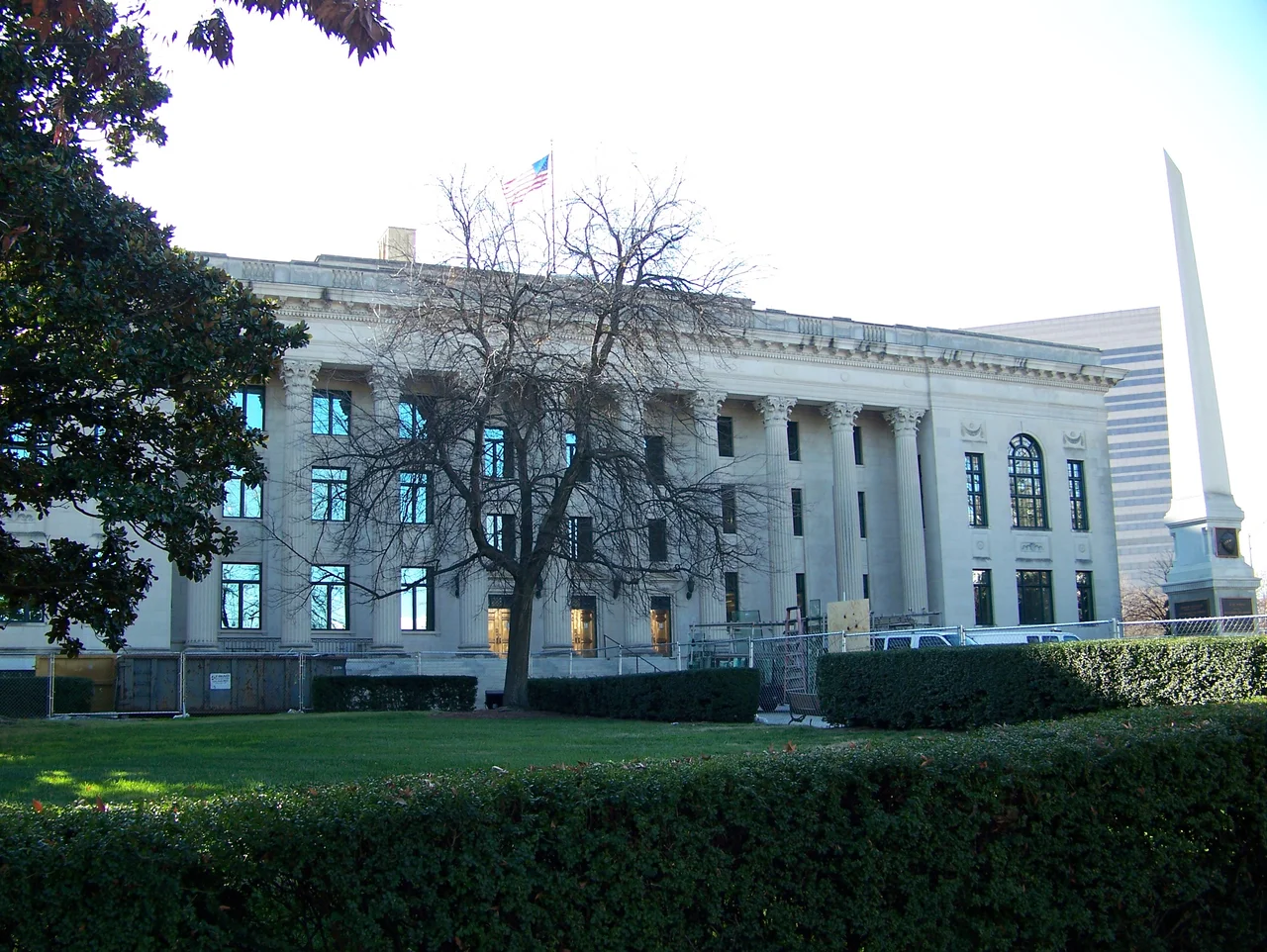

Mecklenburg County, North Carolina
Mecklenburg County is named for a German princess who married a British king and never set foot in North Carolina. Charlotte of Mecklenburg-Strelitz, Queen of the United Kingdom from 1761 to 1818, lent her name to both the county and its seat - the kind of imperial honor American colonies tossed off freely before they decided, quite suddenly, that they were no longer interested in honoring monarchs. The first known European settlers established the county in 1762 by carving it out of Anson. Thirteen years later, residents would gather at a courthouse here and, depending on which historians you believe, declare themselves independent of the very monarchy the county's name commemorated. The Meck Dec has been argued about ever since. The population, meanwhile, kept growing. It passed one million in 2013 and 1.2 million by 2024.
The Meck Dec
On May 20, 1775, residents of Charlotte are said to have signed the Mecklenburg Declaration of Independence - a document declaring the county free of British rule more than a year before the Continental Congress did the same. The story is woven into North Carolina identity. The date appears on the state flag. Mecklenburg celebrates it every May. There is one problem: no original copy of the May 20 document has ever been verified. What survives are the "Mecklenburg Resolves" adopted on May 31, 1775 - a related but more carefully bounded statement of opposition. Whether the May 20 declaration was real or a later embellishment is one of the longest-running disputes in early American history, defended by North Carolinians and questioned by skeptics, including Thomas Jefferson, who suspected forgery. The truth is that Mecklenburg was rebellious whether or not its rebellion was as early as legend says. Cornwallis would soon learn that personally.
Gold and Mint
The first U.S. gold rush began not in California but in Cabarrus County, just northeast of Mecklenburg, in 1799 - when a twelve-year-old named Conrad Reed found a seventeen-pound gold nugget in a stream and his family used it as a doorstop for three years before realizing its value. The rush that followed brought miners, merchants, and federal attention. The United States established a branch mint in Charlotte in 1837, producing gold coins until 1913. The original mint building did not survive in place - it was moved, brick by brick, and rebuilt as the Mint Museum, which opened in 1936 as North Carolina's first art museum. Charlotte's identity as a financial center has roots in literal gold.
The Brooklyn That Was Erased
Mecklenburg County's twentieth-century population growth was not equally distributed. Charlotte's Brooklyn neighborhood, in the area that became the city's Second Ward, was a self-sustaining African-American community of churches, businesses, and homes through the early twentieth century. In the 1960s an "urban renewal" project demolished it - a process repeated in cities across the United States, and recognized later for what it was: the deliberate erasure of a Black community by city governments that had decided the land would be more valuable used by other people. The replacement government buildings stand where Brooklyn stood. The people who lived in Brooklyn were displaced, their property values shattered, their generational wealth lost. The city's official histories long underplayed what happened. More recent acknowledgments have begun to call it by its name. Mecklenburg County's growth story includes the people who were not allowed to grow with it.
The Banking Boom
Charlotte's emergence as the second-largest banking center in the United States - behind only New York - was a late-twentieth-century transformation. North Carolina's interstate banking laws, more permissive than most, allowed local banks to grow into national giants: NCNB became NationsBank became Bank of America; First Union became Wachovia became Wells Fargo. By the 2000s the county was home to ten Fortune 1000 companies. Charlotte Douglas International Airport expanded into one of the busiest in the country, partly to serve those banks' executives. The light rail Lynx Blue Line opened in 2007 and reached UNC Charlotte by 2018. The Carolina Panthers came in 1995; Charlotte FC joined them at Bank of America Stadium in 2022. The banking towers reshape the skyline. The people the banks employ reshape the county - one transplant at a time, from everywhere.
What Stays Mecklenburg
For all the growth, the county still includes Lake Norman to the north (completed in 1964), Lake Wylie to the southwest, the U.S. National Whitewater Center along the Catawba River, and the Carolina Raptor Center at Latta Plantation Nature Preserve. Davidson College sits on the lake's edge; UNC Charlotte holds the northeast corner. The county is divided into fifteen original townships - Charlotte at Township 1, Berryhill at 2, on through Huntersville at 15 - a numbering scheme inherited from the 1868 state constitution and never fully replaced. James K. Polk was born in Mecklenburg in 1795. Romare Bearden, the twentieth-century African-American artist, was born here in 1911. Billy Graham was born in nearby Charlotte in 1918. The county votes Democratic in federal elections now after a century of mostly voting Republican. The demographics keep shifting; the identity keeps layering. Mecklenburg is, at this point, several places at once - the colonial cradle, the gold-rush hub, the erased Brooklyn, the banking capital, the airport hub, the soccer city, the place where, on September 20, 2016, the protests for Keith Lamont Scott filled streets that had been quiet about police shootings for too long.
From the Air
Mecklenburg County covers 546 square miles centered roughly at 35.25°N, 80.85°W. The county seat Charlotte's Uptown skyline is the most visible feature from the air - a tight cluster of skyscrapers at Trade and Tryon Streets. Lake Norman to the north and Lake Wylie to the southwest define the county's water boundaries. Nearest airports: Charlotte/Douglas International (KCLT) in the western part of the county is one of the busiest hubs in the U.S.; Concord-Padgett Regional (KJQF) sits at the northeast edge in Cabarrus County. Best viewing altitude 5,000-10,000 feet for the full county; the Catawba River system on the western border is the obvious topographical feature.
Nearby Stories
- Battle of Colson's Mill 12 km away
- Kings Mountain Mine 13 km away
- Thyatira Presbyterian Church, Cemetery, and Manse 16 km away
- Andrew Jackson State Park 19 km away
- Hickory Motor Speedway 22 km away
- North Carolina Aviation Museum 29 km away
- Cheraw, South Carolina 40 km away
- Battle of Fishdam Ford 47 km away