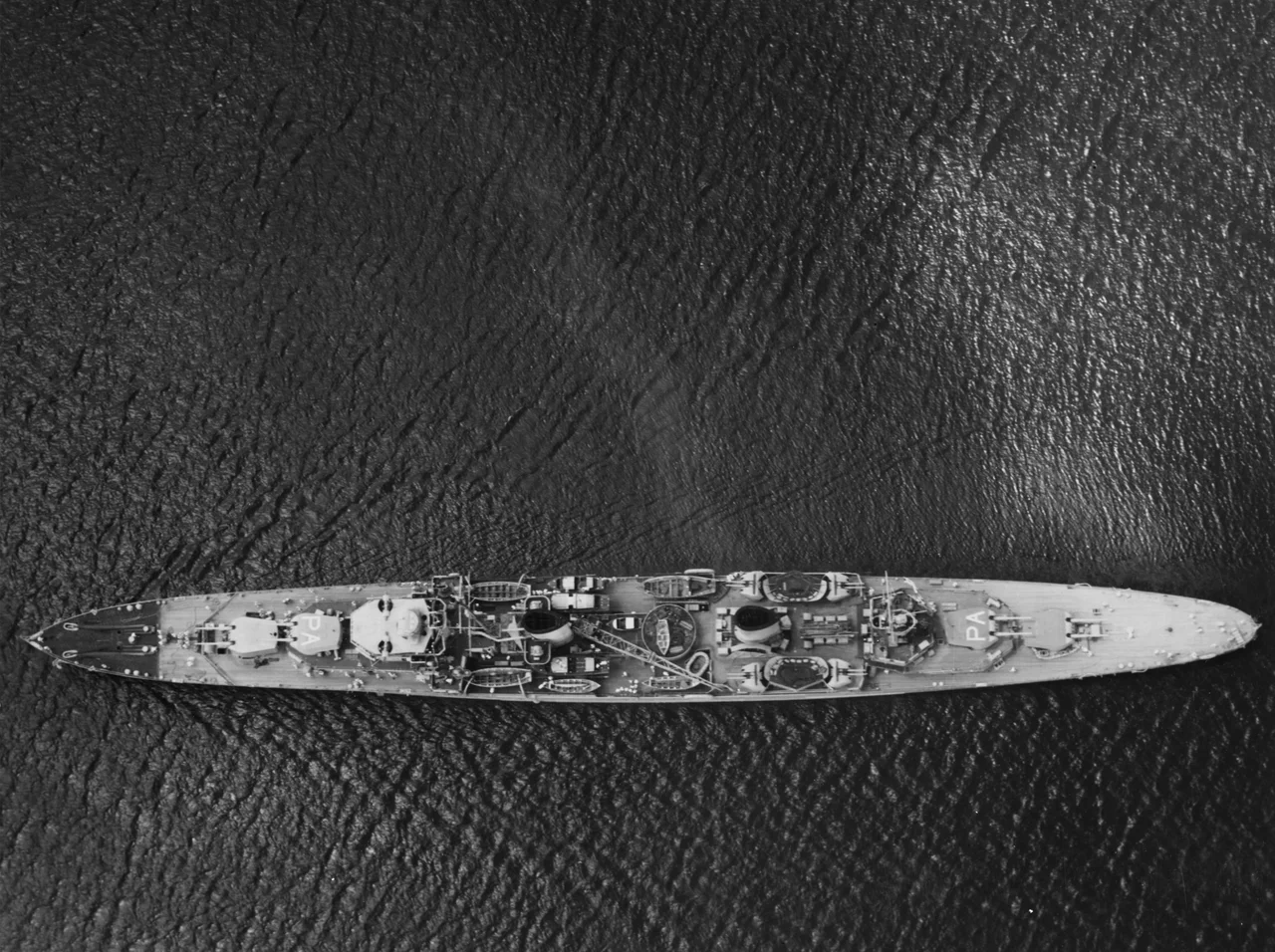
_in_March_1940.jpg)
The Cruiser That Wouldn't Stop Fighting
By the time HMAS Perth entered the Sunda Strait on the evening of February 28, 1942, she had 160 six-inch shells remaining. Not 160 high-explosive rounds -- 160 shells total, some of them practice ammunition, the kind meant for training exercises rather than combat. Her fuel tanks were half empty. She had fought a running naval battle the day before, survived when four other Allied warships had not, and now she was trying to slip through a narrow passage between Java and Sumatra to reach safety. What Perth's crew did not know -- what no one on the Allied side knew -- was that a Japanese invasion fleet had gathered on the other side of the strait, waiting in the darkness with four heavy cruisers, eleven destroyers, and enough firepower to sink a dozen ships.
Born British, Reborn Australian
The ship that would become Perth started life as HMS Amphion, laid down at Portsmouth Dockyard on June 26, 1933. She was a Modified Leander-class light cruiser -- 562 feet long, armed with eight six-inch guns in four twin turrets, carrying a crew of more than 600. For three years she served as flagship of the Commander-in-Chief, Africa. In 1939, with war approaching, the Royal Navy transferred her to Australia. On July 10, Princess Marina, Duchess of Kent, rechristened the ship HMAS Perth. Weeks later, still en route to her new home, the cruiser stopped at the 1939 New York World's Fair to represent Australia -- a diplomatic gesture that seems impossibly quaint given what lay ahead. War broke out while Perth was steaming off Venezuela, and she spent six months hunting German merchant ships across the Caribbean before reaching Australian waters in March 1940.
From Malta to Crete
Perth was barely home before the Navy sent her to the Mediterranean at the end of 1940. For seven months she was in constant action -- escorting convoys to Malta, where a Luftwaffe bomb knocked out her power in Grand Harbour, and playing a minor role in the Battle of Cape Matapan, where her squadron drew the Italian fleet toward the main British force. She ran troops to Greece and helped evacuate them when the Axis advance made their positions untenable. At Kalamata, her captain made the agonizing decision to withdraw rather than risk his ships against a port where fighting raged on the docks. Then came Crete. On May 30, while evacuating soldiers from Sphakia, a German bomb struck Perth's forward boiler room, killing four sailors and nine of the 1,188 soldiers packed aboard. The explosion bent a propeller shaft and destroyed the fire-control computers. She limped to Alexandria, was patched up in three weeks, and sailed for the invasion of Vichy Syria.
The Java Sea
Perth returned to Australia in August 1941 for permanent repairs, and Captain Hector Waller took command in October. When the Dutch East Indies grew desperate, Perth was sent to Java, arriving at Tanjung Priok on February 24, 1942. Three days later, under Rear Admiral Karel Doorman, an Allied fleet of five cruisers and nine destroyers sortied to intercept the Japanese eastern invasion force. The Battle of the Java Sea lasted from afternoon into night. Perth laid a smokescreen around the crippled HMS Exeter after a shell detonated in the British cruiser's boiler room. The Dutch destroyer Kortenaer was blown in half by a torpedo. Doorman's flagship De Ruyter and the cruiser Java were both sunk by Long Lance torpedoes near midnight. Perth and USS Houston were the only large Allied ships to survive. They withdrew to Tanjung Priok at dawn, exhausted and nearly spent.
The Last Fight
That evening, Perth and Houston sailed at 19:00, heading for Tjilatjap via the Sunda Strait. Neither ship knew that Rear Admiral Kenzaburo Hara's invasion force had assembled at Bantam Bay. At 23:06, Perth's lookouts spotted an unidentified vessel and flashed a challenge, expecting a friendly corvette. The reply was unintelligible. When the ship turned away and laid smoke, Waller recognized a Japanese destroyer and opened fire. What followed was a close-range brawl in darkness. Japanese destroyers launched wave after wave of torpedoes -- over 90 in total -- while Perth's gunners burned through their last shells, then switched to practice rounds, then starshells, firing anything that would fit in the breech. A six-inch shell struck the destroyer Harukaze's bridge, killing one and wounding eleven. But the mathematics were fatal. Two torpedoes found Perth. Waller gave the order to abandon ship. At 00:25 on March 1, 1942, the cruiser capsized to port and sank, carrying 353 of her crew to the bottom -- including Waller himself.
What the Sea Has Not Preserved
Of the roughly 300 Perth survivors who reached the water, about two-thirds survived Japanese prisoner-of-war camps to return home after the war. The wreck was discovered by diver David Burchell in 1967, lying on her side at about 35 meters depth, reasonably intact. For decades she rested undisturbed. Then in late 2013, divers found that unauthorized Indonesian salvagers had stripped the superstructure, forward turrets, and decking with crane-equipped barges, using explosives to break the hull apart. The wreck is not protected as a war grave -- neither Australia nor Indonesia has signed the UNESCO Convention on the Protection of the Underwater Cultural Heritage. Today, Perth's memorial lives ashore: an annual regatta at the Nedlands Yacht Club, a plaque in St. John's Anglican Church in Fremantle, and the original ship's bell at Perth Town Hall. She is the only foreign warship commemorated in the grounds of Arlington National Cemetery.
From the Air
HMAS Perth's wreck lies at approximately 5.86S, 106.13E in the Sunda Strait, near Bantam Bay on Java's northwestern tip, at a depth of roughly 35 meters. The wreck site is about 15 km from the Java coastline. From cruising altitude, the Sunda Strait narrows visibly between Java and Sumatra, with heavy shipping traffic. Anak Krakatau is visible to the southwest. Nearest major airport: Soekarno-Hatta International (WIII), approximately 90 km east-southeast. The battle took place in the waters between Bantam Bay and the strait's northeastern entrance, an area now busy with ferry traffic between Merak and Bakauheni. Recommended altitude: 5,000-10,000 feet for perspective on the confined waters where the battle unfolded.
Nearby Stories
- The Eye of Krakatoa 2.7 km away
- Four Minutes Over the Java Sea 9.8 km away
- Locked Doors at 1:45 AM 14 km away
- Anak Krakatoa 24 km away
- The Crossing at Silebu 27 km away
- Way Kambas National Park 81 km away
- 1933 Sumatra Earthquake 86 km away
- Battle of the Java Sea 501 km away