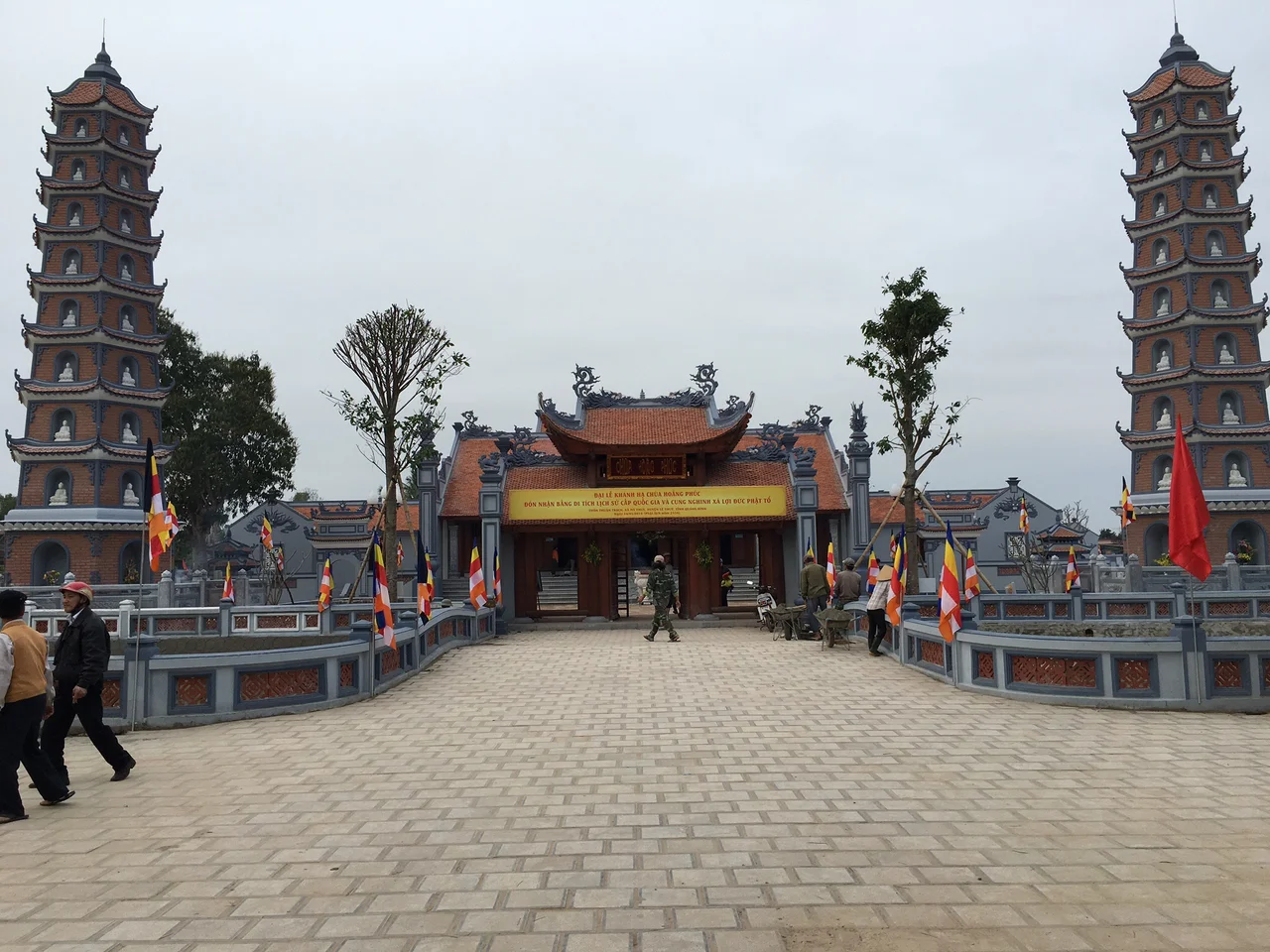

Hoằng Phúc Temple
For thirty years the most substantial thing at Hoằng Phúc was a gate that led nowhere. The temple behind it had come down in the storm of 1985 — typhoon number twelve, in the Vietnamese numbering — and what the wind left standing was a stone gateway, the outline of a foundation, a handful of old Buddha figures and a bronze bell weighing eighty kilograms, a little over a metre tall and half a metre across. Seven hundred years of continuous religious use, reduced to an entrance and the things too heavy to blow away.
A King Who Stopped Being King
The story begins with a man who walked away from a throne. Trần Nhân Tông had ruled Đại Việt through the Mongol invasions, then abdicated, took monastic vows, and founded the Trúc Lâm school of Vietnamese Zen — which is why Vietnamese sources still call him Phật hoàng, the Buddha Emperor. In 1301, travelling south, he stopped at a small hermitage in what is now Thuận Trạch village and prayed for blessings on the people living there. The place was then called am Tri Kiến — Tri Kiến hermitage. It was not yet a famous temple. It became one largely because he had been there.
Three Names, Three Dynasties
Each time Vietnam's rulers changed, the temple's name changed with them, which makes its signboard a rough chronology of the state. In 1716 the Nguyễn lord Nguyễn Phúc Chu renamed it Kính Thiên tự, the Temple of Reverence for Heaven. Just over a century later, in 1821, the Nguyễn emperor Minh Mạng passed through on a progress north and renamed it again — Hoằng Phúc tự, written 弘福寺, Great Blessing. That name stuck, though locals rarely used it. To people in the surrounding villages the place was simply chùa Trạm or chùa Quan — everyday names that outlasted every imperial one.
Storm Number Twelve
This coast takes a beating. Quảng Bình sits directly in the path of the typhoons that come off the South China Sea between September and November, and the temple had already been rebuilt several times over the centuries before the 1985 storm finished it. Nothing much survived that one. The gate held. The foundations held. The bell — small as temple bells go, but bronze and low to the ground — held. Everything above waist height did not. For three decades the site existed as a ruin that was still, in every sense that mattered locally, a temple.
Building It Back
Reconstruction began on 30 November 2014 and cost 40.4 billion đồng. The completed temple was inaugurated on 16 January 2016 in front of an audience that said something about how far the site's reputation had travelled: officials from the Vietnamese government, monks from the Buddhist sanghas of both Vietnam and Myanmar, and Tep Vong, the Supreme Patriarch of Cambodia. The Ministry of Culture designated Hoằng Phúc a national historical relic. The old gate was kept and incorporated, which is the detail that matters most — the new buildings are new, and honest about it, but you still enter through the thing that survived.
A Relic from Shwedagon
The inauguration came with a gift. Myanmar's Buddhist sangha presented Hoằng Phúc with śarīra of Shakyamuni Buddha — relic remains, the most consequential object one Buddhist community can give another — brought from the Shwedagon Pagoda in Yangon. Later that year, between 27 March and 5 April, the Jade Buddha for Universal Peace was placed on display at the temple. For a rural site in Mỹ Thủy commune, a stretch of Lệ Thủy rice country better known to Vietnamese history for the massacre French troops committed at Mỹ Trạch in 1947, it was an unlikely elevation. Seven hundred years after a former emperor stopped there to pray, the hermitage he visited had become a place that other countries sent relics to.
From the Air
Located at 17.18°N, 106.735°E in Mỹ Thủy, on the Kiến Giang floodplain of former Lệ Thủy district, now part of Quảng Trị province. A small target — best seen below 3,000 ft, where the tiled roofs and enclosure wall stand out against flat green paddy. Visual references: the Kiến Giang River a short distance north, National Route 1 and the Hanoi–Saigon railway running parallel a few kilometres to the east, and the Annamite foothills rising on the western horizon. Nearest airport is Đồng Hới (VVDH), roughly 45 km north; Huế/Phú Bài (VVPB) is about 150 km south. Low cloud and rain dominate September through November, when typhoons regularly cross this coast; spring mornings often bring haze off the paddy that burns off by mid-morning.
Nearby Stories
- Tam Tòa Church 11 km away
- Phong Nha – Kẻ Bàng National Park 15 km away
- Mutter's Ridge 16 km away
- Grès supérieurs Formation 24 km away
- DMZ Campaign (1969–1971) 28 km away
- Battle of the Mỹ Chánh Line 57 km away
- National Route 9 (Vietnam) 60 km away
- Bach Long Vi Island 308 km away