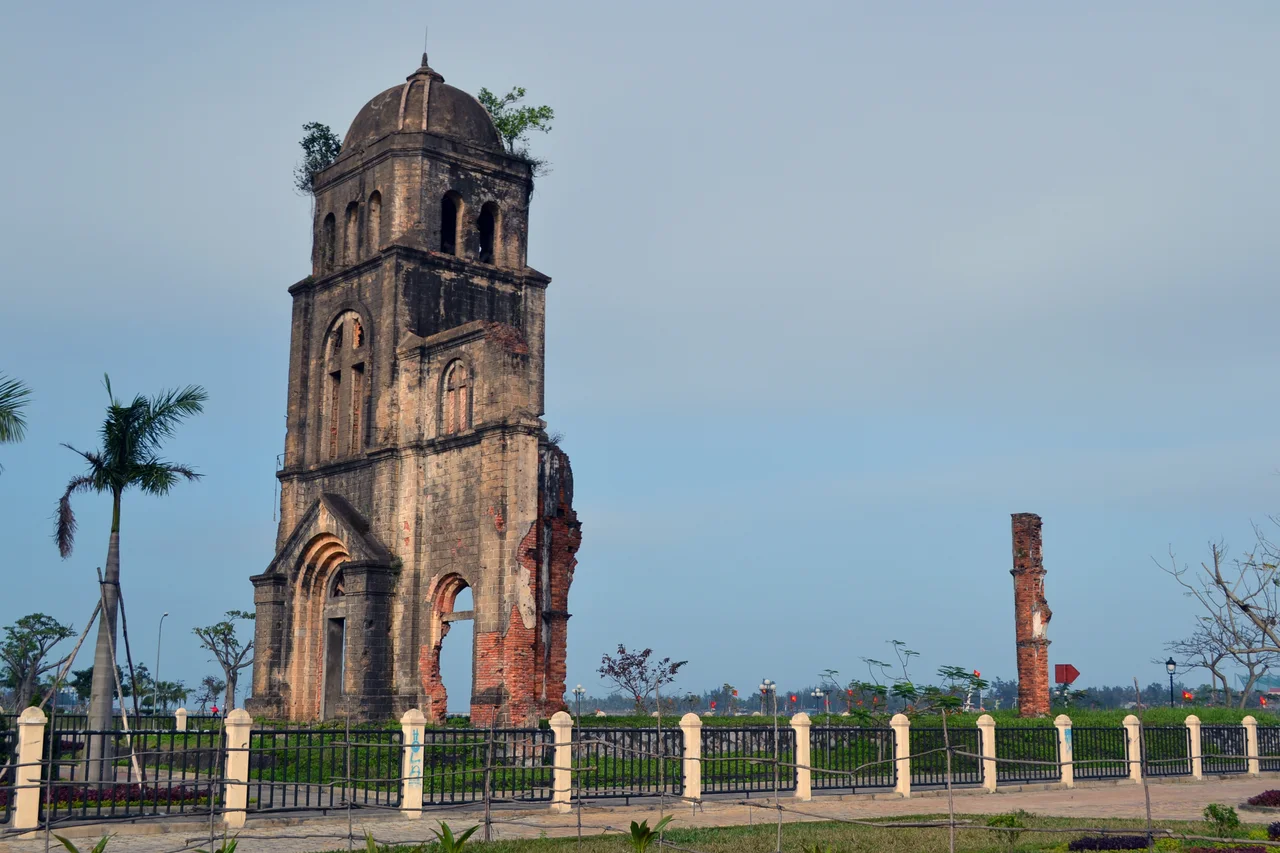

Tam Tòa Church
Tam Tòa the building lasted seventy-eight years. Tam Tòa the parish is going on four hundred. That mismatch explains most of what has happened on this patch of ground in Đồng Hới, where a shrapnel-scarred bell tower stands alone in a city that rebuilt itself completely around it. The tower has been left exactly as the bombing left it, which sounds like neglect and is in fact policy. Two very different institutions have spent decades insisting that it must stay standing, and they do not agree on what it means.
Older Than Its Walls
The parish grew out of Đông Hải and traces its roots to the middle of the seventeenth century, which makes it one of the oldest Catholic communities in Vietnam — established when Catholicism in the country was still an experiment run by a handful of Jesuits, and generations before anyone considered building in stone. The church that eventually rose here went up in 1887, in a Portuguese-influenced style, and was restored and enlarged in 1940. It served an ordinary coastal congregation: fishing families, market traders, railway workers, people who were baptised and married and buried under the same roof their grandparents had used. By the early 1960s it was simply the parish church, the most familiar building on the street, unremarkable in the way that a place you attend every week becomes unremarkable.
Eleven February 1965
American bombing of Đồng Hới ran, on and off, from 1964 into 1972, and the raid of 11 February 1965 destroyed most of the city. Tam Tòa collapsed. What was left when the dust settled was the bell tower — walls open to the sky, masonry chewed through by shrapnel, the nave gone. The congregation went with it. People who survived were scattered north and inland by the evacuation of a city that had ceased to be habitable, and many did not come back for years. It is worth holding both facts at once: this was a legitimate strategic corridor in a war, and it was also somebody's parish church, full on Sundays, in a town where almost every family lost a house.
Kept as Evidence
The ruin was never cleared, and after the war it acquired an official function. Until 1996 mass was still celebrated weekly in the open ground in front of the tower. That year the local authorities took the site back, intending it to serve as a monument to American bombing, and on 26 February 1997 the Quảng Bình provincial People's Committee formally designated the bell tower and its grounds a war-crimes site and a provincial-level historical-cultural monument under strict protection. Strict protection, in practice, meant the tower was to be left precisely as the bombing had left it. The Diocese of Vinh and the Archdiocese of Huế had been petitioning for the return of the land since the moment it was taken, and now found their church protected against them by law.
July 2009
Negotiation went nowhere for over a decade. In February 2009 fourteen parish priests and the Bishop of Vinh concelebrated mass on the property without seeking permission. That summer a rumour spread that a tourist resort was planned beside the ruin, and parishioners responded by building an altar on the site and raising a cross. On 21 July police were sent to break up the gathering. Around a dozen people were arrested and some were beaten; two priests who travelled from other parishes to show support were seriously injured. Vigil masses and silent protests followed through the weekend across central Vietnam, where much of the country's roughly seven million Catholics live. The dispute read publicly as church against state, but the underlying grievance — land confiscated decades ago and never returned — is one that Vietnamese of no particular faith have raised for years.
Two Tam Tòas
The impasse ended without either side conceding the ground. On 21 April 2016 construction began on a new Tam Tòa church about three kilometres away on Phạm Văn Đồng Street, and the parish now worships there. The old site remains what the 1997 order made it: a protected ruin, the tower standing in a small open space with the traffic going round it. The building's two identities — atrocity exhibit and confiscated altar — have simply been allowed to coexist, which in the end is how most of Đồng Hới's history is handled here: not resolved, just left standing.
From the Air
Coordinates 17.475°N, 106.623°E, in central Đồng Hới on the west bank of the Nhật Lệ river, a few hundred metres from the water. The tower is small and best appreciated from the ground, but from 2,000–4,000 ft the site reads as a green gap in a dense urban grid immediately inland of the river. Navigation cues: the Nhật Lệ river mouth and Bảo Ninh sandspit to the east, the restored Quảng Bình Quan gate and National Route 1 to the west, and the North–South railway beyond. Đồng Hới Airport (VVDH) lies about 5 km north, elevation 59 ft. Best light and visibility March through August; the autumn monsoon brings persistent low cloud.
Nearby Stories
- Phong Nha – Kẻ Bàng National Park 5.3 km away
- Tú Làn Caves System 5.9 km away
- Hoằng Phúc Temple 6.4 km away
- Gianh River 30 km away
- Grès supérieurs Formation 31 km away
- DMZ Campaign (1969–1971) 67 km away
- Battle of the Mỹ Chánh Line 96 km away
- Bach Long Vi Island 269 km away