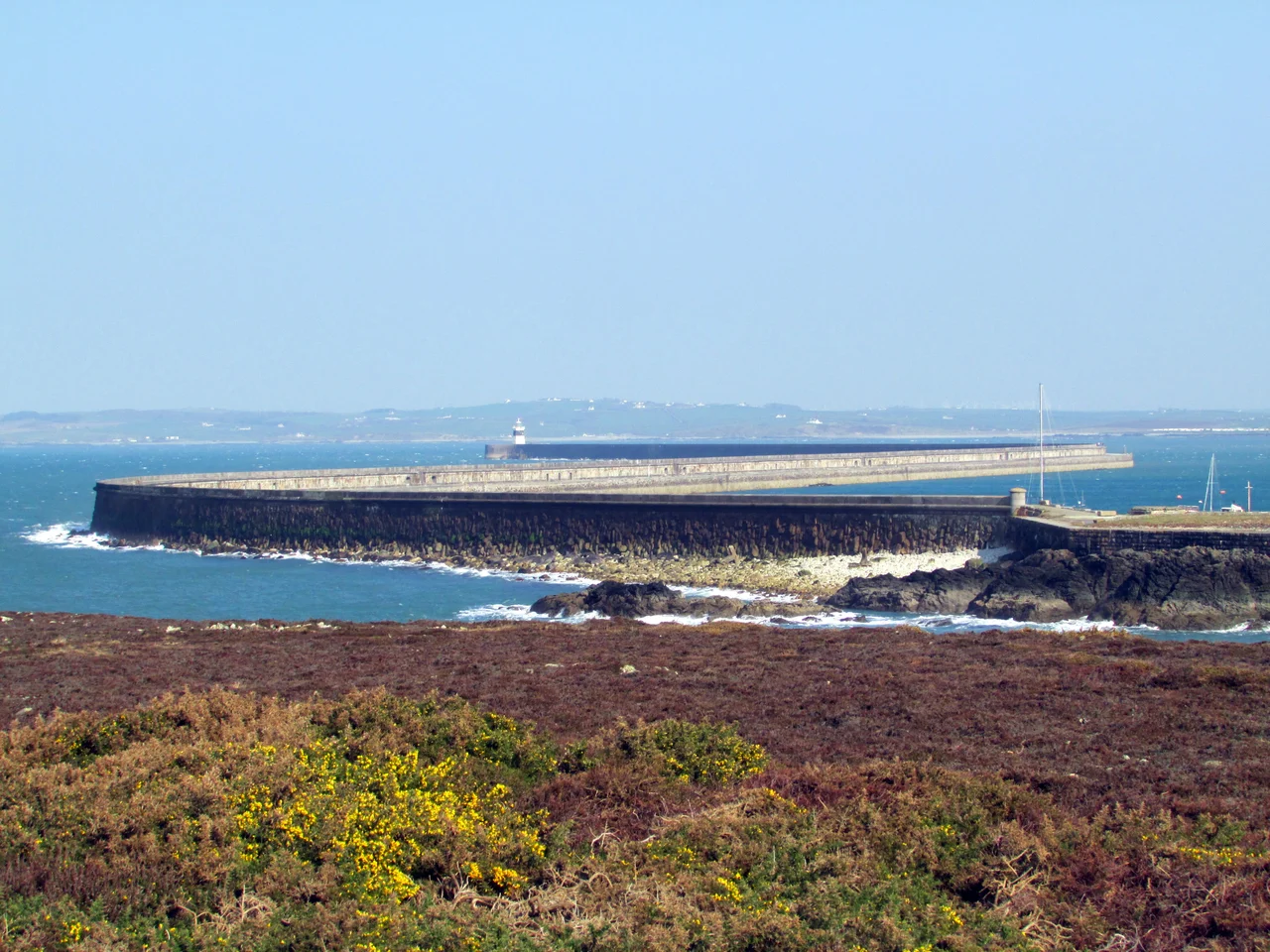

Holyhead Breakwater
Seven million tons of stone, taken from the side of Holyhead Mountain and laid out into the Irish Sea in a single curving wall over a mile and a half long. That is what the Victorians built between 1848 and 1873 to make Holyhead safe enough for the Dublin packets to run on schedule. There is still nothing longer in Britain. Walk out along the promenade on top of the breakwater today and you can read the scale of nineteenth-century ambition in the most literal terms imaginable: a kilometres-long pile of mountain, dropped into deep water by hand because trains carrying Irish mail were starting to run late.
Why a Breakwater Got Built
The Acts of Union in 1800 had just merged the parliaments of Britain and Ireland, and London suddenly needed to send mail, ministers, and military officers back and forth to Dublin on a reliable schedule. Holyhead was the obvious sea port - it was as far west as you could push a road across north Wales, and Thomas Telford had built one to get there, terminating his great London-Holyhead Road at the Admiralty Arch on Salt Island. John Rennie added the Admiralty Pier in the 1810s and 1820s. Telford himself designed the South Pier and the graving dock. None of it was enough. The old harbour stayed congested. Bad weather wrecked schedules. And then the Chester and Holyhead Railway opened in August 1848, dumping passengers and freight at Holyhead in numbers the old port simply could not absorb. The New Harbour was authorised by Parliament in 1847, enclosing over 400 acres of deep water. Construction started in January 1848. It would take twenty-eight years.
Men in Bells, Powder in Pipes
The chief engineer was J. M. Rendel, and his methods were brutally direct. Divers worked underwater in submarine bells, levelling the foundation by hand with picks and hammers. To blast obstacles out of the seabed they used gunpowder sealed inside watertight tin pipes, lighting fuses in the murk and waiting for the shock to arrive. The stone came from quartzite quarries on the north side of Holyhead Mountain, hauled to the construction site on a dedicated 7 ft 0 1/4 inch broad-gauge railway built specifically for the breakwater. Specialist bricks fired in a Holyhead brickworks were used in the facing. Tier by tier, the wall grew out into the Irish Sea. The Prince of Wales, the future Edward VII, formally opened the completed breakwater on 19 August 1873.
A Railway That Wouldn't Quit
The breakwater railway is one of the strangest legacies of the project. The original line stayed in use for maintenance long after construction ended, eventually transitioning from steam to diesel - and not just any diesel. It used British Rail Class 01 locomotives, the lightest standard-gauge shunters ever to run on British railways. The line carried on into the 1980s, lugging stone for repairs and supplies for the lighthouse out at the end of the wall, before finally giving way to road and all-terrain vehicles. One of the original Rigby locomotives from 1861 ended its working life on a 7 ft gauge harbour railway thousands of miles away in Ponta Delgada in the Azores, where it ran until 1973 - exactly a century after the breakwater it had been built to serve was officially completed.
Walk It If You Can
Since November 2014, concrete blocks have closed the breakwater entrance to vehicles. Walkers are still welcome, weather permitting. The promenade runs all the way out to Holyhead Breakwater Lighthouse at the far end, white-painted and small against the open sea. On a calm day it is one of the great long walks in north Wales - over a mile of carefully fitted Victorian stonework with the Irish Sea to one side, the sheltered harbour to the other, and Holyhead Mountain rising behind you with the visible scar of the quarry it took to build the wall beneath your feet. On a rough day it is a different proposition entirely. The breakwater was built to take the worst the Irish Sea could throw at it, and twenty-eight years of construction were not wasted.
From the Air
The breakwater is impossible to miss from the air: a sharp pale line jutting roughly 2.7 km northwest from the Holyhead coast at 53.33N, 4.63W, ending in a small white lighthouse. From cruising altitude the whole arrangement reads as a deliberate geometric statement against the otherwise irregular coastline. Holyhead Mountain (722 ft) rises just inland, with the visible quarry scars that produced the breakwater stone. Nearest airfields: RAF Valley (EGOV) 6nm southeast, Caernarfon (EGCK) 20nm southeast. Best viewed at 1,500-3,000 ft AGL in clear conditions.
Nearby Stories
- Snowdon Mountain Railway 8 km away
- German submarine U-1051 8.3 km away
- German submarine U-246 11 km away
- Trwyn Du Lighthouse 13 km away
- Irish Sea Bridge 20 km away
- HMS Manners (K568) 34 km away
- HMS Tyler 47 km away
- Birkdale Palace Hotel 79 km away