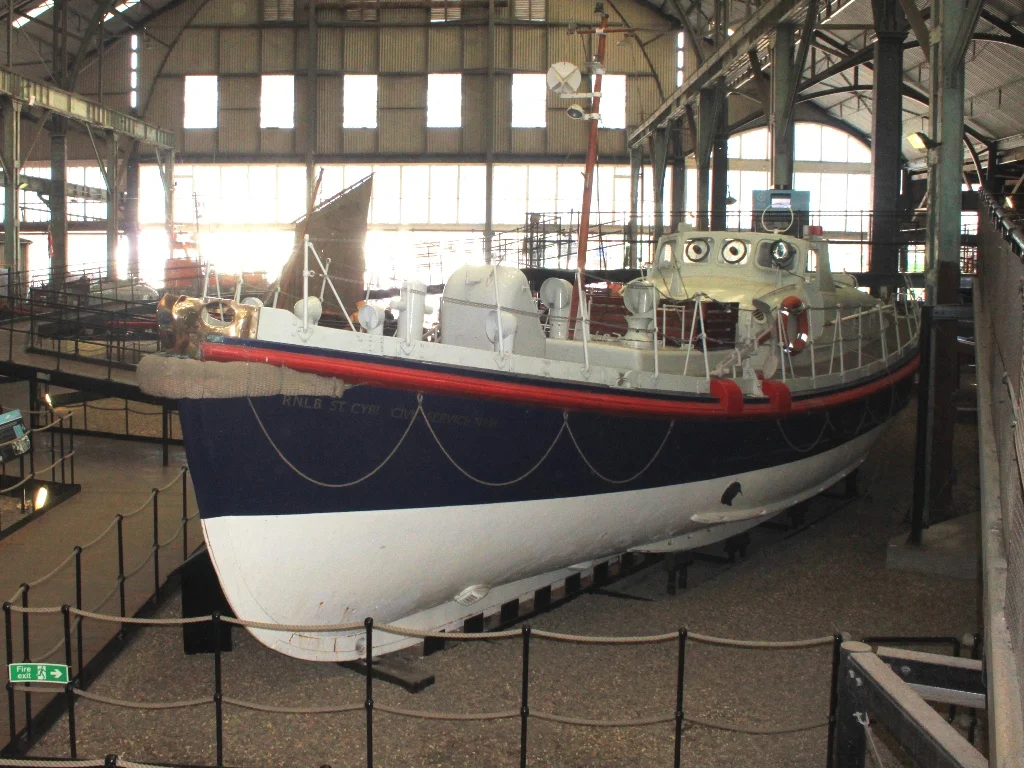
_at_Chatham.jpg)
Holyhead Lifeboat Station
In 1828, the people of Holyhead got tired of watching ships die on the rocks between North Stack and South Stack and asked Lloyd's of London for fifty pounds to build a lifeboat. They had asked before, in 1808, and nothing had come of it. They had asked again in 1825 - again, nothing. But the third time, the Anglesey Association for the Preservation of Life from Shipwreck took matters into its own hands, commissioned a 31-foot Palmer-class boat from a local builder named McVeagh for the sum of eighty pounds, and put it on station in 1829. The Royal National Lifeboat Institution would not absorb the station for another twenty-six years. By then, Holyhead crews had already proven they would launch into weather that nothing else on the Welsh coast would face.
The Fielden Money
In August 1875, three brothers - Samuel, John, and Joshua Fielden - wrote the RNLI a cheque for 2,500 pounds in memory of their father Thomas. They were the sons of John Fielden of Todmorden, a cotton-mill industrialist and Radical MP for Oldham, and they had inherited their late brother's estate worth 1.3 million pounds. The money paid for a 37-foot self-righting lifeboat at Holyhead, named Thomas Fielden, plus a new boathouse to keep her in. Sixteen years later the family gave another 2,000 pounds for the replacement, a 39-foot boat also named Thomas Fielden. Northern industrial money, channelled through three brothers' grief, kept Holyhead's lifeboat service afloat through the worst decades of the Irish Sea packet trade.
The SS Harold and Ten Silver Medals
On 22 February 1908, the steamship Harold ran aground between North Stack and South Stack in heavy weather. The Holyhead steam lifeboat went to her. Coxswain Superintendent William Owen brought back every member of the Harold's crew. He was awarded the RNLI's Gold Medal - the institution's highest decoration. Ten of his crewmen were each awarded the RNLI Silver Medal for the same service: Thomas Brooke, George Jones, Lewis Jones, Richard Jones, Samuel Jones, James Lee, William McLaughlin, Charles Marshall, William Owen Junior, and Lewis Roberts. Naming them matters, because they did the work, in the dark, in winter, in a steam lifeboat, against rocks that had killed plenty of others. Holyhead has earned three Gold Medals and dozens of Silver and Bronze across its history. The Harold rescue accounts for eleven of those medals in a single night.
1967, and the Survivors of Worse
Bad nights kept coming. In March 1967, the Holyhead boat fought through gale-force weather to assist multiple casualties; Coxswain Thomas Alcock and Motor Mechanic Eric Samuel Jones earned Silver Medals, and six other crew received Bronze. Then in 1971, the lifeboat went to another rescue and lost a crewmember in the attempt - Bronze Medals to Mechanic Donald Forrest, Gareth Ogwen Jones, and John Michael Hughes for what they did before things turned. In 1977, Coxswain William John Jones earned a second-service clasp on his Bronze - meaning his second Bronze Medal for two separate rescues. The roll of honour for those who died serving the Holyhead lifeboat is etched into the station, and the medals on the wall represent only the rescues that succeeded enough for medals to be possible. The other rescues are remembered differently.
The Current Crew, and the First Woman to Helm
In February 2015, the station appointed its first female helm in almost two centuries of continuous service. The current boats are 14-07 Frederick Storey Cockburn, a 14-metre Trent-class all-weather lifeboat that arrived from the RNLI relief fleet in 2025, and the smaller inshore D-class Mary and Archie Hooper, on station since 2016. The original 1858 boathouse - built by Forrestt of Limehouse during the early RNLI years - still stands at Newry Beach, but it now houses the Holyhead Maritime Museum, the lifeboat work itself having moved to better moorings down the harbour. In 2007, Coxswain Brian Thomson was appointed MBE for his service. The station that began with a fifty-pound Lloyd's grant in 1828 has, by the count of medals alone, become one of the most decorated lifeboat stations in the entire RNLI.
From the Air
Holyhead Lifeboat Station sits at Newry Beach (53.32N, 4.64W), on the eastern shore of the New Harbour and immediately east of the Holyhead Breakwater. The station is between the Maritime Museum (the old 1858 boathouse) and the main harbour entrance. The waters offshore between North Stack and South Stack - site of many of the historic rescues - are roughly 2-4 nautical miles to the northwest. Nearest airfields: RAF Valley (EGOV) 6nm southeast, Caernarfon (EGCK) 20nm southeast. Best viewed at 1,500-2,500ft AGL.
Nearby Stories
- Snowdon Mountain Railway 8 km away
- German submarine U-1051 8.3 km away
- German submarine U-246 11 km away
- Trwyn Du Lighthouse 13 km away
- Irish Sea Bridge 20 km away
- HMS Manners (K568) 34 km away
- HMS Tyler 47 km away
- Birkdale Palace Hotel 79 km away