.jpg)
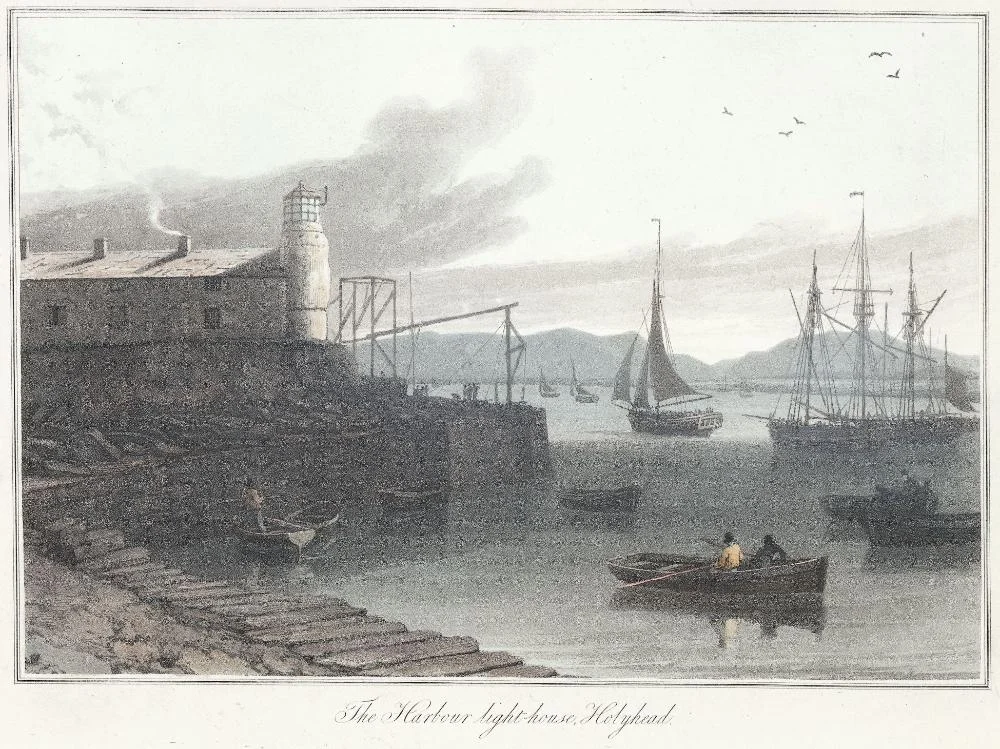
Holyhead Mail Pier Lighthouse
It is hard to think of two lighthouses as more closely related than the one at the end of Holyhead's Admiralty Pier and the one across the Irish Sea at Howth Harbour outside Dublin. Both were designed by the same engineer, John Rennie. Both were built around the same time, in the early 1820s. Both were created for the same job: guiding the steam packet between England and Ireland into harbour at either end. They share the same elegantly curved gallery railings, the same Georgian proportions, the same understated dignity. Stand at one and look across the water on a clear day and you are looking, in effect, at the other end of a single piece of infrastructure designed to make the Dublin run reliable.
The Pier and the King's Inconvenient Weather
The lighthouse was built as part of a much larger scheme - the extensive improvements to Holyhead Harbour authorised by Parliament in 1810 to handle the surge of post-Union traffic between Britain and Ireland. Rennie designed it in 1821, the same year George IV was scheduled to visit Holyhead and sail from there to Howth on the royal yacht. The weather had other ideas. Strong winds kept the royal yacht in port. George IV ended up boarding the steam packet Lightning instead - probably the first reigning monarch to make a state visit by steamship. The lighthouse he passed on his way out of the harbour was so new it had likely just been finished. The Admiralty Arch at the landward end of the same pier was built specifically to commemorate his visit, designed by Thomas Harrison and now a Grade II* listed building.
The Last of Three
Salt Island had carried lighthouses before. The Mail Pier Lighthouse is the third on the site, the last of a sequence that tracked the growing importance of the Dublin packet through the late eighteenth and early nineteenth centuries. An 1815 print survives showing the earlier lighthouse Rennie's tower replaced - shorter, simpler, less polished. The 1821 structure is recognisably the work of a major civil engineer rather than a local builder: balanced proportions, the elegant curved railings around the lantern gallery, a presence that pulls the eye even when the light is no longer burning. Rennie's other Irish Sea projects included harbours and bridges across half of Britain. The Holyhead lighthouse is a small example of what he could do when the brief was modest and the budget was real.
Listed, Inactive, Still Useful
The tower is a Grade II listed building, formally protected as an integral part of Rennie's harbour scheme and as one of the best-preserved early 19th-century harbour lights anywhere in Britain. It is no longer in operation as an active aid to navigation. The breakwater lighthouse at the end of the much longer 1873 breakwater does that work now. But the Mail Pier Light still gets used unofficially - sailors entering Holyhead reference it as a daymark, a recognisable shape against the harbour clutter that tells you exactly where you are. Detail photographs of the lantern room show the original metalwork still intact, weathered but recognisably Georgian, a small architectural fossil from the moment when Britain decided getting to Dublin on time was a national priority.
Twins Across the Sea
Howth Harbour Lighthouse, the matching tower on the Irish side, also survives. Rennie designed it for the same packet service, finished it around the same time, and gave it the same gallery railings. It is also no longer active, replaced by newer lights, also Grade-listed in its own jurisdiction. The two lighthouses together are something rare: a deliberately matched architectural pair separated by sixty nautical miles of open water, designed to be the first thing the Dublin packet saw at each end of its run. Bardsey Lighthouse, further down the Welsh coast, shares some of the same Rennie details. But the Holyhead-Howth pairing was the deliberate one - a single engineer's signature visible on both sides of a single sea crossing, built when getting Irish mail to London on time was the most important transport problem in the British state.
From the Air
The lighthouse stands at the seaward end of the Admiralty Pier on Salt Island, on the north side of Holyhead's Inner Harbour at 53.31N, 4.62W. Look for a small Georgian stone tower with a metal lantern, just inside the much longer breakwater. The Admiralty Arch sits at the landward end of the same pier. Nearest airfields: RAF Valley (EGOV) 6nm southeast, Caernarfon (EGCK) 20nm southeast. Best viewed at 1,000-2,000ft AGL in clear conditions.
Nearby Stories
- Snowdon Mountain Railway 8 km away
- German submarine U-1051 8.3 km away
- German submarine U-246 11 km away
- Trwyn Du Lighthouse 13 km away
- Irish Sea Bridge 20 km away
- HMS Manners (K568) 34 km away
- HMS Tyler 47 km away
- Birkdale Palace Hotel 79 km away