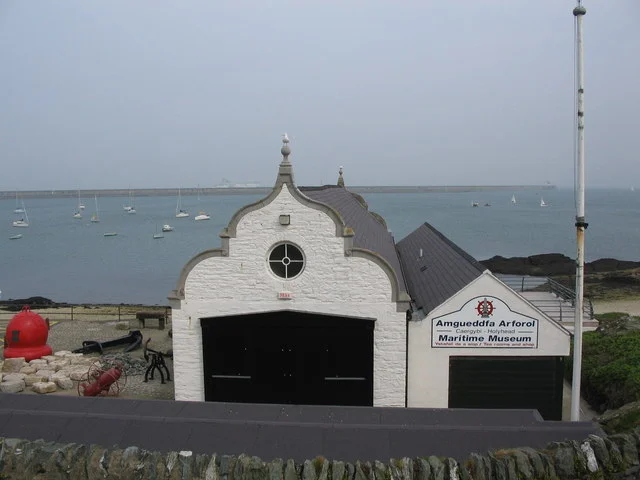

Holyhead Maritime Museum
It is the oldest lifeboat station in Wales, or so the claim goes, and the claim has survived enough scrutiny to be worth repeating. The Newry Beach boathouse was built in 1858 by Forrestt of Limehouse for the Royal National Lifeboat Institution, three years after the RNLI took over from the local Anglesey Association for the Preservation of Life from Shipwreck. It served as a working lifeboat station for ninety-one years, until a new boathouse and slipway opened on Salt Island in 1949. Then it sat. By the time Stena Line, the Swedish ferry company that runs the Dublin route out of Holyhead, owned the land in the 1990s, the building was in decline and a more profitable future was being planned around it. The maritime museum survived because Stena offered the building back at a peppercorn rent, the Heritage Lottery Fund paid for the refit, and the lease was renegotiated to ninety-nine years.
The First Boats and the First Crews
The 1858 station opened with an unnamed Peake-class self-righting lifeboat that launched eighteen times and saved 128 people in its working life. Its replacement, Prince of Wales, launched 38 times and rescued another 128. Then in 1875 came the Thomas Fielden - paid for by the Manchester industrialist family of the same name and named for their late uncle - which required the boathouse to be extended. In 1890 came another extension, this time to fit a second large boat that needed to be launched off the beach by horse-drawn carriage. Every additional bay you can see on the museum building corresponds to a generation of bigger, harder-working lifeboats and the people who crewed them through some of the worst weather the Irish Sea produces.
Stena, the Heritage Lottery, and Ninety-Nine Years
When the original lease expired and negotiations for a place in a new harbour development collapsed, the museum's future looked thin. Stena Line stepped in. The Swedish ferry company, the largest operator at the Port of Holyhead, offered the museum the renovated lifeboat house at Newry Beach at a peppercorn rent - effectively a token amount, the legal device that lets one party give something to another while preserving the form of a commercial transaction. A successful Heritage Lottery Fund bid paid for new visitor facilities. The lease was renegotiated to ninety-nine years, long enough to count as permanent. The museum reopened on its current site in 1998. The cafe attached to it - the Harbour Front Bistro - looks straight out across the water at the breakwater the museum spends a lot of its display space explaining.
Holyhead at War
Next door to the main museum, in a Second World War air-raid shelter that has somehow survived demolition, the museum runs a separate exhibition called Holyhead at War. The shelter itself is the artefact - a low concrete bunker built to protect townspeople from the German bombing raids that targeted the port and railway terminus. Holyhead was a logical target. The Irish Mail traffic, the naval base established in 1916 to fight U-boats during the First World War, the railhead serving the Irish Sea - all of it mattered enough strategically to draw enemy attention twice. The museum keeps the wartime story separate from the lifeboat story because the two were running on parallel tracks: civilians sheltering in concrete bunkers from bombs while the same town's lifeboat crews were rescuing torpedoed merchant sailors from the same sea.
What the Collections Hold
The museum's collections include artefacts from Captain John Macgregor Skinner, the American-born master of Holyhead packet ships who was washed overboard and drowned in 1832, and for whom the town built an obelisk that still stands. There are objects from the Royal Yacht Mary, the 1660 Dutch yacht wrecked on the Skerries in 1675 and rediscovered by amateur divers in 1971, though the bulk of the Mary collection is at the Merseyside Museums in Liverpool. There is a model of the Mary by Des Newton. There are photographs, charts, instruments, scale models of every important Holyhead boat from the wooden Palmer-class of 1829 to the modern Severn-class. It is a small museum, run largely by volunteers, in a building whose primary qualification as a museum is that it was itself a piece of the maritime history it now exists to remember.
From the Air
The museum sits at Newry Beach on the eastern shore of Holyhead's New Harbour at 53.32N, 4.64W, just south of the modern lifeboat station and immediately east of the Holyhead Breakwater. The cafe and air-raid shelter exhibit are alongside the main building. Nearest airfields: RAF Valley (EGOV) 6nm southeast, Caernarfon (EGCK) 20nm southeast. Best viewed at 1,000-2,000ft AGL in clear conditions; the harbour scene is busy in summer with cruise ships and ferry traffic.
Nearby Stories
- Snowdon Mountain Railway 8 km away
- German submarine U-1051 8.3 km away
- German submarine U-246 11 km away
- Trwyn Du Lighthouse 13 km away
- Irish Sea Bridge 20 km away
- HMS Manners (K568) 34 km away
- HMS Tyler 47 km away
- Birkdale Palace Hotel 79 km away