_(32932192272).jpg)
Holyhead railway station
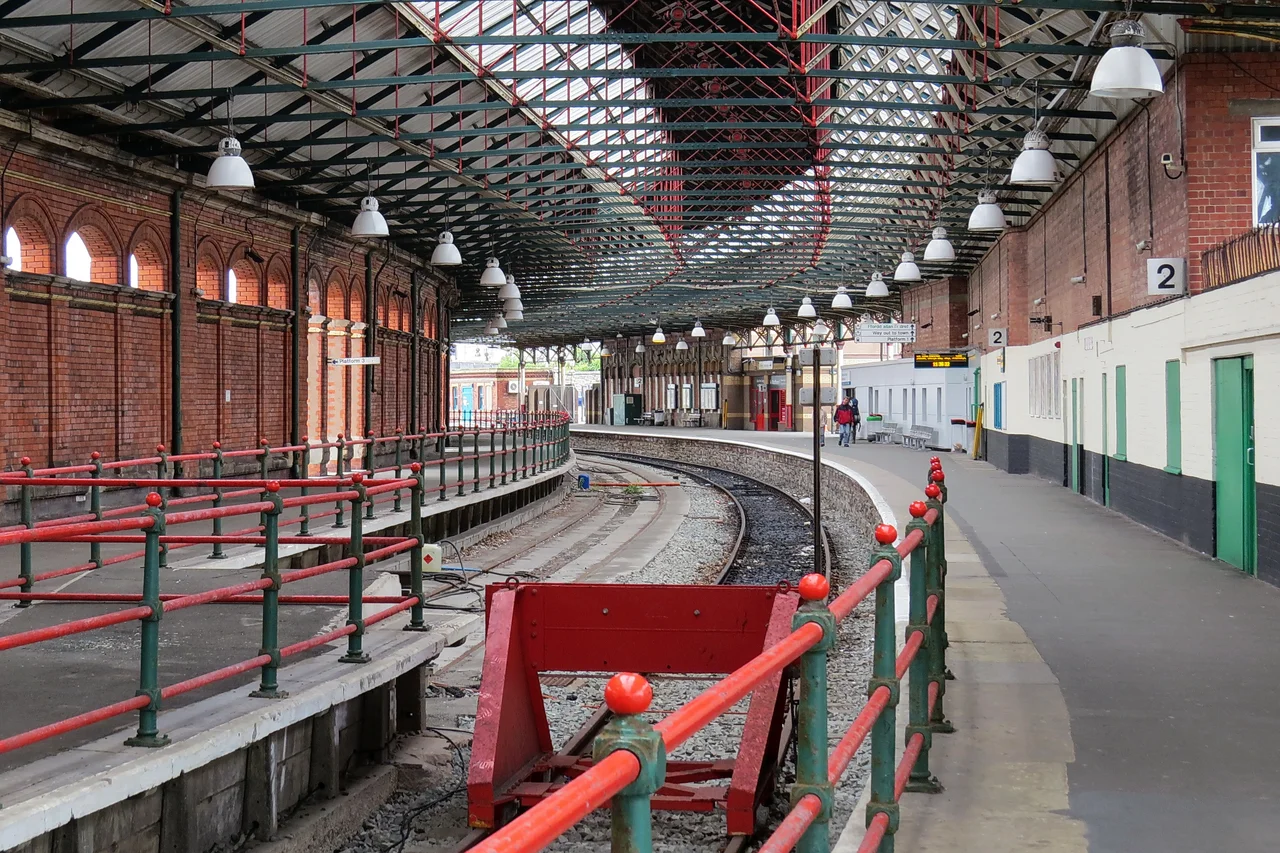
Walk off an Avanti train from London Euston at Holyhead station and within two minutes you can be checking in for a ferry to Dublin. The station and the ferry terminal share a building. The platforms run almost up to the quayside. There is a stainless steel pedestrian bridge called the Celtic Gateway connecting the joint terminal to the town centre five minutes' walk away. This is the western end of the British railway network, and it has been engineered, deliberately and over a century and a half, to be a single piece of infrastructure with the maritime crossing to Ireland. Trains arrive, ferries leave; ferries arrive, trains leave. The whole point of Holyhead is the handover.
Three Stations in Eighteen Years
The first Holyhead station opened on 1 August 1848, the day the Chester and Holyhead Railway reached the town. It was replaced almost immediately by a second station on 15 May 1851 - the original was inadequate within three years. The present station opened on 17 January 1866 under the London and North Western Railway and was formally unveiled on 17 June 1878 by Albert Edward, Prince of Wales, marking the completion of the old harbour extension. The station clock, still keeping time over the platforms, was made by J. B. Joyce and Company of Whitchurch in Shropshire - one of the oldest tower-clock makers in Britain. Joyce clocks turn up in railway stations and town halls across the country. The Holyhead one has been counting passengers off the Irish boat trains for over 150 years.
Three Platforms, Three Different Operators
The track layout is unusual because the geography is unusual. Platform 1 sits on the western side of the building, separated from the other platforms by the ferry terminal and the inner harbour. It is normally used by Avanti West Coast services to London Euston. Platform 2 handles most Transport for Wales DMU services. Platform 3 is outside the train shed - the early morning Premier Service to Cardiff Central uses it, along with extra trains at busy times. There are carriage sidings and servicing facilities next to Platform 1, and an engine release line and run-round loop alongside Platform 3. The station also once handled rail freight. A container terminal next to the station closed in 1991 when the traffic transferred to Liverpool, and the site became a car park for the Stena Line ferry service.
The Schedule That Connects Two Countries
Transport for Wales runs an hourly basic service from Holyhead eastward along the North Wales Main Line - the timetable thins out on winter Sundays but otherwise stays steady. Some early-morning and late-evening trains continue to Crewe; two services a day run through to Manchester Piccadilly on weekdays. Avanti West Coast operates four trains per day to London Euston on weekdays - the long-distance link that connects Holyhead via the West Coast Main Line to the national network - plus three trains as far as Crewe. Sundays drop to three Avanti services to London. The Premier Service runs early-morning trains to Cardiff. None of this is enormous in absolute terms, but every one of those trains is timed to either feed or be fed by a ferry.
The Ferry Side of the Building
Stena Line and Irish Ferries operate the Dublin sailings out of the same terminal building. Until September 2014, Stena ran a high-speed catamaran service to Dun Laoghaire, a coastal town twelve kilometres south of Dublin city centre; that route closed when the fast ferry became uneconomic. The conventional Dublin services continue. Holyhead until recently was the second-busiest roll-on roll-off port in the UK after Dover, with around 450,000 lorries a year taking ferries to Dublin. The 2024 Storm Darragh damage that closed the port for weeks slowed things considerably. The rail-ferry handover, though, remains the architectural and operational point of Holyhead: a single building, a single combined ticket if you book the right fare, and a brisk walk between train and gangplank. Trains from London still arrive on platforms that sit, almost literally, next to the boat.
From the Air
Holyhead railway station and ferry terminal sit at the south end of the Inner Harbour at 53.31N, 4.63W. The station building extends along the quayside with platforms running parallel to the water. Look for the stainless steel Celtic Gateway pedestrian bridge linking the terminal to the town centre to the south. The Holyhead Breakwater curves out into the Irish Sea immediately to the north. Nearest airfields: RAF Valley (EGOV) 6nm southeast, Caernarfon (EGCK) 20nm southeast. Best viewed at 1,500-2,500ft AGL.
Nearby Stories
- Snowdon Mountain Railway 8 km away
- German submarine U-1051 8.3 km away
- German submarine U-246 11 km away
- Trwyn Du Lighthouse 13 km away
- Irish Sea Bridge 20 km away
- HMS Manners (K568) 34 km away
- HMS Tyler 47 km away
- Birkdale Palace Hotel 79 km away