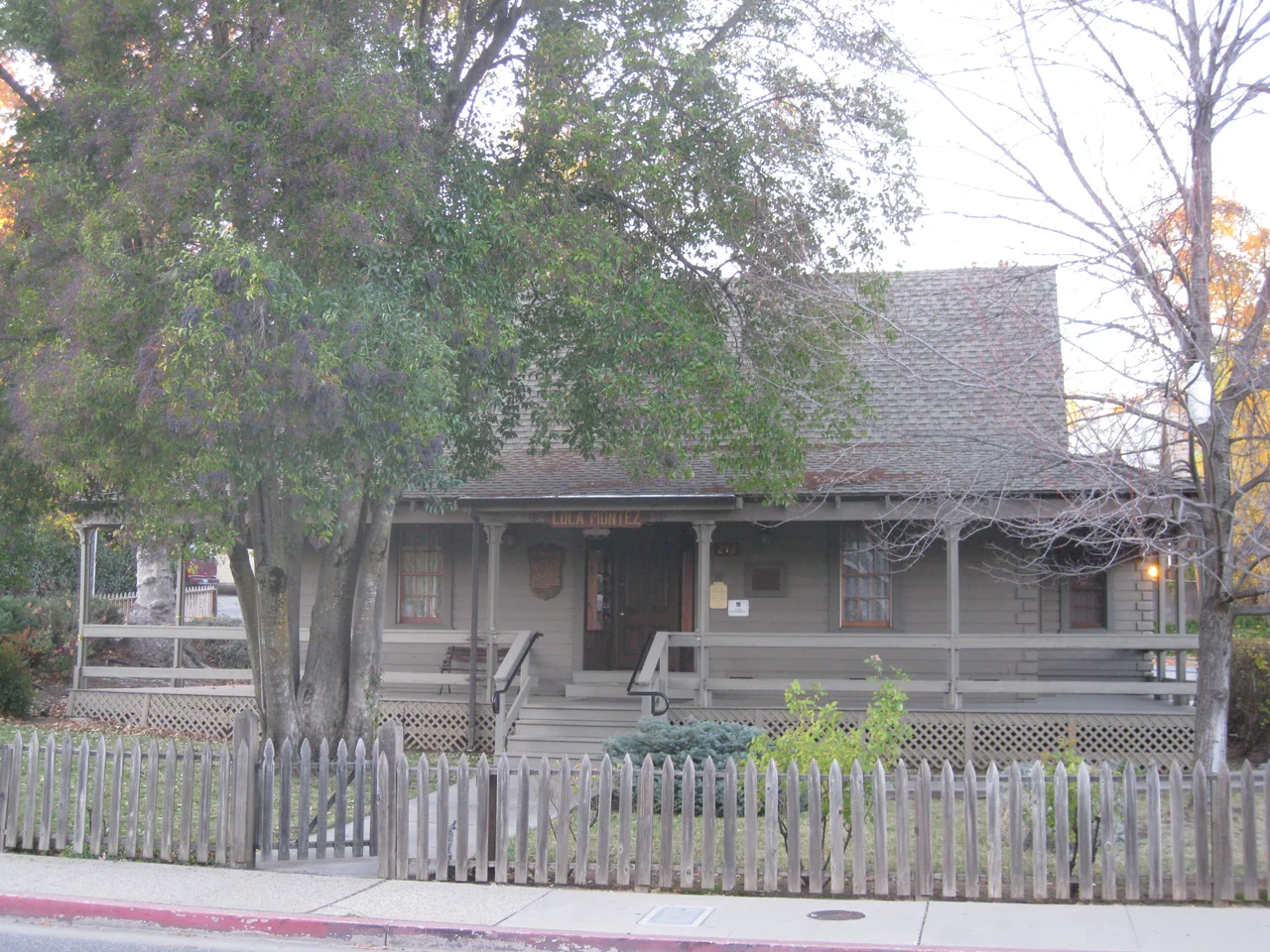

The Only Home She Ever Owned
She had toppled a government before she moved to Mill Street. Born Eliza Rosanna Gilbert in County Sligo, Ireland, in 1821, the woman the world knew as Lola Montez had reinvented herself as a Spanish dancer, seduced the King of Bavaria, been named Countess of Landsfeld, triggered a revolution that cost Ludwig I his throne, fled across Europe, married three times, and performed her notorious Spider Dance -- a tarantella in which she shook rubber spiders from her petticoats -- on stages from London to San Francisco. By 1853, when she arrived in Grass Valley, California, she was thirty-two years old and famous for all the wrong reasons. The cottage at 248 Mill Street became the only home she ever owned.
From Munich to the Mines
The path from the royal court of Bavaria to a Gold Rush mining town traces one of the stranger arcs in nineteenth-century biography. Lola Montez arrived in Munich in 1846, and King Ludwig I fell for her almost immediately. He installed her in a palace, granted her a title, and allowed her influence over cabinet appointments -- the government became known mockingly as the Lolaministerium. When revolution swept Bavaria in 1848, Ludwig abdicated, and Lola fled. She surfaced in London, then New York, then San Francisco, performing to crowds that came as much for the scandal as the dancing. Her third marriage, to a San Francisco newspaper editor named Patrick Hull, collapsed within weeks. Grass Valley, sixty miles northeast of Sacramento in the Sierra Nevada foothills, offered something Lola had never had: anonymity. She bought the cottage on Mill Street, planted a garden, and settled in.
The Neighbor on Mill Street
Grass Valley's respectable women wanted nothing to do with her. The town's elite shunned the woman whose reputation had preceded her across an ocean and a continent. But Lola found an unlikely friendship with a six-year-old girl next door. Lotta Crabtree, the daughter of British immigrants running a boarding house for Cornish miners at 238 Mill Street, was captivated by her glamorous neighbor. Lola taught the child to sing and dance, coaching her in the performing arts with the intensity of someone who understood exactly what stage presence could do for a life. She also kept a menagerie that reportedly included pet bears -- a detail that did nothing to reassure the neighbors. Yet Lola was not merely the provocateur her reputation suggested. Historical accounts record her riding miles into the hills to bring food and medicine to sick miners, and sitting through the night at the bedsides of children whose families could not afford a nurse.
A Brief Stillness
Lola lived in Grass Valley for only two years, from 1853 to 1855. It was the closest thing to domestic stability she ever experienced -- and it did not last. The restlessness that had carried her from Ireland to India to London to Munich to California reasserted itself. She left for Australia, performed across the Pacific, then returned to New York, where she spent her final years lecturing on beauty, fashion, and the art of conversation. In December 1860, she developed pneumonia. She died on January 17, 1861, at the age of thirty-nine, in a small apartment in Brooklyn. She was buried at Green-Wood Cemetery. The cottage on Mill Street passed through other hands, was remodeled beyond recognition, and by 1975 had been condemned. What stands at 248 Mill Street today is a replica, reconstructed from an 1854 sketch, housing the Nevada County Chamber of Commerce and a small museum.
Landmark Number 292
California designated the Home of Lola Montez as Historical Landmark number 292 on July 20, 1938, more than three-quarters of a century after her death. The plaque does not attempt to summarize the full biography -- how could it? It notes that the internationally known singer and dancer lived here, that this was her only home. The replica building sits on Mill Street alongside Landmark number 293, the Home of Lotta Crabtree, the child prodigy Lola helped create. The two landmarks are separated by ten feet and seventy-seven years of consequences. Lotta Crabtree went on to become the highest-paid actress in America and died with a four-million-dollar fortune. Lola Montez died nearly penniless in Brooklyn. The teacher's legacy lives in the student's success, and both legacies live on one short block in a Gold Rush town that most people drive through on the way to somewhere else.
From the Air
Located at 39.217N, 121.064W on Mill Street in downtown Grass Valley, California, at approximately 2,500 feet elevation. The home is a small historic structure not individually distinguishable from the air but sits in the historic downtown core. Nevada County Air Park (KGOO) is approximately 3 nm east at 3,154 feet elevation. Sacramento International Airport (KSMF) is about 55 nm southwest. Best viewed as part of the Grass Valley historic district from 2,000-3,000 feet AGL.
Nearby Stories
- The Hospital That Became a County 9.3 km away
- The Middle Mountains Nobody Can Reach 16 km away
- The Yuba County Five 18 km away
- Honey Run Covered Bridge 21 km away
- Western Pacific Railroad Museum 30 km away
- Griffith Mansion 36 km away
- New Melones Dam 120 km away