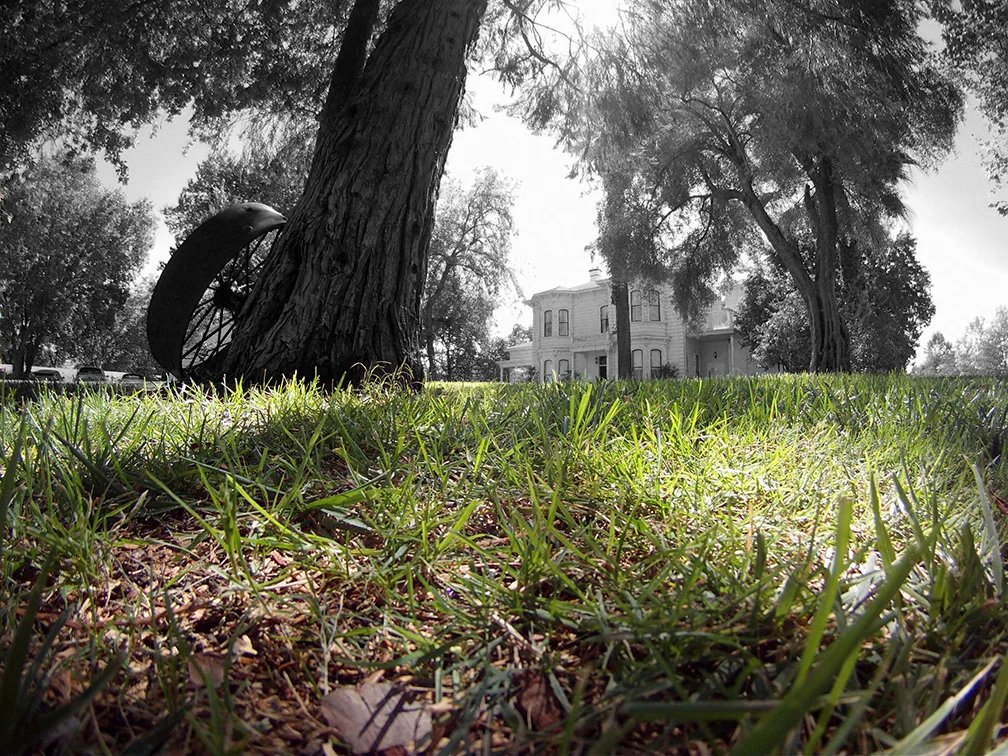

Griffith Mansion
In May 1998, contractors excavating a swimming pool behind a Victorian mansion in the tiny town of Yolo, California, struck something unexpected: a 400- to 500-year-old Patwin village. Arrowheads, spear points, chert drills, shell bead currency, and human remains emerged from the same ground where Abraham Griffith had built his Italianate home 112 years earlier. The discovery was not entirely a surprise. When Griffith's workers dug the foundation for the mansion's chimneys in 1886, they had found the bones of a Patwin individual buried in a sitting position. Two eras of habitation, separated by centuries, layered on top of each other along the banks of Cache Creek, just outside Woodland in Yolo County.
From Newcastle to Cache Creek
Abraham Griffith was born in 1822 in Newcastle-under-Lyme, Staffordshire, England. He crossed the Atlantic in 1844, landing in New York City, where he spent five years working as a store clerk and waiting for his chance. When news of the California Gold Rush reached the East Coast, Griffith secured passage as a stoker on the steamship Panama through a connection to the Aspinwall family, founders of the Pacific Mail Steamship Company. The ship broke down five days out and limped back to New York. Griffith tried again the following season, this time aboard the steamer Empire City to the Isthmus of Panama and then the steamer Oregon to San Francisco. He arrived to find a territory in the grip of gold fever. On the night of October 2, he camped on the bank of Cache Creek at the settlement called Cacheville, helped an old man named Thomas Cochran build a hut for a country tavern, and then headed north to the Trinity mines.
The Merchant of Cacheville
Mining treated Griffith roughly. He saved about $500 working the Trinity diggings, only to have the money stolen by a fellow traveler. Disgusted, he returned to Cacheville and took a job cooking for Cochran, who soon absconded to Australia, leaving debts behind and nothing but a letter from San Francisco as farewell. Griffith pivoted. He managed a hotel with William Hammack, then clerked in a store for $75 a month. In 1854, he married Mary Rush, who had crossed the plains that year. By 1855, Griffith had bought out Hammack, forming the partnership Hutton and Griffith. When the county seat moved from Washington to Cacheville in 1857, Griffith was already one of the town's leading merchants. He purchased the first brick store in town in 1861, served as Postmaster, and became the local agent for the Wells Fargo Express Company, a position he held for sixteen years. Cacheville would eventually be renamed Yolo, but Griffith's imprint on the place was already permanent.
Ashes and Italianate Columns
Griffith retired in 1880 with a family of eight children, though his daughter Jennie had died at age three in 1868. In September 1885, while he was in San Francisco with his wife and four youngest sons, his house in Cacheville burned to the ground. He had no insurance. Rather than retreat, the 63-year-old Griffith responded by building something grander. In 1886, he erected a High Victorian Italianate residence on 20 acres along the bank of Cache Creek. The mansion featured prominent bay windows, keystone-arched sash windows, scrolled brackets at the eaves, and classical Corinthian columns. It was, and remains, the grandest home in town, sitting on the edge of the commercial district where Griffith had made his name. The residence stayed in the Griffith family until 1935, when it was sold to the Hugo Maassen family, who reportedly never occupied the upper floors.
What the Ground Remembered
The 1998 pool excavation brought UC Davis anthropologists to the property for six days. Volunteers and undergraduate students spent 240 hours collecting materials from what turned out to be a significant Patwin archaeological site. Among the finds were delicate chert drills, important because they are believed to have been used to perforate marine clam shells for making beads, the currency of Patwin trade networks. Animal bones, cutting tools, and human skeletal remains also emerged. The anthropology department identified the most likely descendants of the people whose remains had been disturbed and brought them into contact with the property owners. The descendants permitted the excavation to continue and allowed UC Davis to study the artifacts for an additional year, after which all skeletal remains and associated grave goods were reburied in a secluded area of the property where they would not be disturbed again.
Layers Still Visible
A Bay Area family eventually purchased the mansion and undertook a fifteen-year restoration, returning the residence to its original Victorian character while adding modern utilities. The home remains a private family residence today on 14 acres of the original parcel. From the air, the Griffith Mansion is part of a cluster of historic buildings in the Woodland area that includes the Gable Mansion, the Gibson Mansion, the Woodland Opera House, and the Yolo County Courthouse. Together they form a pocket of nineteenth-century architecture preserved in the agricultural flatlands of the Sacramento Valley. But the Griffith Mansion carries something the others do not: the knowledge that its foundations rest on ground that was significant long before Abraham Griffith arrived from England, before the Gold Rush remade California, before Cacheville had a name. The Patwin artifacts now rest quietly beneath the property, reburied where they belong, a layer of history that predates the mansion by centuries.
From the Air
The Griffith Mansion sits at approximately 38.730N, 121.807W in the town of Yolo (formerly Cacheville), California, about 5 miles west of Woodland along Cache Creek. From the air, look for the small residential settlement of Yolo along the creek in the flat agricultural landscape of the Sacramento Valley. The mansion is a large Victorian structure on a spacious lot near the edge of the commercial area. The nearest airports are Watts-Woodland Airport (KDWA), approximately 5 nautical miles east, and Sacramento Executive Airport (KSAC), about 25 nautical miles southeast. Sacramento International Airport (KSMF) is roughly 20 nautical miles to the east. Visibility is typically excellent except during winter tule fog events.
Nearby Stories
- Ten Thousand Lightning Strikes 0.6 km away
- Postlegate: The Scandal That Shook Poker's Trust 7.5 km away
- Sutter National Wildlife Refuge 8.4 km away
- The Canyon That Burned on Independence Day 12 km away
- The Roadside Stand That Fed a Queen 19 km away
- The Pawnee Fire 23 km away
- A Dam Built for Ghosts 24 km away
- Rancho Seco Recreational Park 24 km away