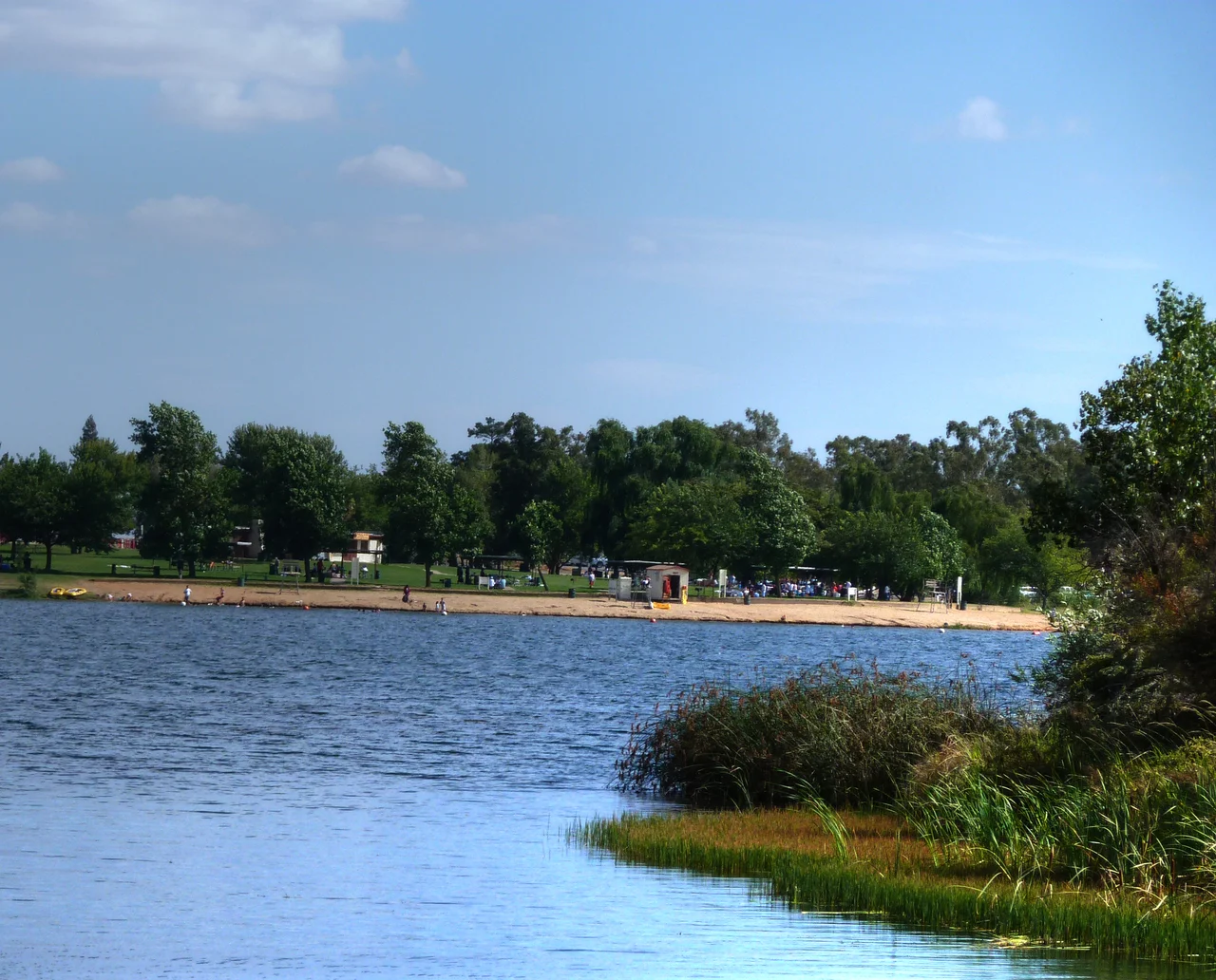

Rancho Seco Recreational Park
Somewhere in the flat oak woodlands of Sacramento County, a concrete cooling tower rises above the treeline like a monument to an energy future that never arrived. Beneath it, on a lake that was built to prevent nuclear meltdown, a fisherman casts for largemouth bass that may one day shatter a world record. This is Rancho Seco Recreational Park, where Cold War-era infrastructure became one of the Central Valley's most unlikely outdoor playgrounds.
Born from the Atom
The lake at Rancho Seco did not begin as a place for recreation. In the early 1970s, Sacramento County expanded a small pond near the Rancho Seco Nuclear Generating Station into a full reservoir, its purpose purely industrial: backup emergency cooling water in case the reactor overheated. The nuclear plant operated from 1974 until Sacramento voters chose to shut it down in a 1989 referendum, making it one of the first commercial reactors in the country to be closed by public vote. By 1992, with the reactor cold and the cooling water no longer needed for emergencies, the Sacramento Municipal Utility District took over the park surrounding the lake and began reimagining it as a public recreation area. What had been a piece of nuclear safety infrastructure became a campground, a swimming hole, and a fishing lake fed by the Folsom South Canal.
The Bass That Ate the Rainbow
SMUD stocks Rancho Seco's lake with rainbow trout each year and hosts an annual trout fishing competition each spring, with cash prizes for adults and children alike. But the trout serve a second, less obvious purpose. Florida-strain largemouth bass, introduced to the lake, feed on the planted rainbows, and the steady supply of high-protein prey allows them to grow to extraordinary sizes. Dennis Lee, a senior fishery biologist with the California Department of Fish and Game, identified the lake as having all three characteristics needed to produce record-class fish: Florida-strain genetics, conditions that promote large growth, and an abundant food source. On April 10, 2003, an angler pulled in a bass measuring 29 inches and weighing 18.4 pounds, setting the lake record. The potential, according to Lee, extends to state or even world record territory. Only electric outboard motors are permitted on the water, keeping the lake calm and undisturbed, which benefits both the fish and the swimmers sharing the reservoir.
A Beach Beside a Reactor
The juxtaposition is startling. A 36,000-square-foot sandy beach, roped off for swimming and watched by a summer lifeguard, sits within view of the decommissioned nuclear plant's structures. Because gas-powered motors are banned, the lake surface stays glassy, making it a favorite spot for kayaking, canoeing, and windsurfing. Tent campers can choose from 31 sites along the south shore, each equipped with a barbecue pit and picnic table, while 18 RV sites offer electrical hookups. A general store opens from May through September, and the park provides showers, laundry facilities, and a recreation room. Six fishing docks with handicap access line both shores. The atmosphere is less state park and more small-town summer retreat, the kind of place where families return year after year, staking out the same campsite.
Vernal Pools and Miss Kitty's Legacy
Beyond the lake, the park holds ecological surprises. The seven-mile Howard Ranch Trail, added in 2006, winds from the north shore through open ranch land, crossing low wooden bridges and passing seasonal vernal pools. These shallow depressions, dry most of the year but filled by winter rains, support threatened and endangered species including the California tiger salamander and the American spadefoot toad. The park offers guided tours of these fragile habitats. West of the lake, across the dam, sits the Amanda Blake Memorial Wildlife Refuge, named for the actress best known as Miss Kitty on the television series Gunsmoke. Blake was a devoted animal welfare advocate, and the 75-acre refuge bearing her name shelters captive-bred and rescued endangered animals, including oryx and giant emu. The refuge rounds out a park that somehow manages to combine nuclear history, world-class fishing, endangered species conservation, and Hollywood legacy in a single Sacramento County address.
An Oak Woodland Sanctuary
Step away from the lake in any direction and the landscape shifts to California oak woodland, the ancient trees forming a canopy over grasses and wildflowers. Bald eagles and red-tailed hawks nest in the oaks surrounding the water. Great blue herons stalk the shallows for fish, while ducks and geese paddle the cleared shoreline near the campgrounds. Dragonflies patrol the vernal pool margins, and raccoons trace narrow trails through the undergrowth to drink from the lake at dusk. Blackberry thickets line most of the shore, giving way only at the dam and the manicured picnic areas. The park sits in the California Central Valley near Herald, a community so small that Rancho Seco itself is the primary landmark. For a place born of nuclear anxiety, it has settled into something gentler: a patch of wildness where endangered toads breed in puddles and record-breaking bass cruise through water that was once meant to cool uranium fuel rods.
From the Air
Located at 38.338N, 121.095W in the California Central Valley southeast of Sacramento. The decommissioned Rancho Seco Nuclear Generating Station cooling tower is the most prominent visual landmark and is visible from cruising altitude in clear weather. The lake and surrounding park are immediately adjacent. Nearest airports include Sacramento Executive (KSAC) approximately 25 nm northwest and Sacramento Mather (KMHR) approximately 15 nm north-northwest. The flat Central Valley terrain makes the cooling tower stand out prominently. Best viewed at 2,000-4,000 ft AGL for the full park layout.
Nearby Stories
- The Invisible Giant Beneath the Delta 3 km away
- Folsom State Prison 5 km away
- Gwen Araujo and the Law She Changed 9.3 km away
- Wings Mended: The California Raptor Center 16 km away
- Griffith Mansion 16 km away
- New Melones Dam 23 km away
- The Emporium 53 km away
- Donner Pass 75 km away