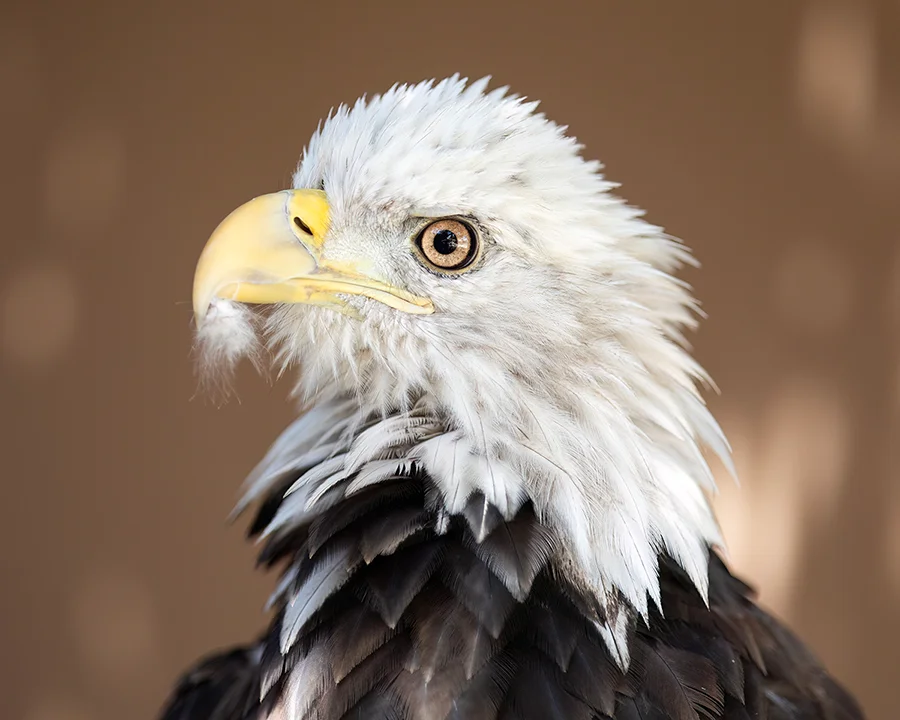

Wings Mended: The California Raptor Center
Sul Wita, a bald eagle whose name means "Eagle Man" in the Patwin language, cannot fly well enough to survive in the wild. A permanent injury keeps him grounded at the California Raptor Center in Davis, California, where he serves a different purpose: standing on a handler's gloved fist, he meets schoolchildren, community groups, and curious visitors who may never have been this close to a raptor. His sharp yellow eyes and seven-foot wingspan tend to make an impression. Sul Wita is one of several ambassador birds at the CRC, each one a living lesson in why these predators matter and how fragile their hold on healthy habitat can be.
Falconers and a Faculty Member
The center traces its origins to 1972, when UC Davis faculty member Dr. Frank Ogasawara joined forces with falconers Mark Fenn and Ole Torgerson, graduate student Alida Morzenti, and a handful of undergraduate volunteers. With support from the California Department of Fish and Game, they began taking in injured and orphaned birds of prey. Two years later they moved to their current location on the UC Davis campus, and in 1980 the university's School of Veterinary Medicine formally partnered with the center, bringing advanced medical care to birds that had previously relied on the good intentions and improvised skills of their caretakers. What began as an ad hoc rescue effort grew into something more systematic, a facility where science and compassion could work in tandem.
The Sixty Percent
Each year the CRC admits between 100 and 200 raptors: hawks, owls, falcons, vultures, eagles. The injuries vary. Some birds arrive with broken wings from collisions with cars or power lines. Others are orphaned chicks found on the ground. About 60 percent are successfully rehabilitated and released back into the wild, returned to the vicinity where they were originally found so they can reclaim familiar territory. Those requiring advanced surgery or diagnostics are referred to the UC Davis Veterinary Medical Teaching Hospital, then returned to the CRC for recovery and flight conditioning. The birds that cannot be released, the ones with permanent injuries that would make survival impossible, join the ambassador program. Their inability to return to the wild becomes, paradoxically, their contribution to it.
A Thousand Visitors a Week
Originally the center offered only private tours. That changed in 1992, when it opened for self-guided visits during operating hours, and the public response was immediate. More than 1,000 visitors now come each week to walk among enclosures housing permanent resident birds, browse a small museum with taxidermy specimens and interactive exhibits for children, or attend guided presentations. Admission is free, funded entirely by public donations that cover raptor food, veterinary care, cage construction, and all other operational costs. The center runs on approximately 7,000 volunteer labor hours each year, a figure that speaks to how deeply the facility has embedded itself in the Davis community. What the CRC lacks in budget it compensates for in dedication.
Teaching Hawks to Teach Engineers
In 2024, the CRC entered unexpected territory. A partnership with the UC Davis School of Veterinary Medicine and the Department of Mechanical and Aerospace Engineering, funded by a nearly three-million-dollar grant from the U.S. Department of Defense, established a bird flight research facility on campus. Researchers use motion capture and photogrammetry to build three-dimensional models of how raptors fly, studying the biomechanics of wing movement, turning, and landing with applications in drone design and improved rehabilitation techniques. The idea that a red-tailed hawk's banking turn could inform the next generation of uncrewed aerial systems is the kind of interdisciplinary leap that universities dream about. Meanwhile, director Dr. Michelle Hawkins co-authored a 2025 study on chlamydial infections in free-ranging raptors, adding decades of clinical data to the scientific understanding of avian disease.
What the Birds Carry
The CRC announced in 2025 a collaboration with the UC Davis Arboretum and Public Garden to build a new naturalistic enclosure for ambassador raptors, a habitat where visitors can observe birds in a setting closer to their wild environment. It is a small but telling evolution. The center has moved from rescuing birds in borrowed facilities to designing purpose-built habitats informed by fifty years of rehabilitation experience. Each ambassador bird carries a story of injury and recovery, and each tells it differently: the great horned owl with one eye, the red-tailed hawk missing flight feathers that will never grow back. They cannot return to the sky, so they do something else. They change how people think about the sky.
From the Air
Located at 38.518N, 121.753W on the southern edge of the UC Davis campus in Davis, California. The center is adjacent to agricultural fields south of the main campus. Nearest airport is University Airport (KEDU) approximately 2 miles northwest. Sacramento International Airport (KSMF) is about 20 miles northeast. The flat Sacramento Valley terrain makes the campus and surrounding farmland clearly visible from altitude.
Nearby Stories
- Emery Worldwide Airlines Flight 17 4.2 km away
- Four Names, Three Wars, Nine Missiles 4.3 km away
- Where Vineyards Became a Canvas 7 km away
- Ten Thousand Lightning Strikes 9.9 km away
- The Commissary That Became a Cathedral 12 km away
- The Rocky Fire: When a Water Heater Burned 69,000 Acres 12 km away
- The Town Beneath the Water 26 km away
- Sutter National Wildlife Refuge 27 km away