
Where Vineyards Became a Canvas
The stone winery had already lived several lives before Rene di Rosa found it. Built by two Frenchmen in 1886, it had survived phylloxera, held mushrooms, hidden moonshine, stored grain, and sheltered hay. By 1960, when di Rosa bought the property in the Carneros region of southern Napa County, the building and its 465 surrounding acres had collapsed into disuse. Most new owners would have bulldozed the ruin and started fresh. Di Rosa added doors, windows, interior rooms, and a bell tower. Then he hung paintings on the walls and started filling the grounds with sculpture. What emerged over the next four decades was one of the most unlikely art collections in the American West: 1,600 works by Northern California artists, scattered across meadows, galleries, and the shores of a 35-acre lake that di Rosa himself had dammed into existence.
The Reporter Who Collected
Rene di Rosa was born in Boston in 1919 and graduated from Yale, where he edited the Yale Daily News. After serving as a Navy lieutenant in World War II, he took a reporter's job at the San Francisco Chronicle in 1950. The assignment placed him near North Beach during one of the most explosive periods in Bay Area art history. Abstract Expressionists, Beat poets, and the emerging Funk Art movement were all working within blocks of each other, and di Rosa began buying their work before most galleries knew their names. When he moved to Napa in 1960 and enrolled in viticulture classes at UC Davis, he discovered that many of the artists he admired were teaching there. Robert Arneson, Roy De Forest, Manuel Neri, and William T. Wiley were all art professors at Davis in the mid-1960s. The friendships di Rosa formed in lecture halls and studio visits became the backbone of his collection.
Winery Lake and the Art Park Dream
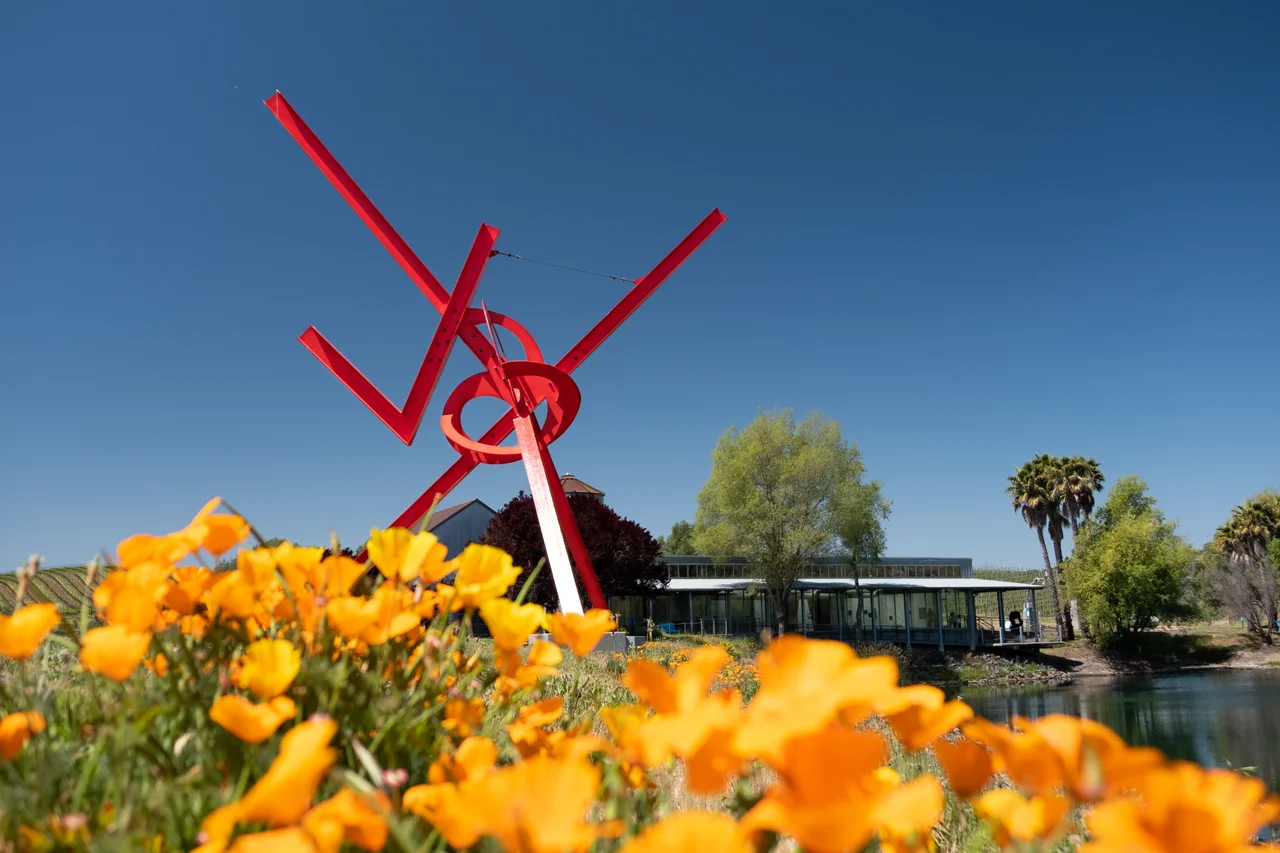
Di Rosa planted vines and established Winery Lake Vineyards in 1963, eventually covering some 250 acres. The property's lake began as a modest irrigation pond dug by WPA workers in the 1930s. Di Rosa built a dam and expanded it into an approximately 35-acre body of water he named Winery Lake, its surface reflecting both the surrounding hills and the sculptures he increasingly placed along its banks. In 1986, he sold the vineyards to Seagram and used the profits to establish the Rene and Veronica di Rosa Foundation. His wife Veronica, a Canadian-born watercolorist and sculptor trained at the Emily Carr School of Art, had shared his vision of building an art park before her death in 1991. The property opened to the public in 1997 and became an independent nonprofit in 2000. Today the 217-acre site encompasses multiple galleries, a sculpture meadow, and land protected in perpetuity under the Napa County Land Trust.
The Collection Under Siege
In July 2019, the foundation's leadership announced plans to sell most of the 1,600-work collection, retaining only several hundred pieces. The reaction was immediate and fierce. Artists whose work hung in the galleries organized petitions. Mark di Suvero, Peter Saul, and dozens of others publicly protested what they saw as a betrayal of di Rosa's vision. The collection represented something rare: not a billionaire's trophy acquisitions, but a half-century record of Bay Area artistic experimentation, from the ceramic irreverence of Robert Arneson to the conceptual investigations of Paul Kos and the visionary paintings of Jay DeFeo. Selling it off would scatter a community's creative memory across auction houses. Under new Executive Director Kate Eilertsen, di Rosa reversed course in 2021, committing to preserve the collection. The crisis had revealed how deeply the art community considered these works their own.
Art Among the Egrets
Di Rosa's programming reflects the landscape it inhabits. Rotating exhibitions in the galleries draw from the permanent collection and feature emerging Bay Area artists, but the site's identity extends well beyond its walls. The sculpture meadow places large-scale works in dialogue with the oak-studded hills of the Carneros. Birdwatching walks follow the shores of Winery Lake, where egrets and herons pick through the shallows beneath steel and stone installations. Summer camps bring children to make art alongside the collection. A 2007 PBS documentary, Smitten, directed by Nancy Kelly, captured the essence of what di Rosa built: not a museum in the traditional sense, but a place where art and the natural world occupy the same ground without apology. Rene di Rosa died in 2010 at age 91, but the landscape he shaped continues to evolve, each new exhibition adding another layer to a property that has been reinventing itself since 1886.
From the Air
Located at 38.26N, 122.35W in the Carneros region of southern Napa County. The property's 35-acre Winery Lake is a distinctive visual landmark from the air, surrounded by 217 acres of galleries, sculpture meadows, and rolling hills. Nearby airports include Napa County Airport (KAPC) approximately 8nm northeast and Sonoma Skypark (0Q9) approximately 10nm west. Best viewed at 1,500-2,500 feet AGL. The Carneros wine country and San Pablo Bay to the south provide clear navigation references.
Nearby Stories
- Remillard Brothers 3 km away
- David Grant USAF Medical Center 4.8 km away
- Where the Valley Came to Grind 5.1 km away
- Austin Creek State Recreation Area 7.9 km away
- The Hole in the Head 8.2 km away
- Black Diamond Mines Regional Preserve 12 km away
- From Radio Towers to Tribal College: D-Q University 12 km away
- ʻAkaka Falls State Park 3689 km away