
Austin Creek State Recreation Area
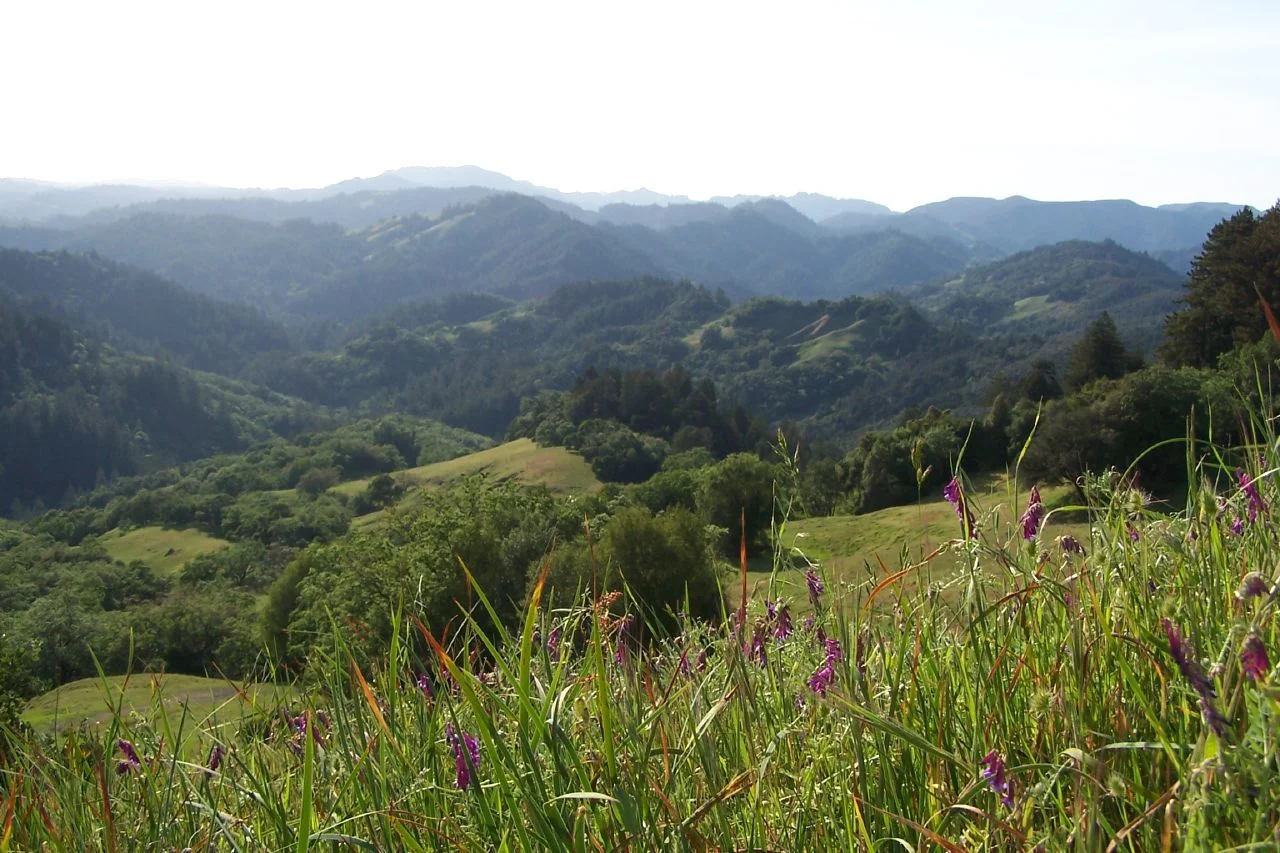
The road into Austin Creek State Recreation Area climbs steeply from the entrance it shares with Armstrong Redwoods State Natural Reserve, and the transition is abrupt. One moment you are among thousand-year-old coast redwoods in a cool, dim canyon. The next, the forest opens onto rolling hills capped with oaks, grassy meadows, and rocky summits where, on a clear day, the Pacific Ocean glimmers on the western horizon. The contrast is the point. These 5,927 acres of Sonoma County backcountry exist in deliberate opposition to the dense redwood groves below - open, sunlit, wild. Twenty miles of trails thread through ravines and along ridgelines, connecting back-country campsites to panoramic views that feel genuinely remote despite being less than eighty miles from San Francisco. Somewhere in this landscape lie the remains of Pond Farm, a ceramics artists' colony founded in the 1940s by Bauhaus-trained potter Marguerite Wildenhain, who chose this isolation precisely because it forced students to concentrate on their craft.
Where the Redwoods End
Elevation determines everything at Austin Creek. The park ranges from 150 feet in the creek bottoms to over 1,900 feet at its highest ridges, and that vertical span produces a patchwork of habitats compressed into a relatively small area. Riparian corridors along the creeks shelter trout, salmon, newts, and salamanders. Chaparral covers the drier slopes, while woodlands of Douglas fir, madrone, and several oak species fill the transition zones. The meadows explode with wildflowers in spring: Douglas irises, Indian paintbrush, California poppies, lupins, buttercups, and shooting stars - the kind of display that makes you understand why the state chose the golden poppy as its emblem. Bullfrog Pond, a small reservoir accessible by trail, hosts sunfish, black bass, and its namesake bullfrogs, their evening chorus audible from the nearby campground.
Predators and Prey
The wildlife list reads like a field guide to Northern California's inland hills. Spotted owls nest in the older timber. Great blue herons fish the creeks. White-tailed kites hover over the grasslands, scanning for rodents, while red-tailed hawks circle the thermals above the ridgelines. Wild turkeys strut through the oak woodlands, and California quail scatter from the trail edges in panicked coveys. On the ground, the mammal roster runs from squirrels and raccoons through foxes and coyotes to the apex predators that keep everything in balance: bobcats, black bears, and mountain lions. Feral pigs, an unwelcome addition, root through the meadows and creek banks. The park's isolation - its lack of paved roads beyond the entrance, its steep terrain, its distance from population centers - is precisely what sustains this density of wildlife. Animals need space without people, and Austin Creek provides it.
The Potter's Retreat
In the 1940s, the ceramicist Marguerite Wildenhain established Pond Farm on this land, a summer arts colony that drew students from across the country to study pottery in conditions that were deliberately spartan. Wildenhain, who had trained at the Bauhaus school in Weimar, Germany before fleeing the Nazis, believed that serious craft required separation from distraction. The colony operated for decades, producing a generation of California potters who carried Wildenhain's Bauhaus-influenced approach into studios across the West Coast. The remains of Pond Farm - foundations, kiln sites, and the traces of studio buildings - are now part of the recreation area, scattered through the landscape like archaeological evidence of an artistic tradition that valued the hand over the machine. Wildenhain taught at Pond Farm until 1980, and the site was designated a National Historic Landmark in 2023 in recognition of its role in American craft history.
A Park That Nearly Vanished
Austin Creek has come closer to disappearing than most visitors realize. In 2008, Governor Arnold Schwarzenegger included it among 48 California state parks threatened with closure during the state's budget crisis. It survived that round, only to face the same threat in July 2012, when it appeared on a list of 70 parks slated for closure as part of California's deficit reduction. The park's relative obscurity - no iconic waterfalls, no celebrity trail, no coastal access - made it vulnerable. What saved it was community attachment. In September 2012, California State Parks granted Stewards of the Coast and Redwoods, a local nonprofit, permission to operate the recreation area. The arrangement has held, sustained by volunteers who maintain trails, staff the entrance, and perform the unglamorous work of keeping a wilderness area open. The lesson is not lost on anyone who hikes here: some places survive not because they are famous, but because the people who know them refuse to let go.
From the Air
Located at 38.57°N, 123.05°W in inland Sonoma County. The park is adjacent to Armstrong Redwoods State Natural Reserve near Guerneville. From the air, the contrast between the dark redwood canopy of Armstrong and the open grasslands of Austin Creek is striking. The Russian River is visible to the south. Nearest airports: Charles M. Schulz-Sonoma County Airport (KSTS) approximately 15 miles southeast; San Francisco International (KSFO) approximately 75 miles south. Terrain is hilly and rugged with elevations from 150 to 1,900 feet.
Nearby Stories
- Where the Sheep Rancher Planted Stars 4.4 km away
- The Petrified Forest 5.8 km away
- The Brewery That Couldn't Behave 6 km away
- The Clayton Fire 9.5 km away
- Bodega Head: Where Two Plates Meet 14 km away
- Pixieland 687 km away
- Neskowin Ghost Forest 725 km away
- ʻAkaka Falls State Park 3649 km away