
The Brewery That Couldn't Behave
On Saint Patrick's Day 2005, agents from the California Department of Alcoholic Beverage Control showed up at Lagunitas Brewing Company in Petaluma with a problem. After staking out the brewery for two months, they had confirmed what the hop-scented air around the place already suggested: people were freely sharing cannabis at the weekly tasting parties. No one would sell it to the undercover officers, founder Tony Magee later admitted, but everyone was willing to give it to them for free. The state shut the brewery down for twenty days. Lagunitas responded the only way it knew how -- by brewing a commemorative beer called Undercover Investigation Shut-down Ale.
From a Hamlet to a Phenomenon
The whole thing started in 1993, not in Petaluma but in Lagunitas, a speck of a community in the redwoods of West Marin where Tony Magee set up shop. The original location was rural, cramped, and quickly overwhelmed by demand. Within a year, the operation moved to Petaluma, a Sonoma County town with enough space and infrastructure to support what Magee was building. Growth came fast and never really stopped. Production figures climbed steadily through the 2000s, and by March 2011 the brewery employed 92 people and distributed beer across 32 states. A $9.5 million expansion in 2012 pushed brewing capacity further still. By 2013, Lagunitas ranked as the fifth top-selling craft brewery in the United States -- a remarkable trajectory for a company that had started in a hamlet most Californians couldn't find on a map.
Picking Fights and Opening Fronts
Magee was never content with just brewing beer. In 2012, Lagunitas broke ground on a satellite brewery in Chicago's North Lawndale neighborhood, occupying a space inside the Cinespace film studio complex that had sat dormant for decades. The Chicago brewery began producing beer on April 18, 2014, and opened a taproom shortly after, bringing West Coast craft brewing to a neighborhood more associated with industrial decline than artisanal hops. The Chicago operation ran for a decade before closing in 2024. Meanwhile, Magee found time for a spectacularly ill-advised lawsuit: in December 2014, Lagunitas sued Sierra Nevada Brewing Company over the use and style of the letters "IPA" on Sierra Nevada's label. The craft beer community erupted. Public outcry was so fierce that Lagunitas dropped the suit a month later, a humbling reminder that the people who drink your beer are also the people who judge your character.
The Number You Couldn't Print
Cannabis and Lagunitas were never casual acquaintances. The brewery wove marijuana culture into its identity with the persistence of someone who genuinely did not care what regulators thought. The number 420 appeared in internal materials and external advertising for years, a winking reference to cannabis culture that eventually attracted a trademark claim from Sweetwater Brewing Company in 2013. Lagunitas dropped the number from its labels but hardly abandoned the spirit behind it. Some beer names had been so directly associated with cannabis that regulators forced name changes; a brew originally called Kronik became Censored, the redaction itself becoming the brand. The Saint Patrick's Day raid and the "disorderly house" violation under Section 24200 of California's Business and Professions Code became part of the brewery's mythology -- proof, in Magee's telling, that Lagunitas was authentic in ways that boardroom breweries could never be.
When Craft Met Corporate
In 2015, Heineken International acquired a 50% stake in Lagunitas. The deal gave the brewery global distribution muscle it could never have built alone, but it cost something that couldn't be bought back: under the Brewers Association's definition, any brewery more than 25% owned by a non-craft entity forfeits the right to call itself craft. Lagunitas was no longer, officially, a craft brewery. Two years later, Heineken purchased the remaining 50%, becoming sole owner. Magee stayed on as CEO, framing the sale as a way to push Lagunitas beer into markets around the world. For loyalists who had loved the scrappy rebel brewery, the Heineken deal felt like watching a favorite band sign with a major label. The beer was the same, but something in the story had changed.
Hops, THC, and Whatever Comes Next
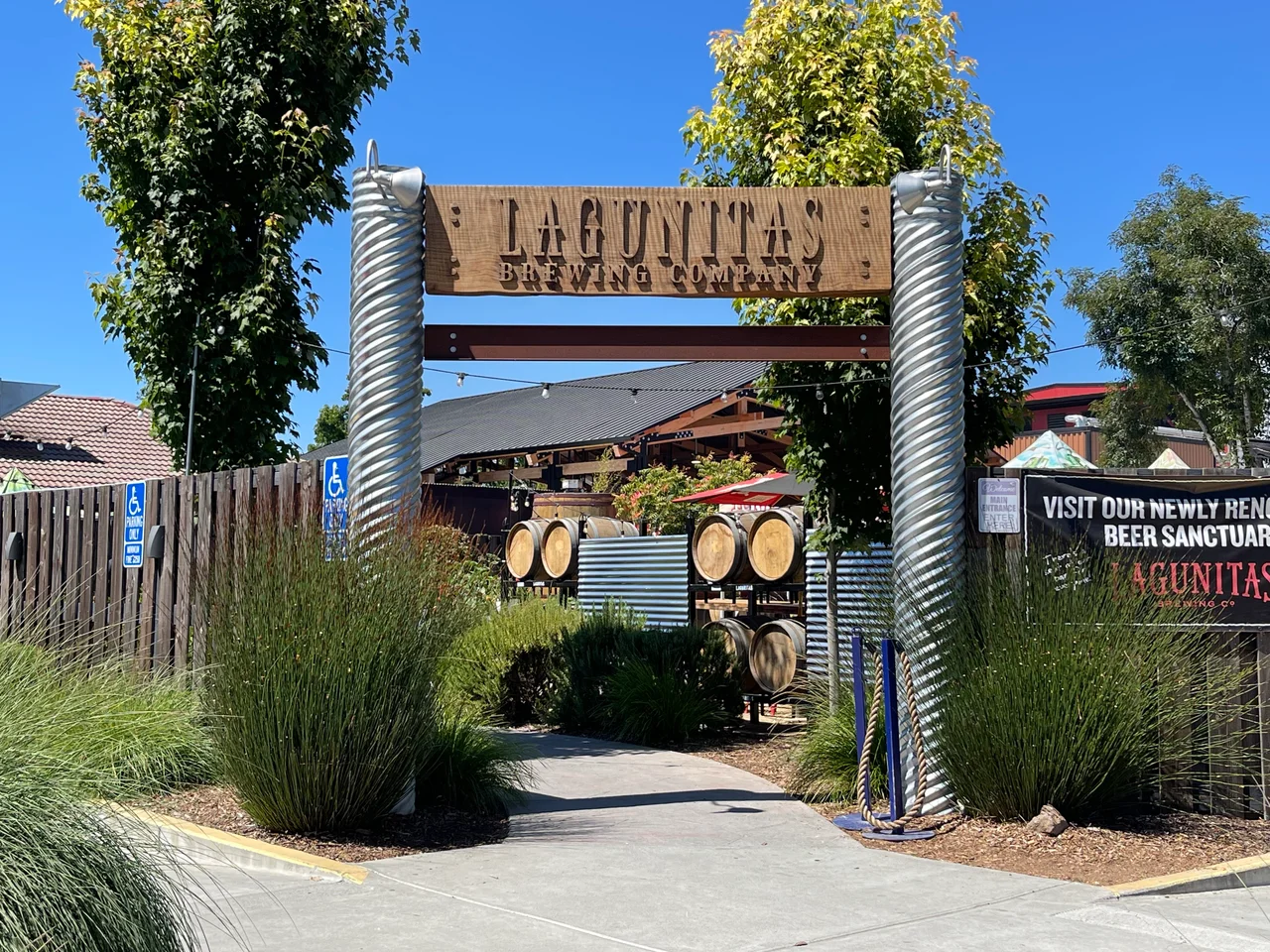
In 2018, Lagunitas leaned into its countercultural roots with a product that would have been unthinkable a decade earlier: Hi-Fi Hops, an IPA-inspired sparkling water infused with THC and CBD, produced in collaboration with cannabis grower AbsoluteXtracts. It contained no alcohol -- just the hop flavor and the high. Available only in California, it was Lagunitas doing what Lagunitas had always done: finding the line between legal and outlaw and setting up shop directly on top of it. The Petaluma taproom still anchors the operation, a sprawling gathering place where the smell of brewing malt drifts across the parking lot and the spirit of the company -- irreverent, generous, slightly reckless -- remains on display. Whether Heineken's ownership has changed the soul of the place depends on who's pouring and who's asking.
From the Air
Located at 38.27N, 122.66W in Petaluma, Sonoma County, in the agricultural lowlands between the Petaluma River and the coastal hills. From the air, the brewery complex is visible along Petaluma Boulevard North on the city's west side. Nearest airports: Petaluma Municipal (O69) approximately 3 nm east, Gnoss Field (KDVO) approximately 10 nm south. Santa Rosa's Charles M. Schulz-Sonoma County Airport (KSTS) is 18 nm north. Best viewed at 1,500-2,500 ft AGL for the surrounding dairy country and river valley.
Nearby Stories
- Remillard Brothers 3 km away
- David Grant USAF Medical Center 4.8 km away
- Where the Valley Came to Grind 5.1 km away
- Austin Creek State Recreation Area 7.9 km away
- The Hole in the Head 8.2 km away
- Black Diamond Mines Regional Preserve 12 km away
- From Radio Towers to Tribal College: D-Q University 12 km away
- ʻAkaka Falls State Park 3689 km away