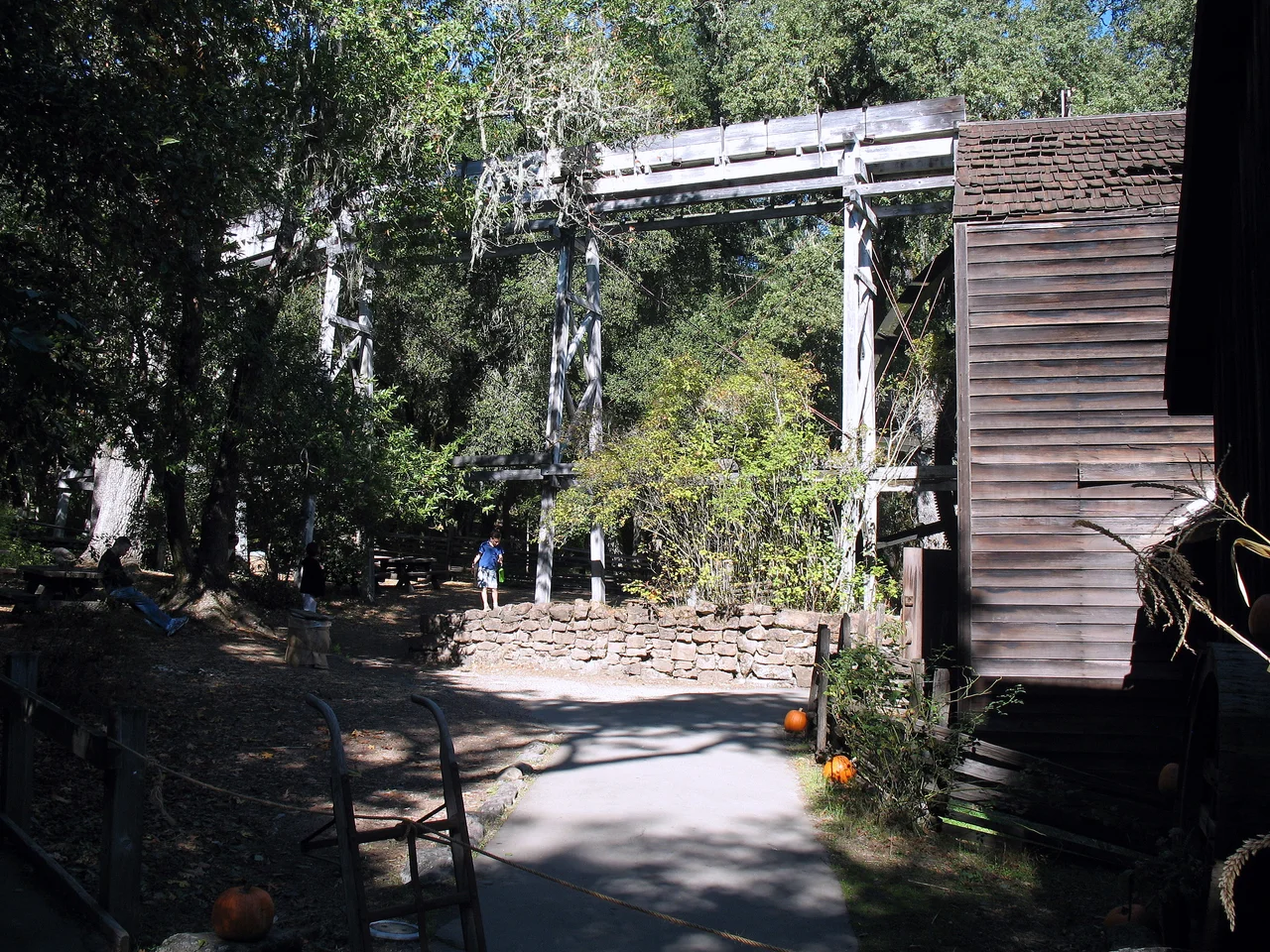

Where the Valley Came to Grind
"When meal comes to you that way, like the heated underside of a settin' hen, it bakes bread that makes city bread taste like cardboard." That was how old-timers in Napa Valley described the flour that came from Bale's mill -- a water-powered gristmill built in 1846 from coast redwood and Douglas fir, tucked along Mill Creek between what are now St. Helena and Calistoga. The quote survives because the mill does. Its 36-foot waterwheel still turns, making it one of only two water-driven mills remaining west of the Mississippi River.
The English Surgeon's Land Grant
Dr. Edward Turner Bale was an English-born surgeon who arrived in California during the Mexican era and married into the Vallejo family, one of the most powerful in Alta California. Through that connection, he received Rancho Carne Humana, a land grant encompassing thousands of acres in the upper Napa Valley. In 1846, the same year California was beginning its tumultuous transition from Mexican to American territory, Bale built his gristmill on the property. The construction used local materials almost exclusively: Douglas fir and coast redwood timbers, some cut to length with the bark still on, others rough-hewn with hand tools. The timbers were notched and fastened with wooden pegs, supplemented by nails and screws. The foundation was native stone. Bale would live near the site for only three more years before his death in 1849, but the mill he built would outlast him by nearly two centuries.
The Social Engine of a Valley
In the years before wine defined Napa Valley, the mill was the valley's gathering point. Settlers brought their corn and wheat to be ground into meal or flour, and the process was slow enough that waiting became a social occasion. Grain was loaded into the boot of a mechanical elevator, lifted upstairs, cleaned through various equipment, then fed between grindstones that turned at a pace dictated by the creek's flow. Water arrived via a ditch from a millpond, traveling through a wooden flume to the top of the waterwheel. The first wheel proved inadequate during dry summers -- a predictable problem in a Mediterranean climate -- and was replaced by the larger wheel whose descendant stands today. The dampness of the site and the unhurried rotation of those stones produced a meal with a texture and warmth that bakers prized. It was not efficiency. It was quality born of slowness.
Changing Hands, Falling Silent
Theodore Benedict Lyman purchased the mill and its surrounding land in 1871 and eventually passed ownership to his son, William Whittingham Lyman. The mill ground its last grain in 1879, the same decade that Napa Valley's identity was pivoting decisively toward viticulture. After William Lyman died, his wife Sarah deeded the property to the Native Sons of the Golden West, a fraternal organization dedicated to preserving California heritage. For decades the mill stood quiet, its machinery stilling as the creek kept flowing. Then, in the late 1960s, the Native Son Parlors of Napa County organized a restoration effort under Bismarck Bruck -- a man with a personal stake in the project. Bruck was a grandson of Dr. Bale himself, a direct link across more than a century to the surgeon who had chosen this creek bank and these trees.
Saved Twice Over
Today Bale Grist Mill State Historic Park preserves the restored mill and its waterwheel as a California state historic landmark. A hiking trail connects it to Bothe-Napa Valley State Park, a two-mile round trip through oak woodland. The park also contains the site of the first church built in the Napa Valley and the Pioneer Cemetery, making the grounds a layered record of the valley's earliest Euro-American settlement. But preservation has not been automatic. During the 2011 California budget crisis, the mill was among state parks targeted for closure. The Napa Valley State Park Association stepped in, petitioning to operate the park and keep it open. In 2014, the state legislature passed a law allowing the mill to sell flour to the public beginning January 1, 2016 -- flour ground on the same stones, by the same water power, that settlers relied on 170 years earlier. The mill survives not as a museum piece sealed behind glass, but as a working machine whose product you can carry home in a bag.
From the Air
Located at 38.54N, 122.51W on Highway 128 between St. Helena and Calistoga in upper Napa Valley. The mill site is tucked into the tree canopy along Mill Creek and is not easily distinguished from the air, but the surrounding parkland and the corridor of Bothe-Napa Valley State Park are visible. Nearest airports: Napa County Airport (KAPC) approximately 14 nm south, and Angwin-Parrett Field (2O3) to the east. The upper Napa Valley narrows here between the Mayacamas Range and the forested slopes of Mount St. Helena to the north.
Nearby Stories
- Bodega Head: Where Two Plates Meet 1.9 km away
- Austin Creek State Recreation Area 2 km away
- The City of San Francisco 4.4 km away
- Vallejo's Sonoma: Where California Changed Hands 5.6 km away
- The Rocky Fire: When a Water Heater Burned 69,000 Acres 5.7 km away
- From Radio Towers to Tribal College: D-Q University 9.3 km away
- The People of the Roundhouse 15 km away
- The Day Two Nuclear Bombs Fell on Yuba City 31 km away