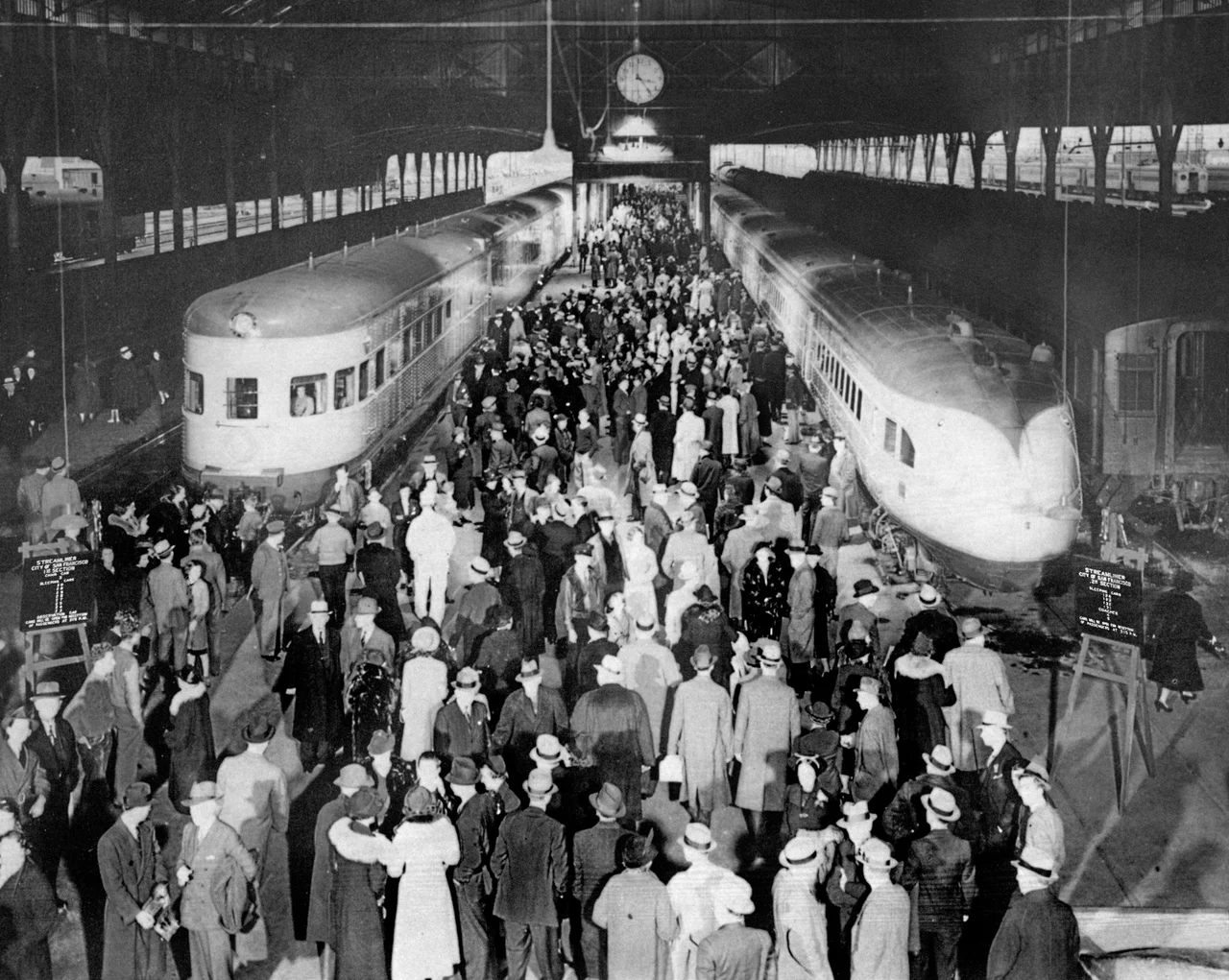

The City of San Francisco
On January 13, 1952, a luxury streamliner carrying 196 passengers and 30 crew disappeared into the Sierra Nevada. Not derailed, not wrecked -- swallowed. A blizzard at Yuba Pass buried the City of San Francisco under twelve feet of snow, winds howling at 100 miles per hour, and for six days the train sat entombed while the nation watched and rescuers fought to reach it. Among those who finally dug through to the stranded passengers was Georg Gaertner, an escaped German prisoner of war who would not be identified for decades. It was the kind of story the City of San Francisco seemed to attract -- operatic, improbable, cinematic. From its debut in 1936 to its final run in 1971, this train was never just transportation. It was theater on rails, a shimmering diesel-powered argument that the journey between Chicago and the Golden Gate could be as magnificent as the destination.
Thirty-Nine Hours of Luxury
When the City of San Francisco made its first run on June 14, 1936, it offered something genuinely new: premium streamlined service from Chicago to Oakland in 39 hours and 45 minutes, with a ferry connection across the Bay. The original consist was a Pullman-built 11-car articulated marvel, powered by twin 1,200-horsepower diesel-electric units. By January 1938, the railroad consortium -- Chicago and North Western, Union Pacific, and Southern Pacific -- replaced it with an even grander 17-car set capable of 110 mph, featuring an 84-foot-6-inch buffet-lounge-observation car called Nob Hill, reportedly the longest passenger car built in the United States at that time. The train accommodated 222 passengers in 60 compartments, drawing rooms, bedrooms, and the then-novel 'roomettes,' offering more sleeping configurations than any other train in America. Operating costs ran less than two cents per passenger-mile, a remarkable figure for a service that felt like a moving hotel.
Sabotage in the Desert
The City of San Francisco's most disturbing chapter played out on August 12, 1939, near Harney, Nevada, when the train derailed catastrophically. Two dozen passengers and crew members died; many more were injured. Investigators ruled it an act of sabotage -- someone had tampered with the track. But despite years of investigation, no one was ever charged. The case remains unsolved, one of the enduring cold cases of American railroad history. The desert around Harney offered no witnesses, no clear motive, only twisted metal and unanswered questions. The railroad repaired the track, rebuilt the consist, and put the City back in service. For passengers, the memory of the sabotage was a shadow that rode alongside the glamour, a reminder that speed and luxury traveled through landscapes that could turn hostile without warning.
Buried Alive at Yuba Pass
The 1952 snowbound incident became the City of San Francisco's defining story. Trapped 17 miles west of Donner Pass -- a location already synonymous with winter catastrophe -- the train sat immobile while the railroad's own snow-clearing equipment and rotary plows froze to the tracks near Emigrant Gap. Hundreds of workers and volunteers labored to clear nearby Route 40, the only lifeline to the stranded passengers. Inside the buried cars, supplies dwindled and temperatures dropped, the luxury fittings offering cold comfort against a Sierra blizzard that made international headlines. Within 72 hours of rescuers finally reaching the train, all 226 people aboard had been evacuated on foot to waiting vehicles, then driven the few highway miles to Nyack Lodge. The train itself was extricated three days later, on January 19. The event became the subject of newsreels, newspaper features, and decades of railfan lore -- a story that seemed to belong more to the age of the Donner Party than to postwar America.
War, Decline, and the Long Goodbye
World War II reshaped the City of San Francisco in ways both practical and symbolic. The War Production Board halted new passenger car construction from mid-1942 through late 1945. The Office of Defense Transportation banned strictly luxury cars without revenue capacity, forcing the removal of the beloved Nob Hill observation car and the Marina lounge-buffet, replaced by sleepers that could carry more bodies westward. After the war, service expanded -- thrice weekly by October 1946, daily by September 1947, with additional consists added through 1950. But the golden age was already dimming. In 1960, the City of San Francisco was combined with the City of Los Angeles east of Ogden, a consolidation that diluted its identity. By 1962, the separate San Francisco Overland had been folded in. On May 1, 1971, Amtrak absorbed what remained. The name lingered until June 1972, when the route became the San Francisco Zephyr, itself replaced in 1983 by today's California Zephyr. The train that had once been the fastest, most luxurious way across the American West simply faded into timetable footnotes.
Ghost Names on the Rails
Many of the City of San Francisco's individual cars bore names drawn from the geography and culture of their namesake city -- Mission Dolores, Nob Hill, Marina. The names turned rolling stock into a kind of mobile atlas of San Francisco, each sleeper and lounge car a postcard from the city at the end of the line. That tradition outlived the train itself. A Pullman Standard sleeping car from the early 1950s bearing the City of San Francisco name now operates on the Boone and Scenic Valley Railroad in Iowa, serving dinner and first-class excursion passengers. Union Pacific maintains a dome lounge car with the same name for executive and special trains. These surviving cars are fragments of a vanished world -- a world where the distance between Chicago and the Pacific was not a flight time but an experience, measured in dining car meals, sleeping car nights, and the slow unfolding of the continent through observation car windows.
From the Air
The City of San Francisco's route ran along the Overland Route from Chicago through Omaha, across Wyoming and Utah to Ogden, then southwest to Oakland/San Francisco. Its coordinates (38.29N, 121.96W) place it near Fairfield-Suisun in the Sacramento Valley, along the Southern Pacific's route through California's Central Valley. From altitude, the Overland Route traces the path of transcontinental settlement -- look for the rail corridor paralleling Interstate 80 through the Sierra Nevada. The dramatic Yuba Pass/Donner Pass section where the 1952 snowbound incident occurred is visible at higher elevations west of Truckee. Nearest airports include Sacramento Executive (KSAC), Sacramento International (KSMF), and Travis AFB (KSUU). The Oakland terminus was at Oakland Pier, visible from altitude as the rail infrastructure along the eastern Bay shoreline.
Nearby Stories
- Where Vineyards Became a Canvas 3 km away
- Black Diamond Mines Regional Preserve 4.1 km away
- Chevron Richmond Refinery 4.9 km away
- Wings Mended: The California Raptor Center 6.1 km away
- Emery Worldwide Airlines Flight 17 7.9 km away
- When Wine Country Burned 13 km away
- Rancho Seco Recreational Park 21 km away
- From Aluminum to Ammunition to Aviation Fuel 43 km away