
Vallejo's Sonoma: Where California Changed Hands
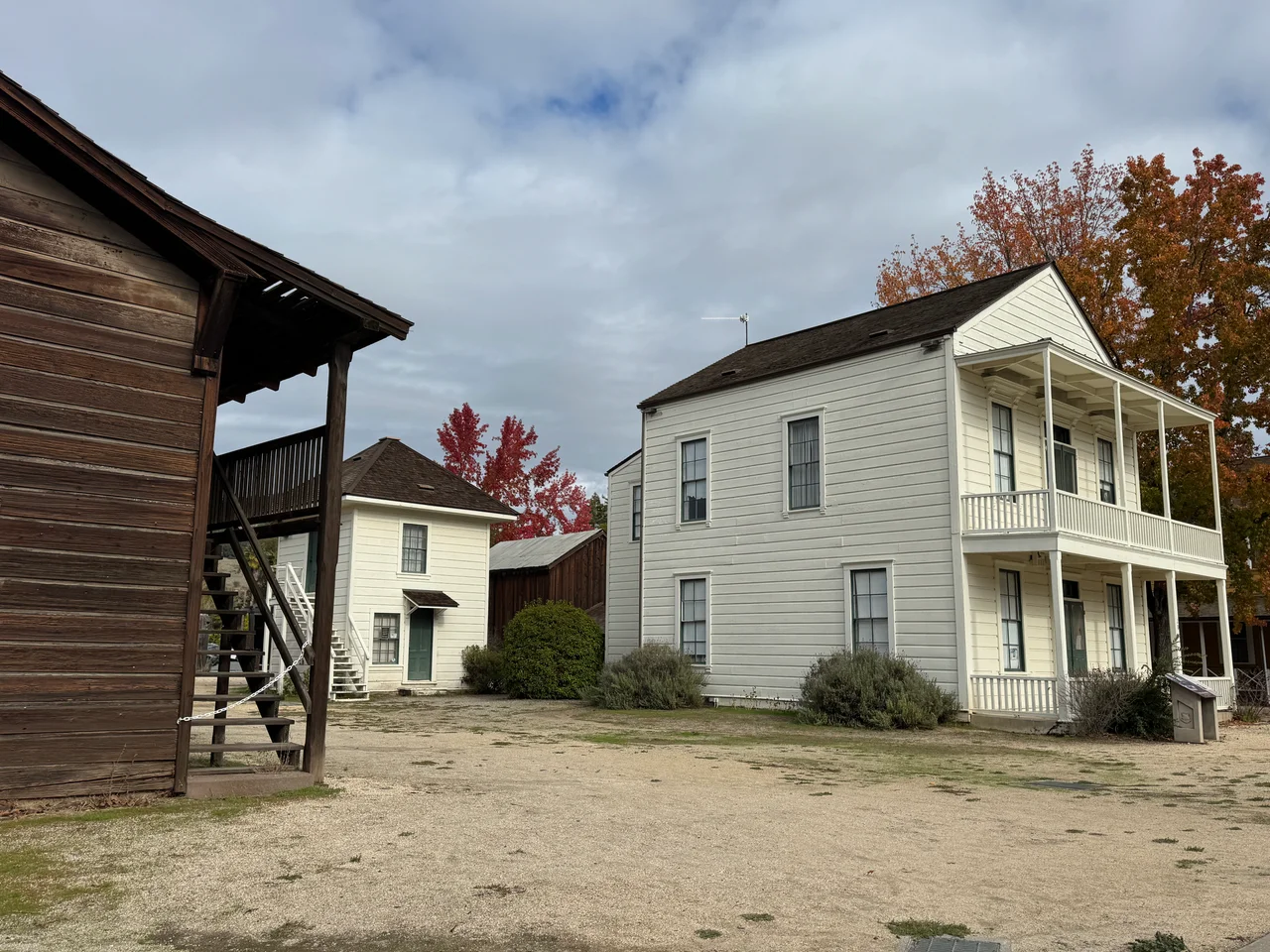
On the morning of June 14, 1846, a group of armed American settlers barged into the grandest house on Sonoma's central plaza and took its owner prisoner. Mariano Guadalupe Vallejo, the Mexican military commander of Northern California, negotiated for hours before being marched off to Sutter's Fort in chains. The house where this confrontation sparked the Bear Flag Revolt still stands, or at least its servants' quarters do, as part of Sonoma State Historic Park. What makes this park unusual is not any single building but rather the constellation of six sites surrounding the same eight-acre plaza, each one a chapter in the story of how California passed from Spain to Mexico to the United States in the span of a single generation.
The Last Mission
Mission San Francisco Solano holds the distinction of being the 21st and final mission established in Alta California, founded in 1823, two years after Mexico won independence from Spain. It was also the northernmost, planted here for strategic rather than purely spiritual reasons. The Mexican governor wanted a bulwark against the Russian-American Company, whose traders at Fort Ross on the coast were inching inland. A young Franciscan friar from Mission Dolores in San Francisco provided the religious justification, seeking better weather and more potential converts. The mission lasted only eleven years before Mexico's 1833 secularization decree shut down the entire system. It was a modest operation compared to the older missions further south, with fewer converts and less diverse industries. But its brief life set the stage for everything that followed, because the man appointed to oversee its closure was Mariano Vallejo, and closing the mission was just the beginning of his ambitions for Sonoma.
Vallejo's Plaza
Vallejo did not merely dismantle the mission. He built a town. Tasked with establishing a pueblo on the old mission grounds, he laid out residential lots, a central square, and a broad avenue running south. He was simultaneously named Military Commander of the Northern Frontier, Director of Colonization, and administrator of the enormous 66,622-acre Rancho Petaluma to the west. He moved soldiers from San Francisco's Presidio to Sonoma, constructing the adobe barracks known as El Cuartel de Sonoma along the plaza's north edge. Beside the barracks rose La Casa Grande, his family home, where eleven of his children were born and where a three-story tower added around 1843 let him survey miles of the Sonoma Valley. The house became the social and diplomatic hub of everything north of San Francisco Bay. Governors, foreign dignitaries, and frontier settlers all passed through its doors, which makes the events of that June morning in 1846 all the more dramatic.
A House Shipped Around the Horn
After the Bear Flag Revolt and American annexation, Vallejo pivoted with remarkable pragmatism. He served in California's first state senate and, in 1851, built a new home several blocks from the plaza. Lachryma Montis, named for a nearby spring whose Latin name translates to "tear of the mountain," was unlike anything else in Sonoma. The two-story Victorian Carpenter Gothic house was prefabricated on the East Coast, shipped around Cape Horn by sailing vessel, and assembled on site. Each room had its own white marble fireplace. Crystal chandeliers and a rosewood concert-grand piano arrived from Europe. The quarter-mile driveway was lined with cottonwood trees and Castilian roses, and a vine-covered arbor shaded pathways around the spring-fed pool. Outbuildings included a retreat called El Delirio and a warehouse built from timbers cut and numbered in Europe, later converted to a residence known as the Swiss Chalet. It was the home of a man determined to remain relevant in a country that had just taken his.
The Boardinghouse That Time Preserved
Not every story around Sonoma's plaza involves generals and revolutions. The Toscano Hotel began as a simple building on land purchased from Vallejo in 1852. By 1886 it was operating under Italian proprietors, Settimo Ciucci and Leonido Quatoroli, who gave it the name that stuck. In 1898, Ciucci's father-in-law bought the property for ten dollars in gold coin. The family ran the hotel for decades as a combined boardinghouse for quarry workers and a summer resort for families of modest means. Jack Walton, who married into the family in 1914, became locally famous for his hospitality and his Old Fashioned cocktails. A 1925 railroad brochure advertised seventy-five guest rooms at twelve dollars a week. When Walton died in 1955, his wife Amelia closed the hotel and sold the property to California for fifty thousand dollars two years later. Today the Toscano is furnished with period pieces that make it look much as it did at the turn of the twentieth century, a quiet counterpoint to the grander dramas that played out across the plaza.
One Plaza, Many Californias
Walking Sonoma's plaza today, you can trace an entire arc of California history without leaving a few city blocks. The mission chapel Vallejo built in 1841 to replace the crumbling original stands on one side. The barracks face the square. The servants' quarters of La Casa Grande survive as a reminder of the home where the Bear Flag rebels changed history. Down the street, Lachryma Montis sits amid its gardens, an improbable Victorian transplant from the Atlantic seaboard. And the Toscano Hotel preserves the ordinary life that filled in around these larger events: Italian immigrants, quarry laborers, railroad tourists, families spending summer weeks at twelve dollars a head. The park was established in 1909 with just the mission. Over the following century, California added the other sites, recognizing that no single building tells the whole story. It takes all six to capture how a frontier outpost became a town, and how one man's career threaded through every phase of the transformation.
From the Air
Sonoma State Historic Park sits at 38.297N, 122.463W, centered on Sonoma Plaza in the town of Sonoma. From the air, the distinctive eight-acre plaza is clearly visible as a green square in the town center, surrounded by historic low-rise buildings. The nearest general aviation airport is Sonoma Skypark (0Q9), about 2 miles south. Schellville-Sonoma Valley Airport is nearby as well. Sonoma County Airport (KSTS) in Santa Rosa is roughly 20 nm to the northwest. Best viewed at 2,000-3,000 ft AGL on approach from the south, where the Sonoma Valley floor and surrounding vineyard-covered hillsides frame the town.
Nearby Stories
- Remillard Brothers 3 km away
- David Grant USAF Medical Center 4.8 km away
- Where the Valley Came to Grind 5.1 km away
- Austin Creek State Recreation Area 7.9 km away
- The Hole in the Head 8.2 km away
- Black Diamond Mines Regional Preserve 12 km away
- From Radio Towers to Tribal College: D-Q University 12 km away
- ʻAkaka Falls State Park 3689 km away