
The Day Two Nuclear Bombs Fell on Yuba City
The crew had been flying for nearly 24 hours, some of them on dexedrine to stay awake. Their B-52F Stratofortress, serial number 57-0166, carried two Mark 39 Mod 2 thermonuclear weapons in its bomb racks as it flew a routine airborne alert mission out of Mather Air Force Base near Sacramento. Then the cabin depressurized. The bomber dropped from cruising altitude to 10,000 feet, burning fuel at a rate the flight plan never anticipated. A tanker rendezvous failed. The crew, according to a later account by retired B-52 pilot Earl McGill, refused an offer of unscheduled aerial refueling and bypassed emergency landing fields. On March 14, 1961, the engines went silent over the Sacramento Valley. The crew ejected safely. The aircraft, now a 200-ton glider carrying two nuclear bombs, plunged into farmland 15 miles west of Yuba City.
Impact
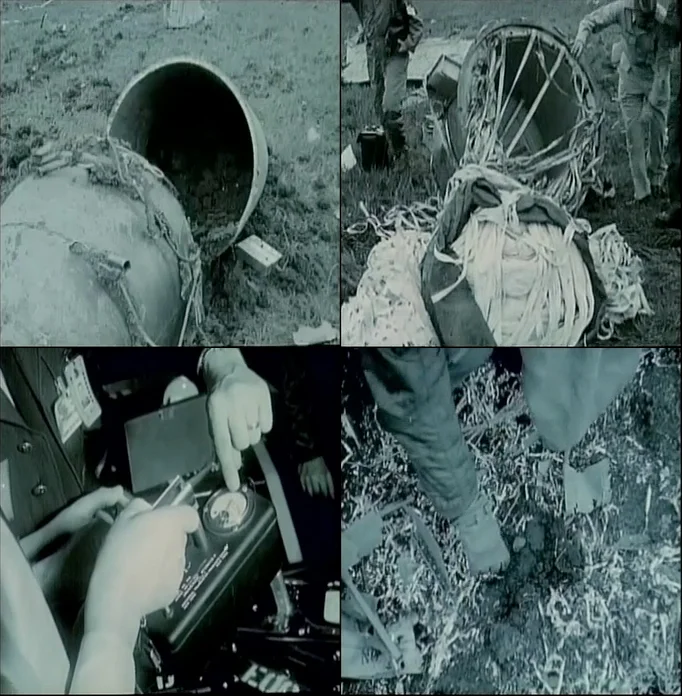
The crash tore both weapons from the aircraft. The bomb in the rear rack stayed mostly intact inside its ballistic drop case, its nuclear components still contained. But the impact had done its work on the weapon's mechanisms: the arming pull-out rods had been extracted, and the internal timer had started. The tritium reservoir had broken off, though its gas remained contained. The high explosives inside were crumbled. The forward weapon fared worse. It separated from the aircraft entirely, tumbling across the field. Its boosted-fission primary stage and most of its fusion secondary stage were thrown clear of the ballistic case. The primary was destroyed -- high explosives shattered and scattered, the enriched uranium pit separated from the assembly, detonators flung across a wide area. Its timer, too, had started. In both weapons, the Arm/Safe switches were found in the Safe position.
How Close Was Close
The safety systems held, but not without alarming caveats. Despite both Arm/Safe switches being set to Safe, the low-voltage thermal batteries in one weapon activated anyway. Post-mortem analysis by the Defense Atomic Support Agency determined that a cable short circuit had allowed energy from a shock-activated generator to bypass the Arm/Safe switch entirely. The mechanical impact of the crash had triggered the generator, and the resulting electrical pulse found a path around the very device designed to prevent accidental detonation. The high-voltage batteries -- the next step in the arming sequence -- did not fire. Officially, all design safety features performed adequately. But the incident revealed how many individual failure points stood between a crash and a nuclear detonation, and how impact forces could defeat them one by one.
The Goldsboro Connection
Three weeks before Yuba City, a nearly identical accident had unfolded over Goldsboro, North Carolina. A B-52 broke apart in midair, dropping two nuclear weapons of the same type into tobacco farmland. The Goldsboro weapons lacked a critical safety upgrade that the Yuba City bombs had received: a modification designated Alt 197, which replaced the older MC-722 Arm/Safe switch with the newer MC-1288. The newer switch was supposed to prevent the low-voltage thermal batteries from charging when the switch was in the Safe position. At Yuba City, the upgrade was installed -- and the batteries activated regardless. Two accidents, three weeks apart, same type of weapon, same era of Cold War airborne alert missions. Together they forced a reckoning with just how robust nuclear weapon safety really was.
Cleanup and Quiet
Explosive ordnance disposal teams from Beale Air Force Base and McClellan Air Force Base arrived the same day. They removed the two tritium reservoirs and the separated uranium pit on March 14. The following day, they collected the scattered high explosives -- including the intact explosive sphere from the rear weapon -- and burned them. The weapon components were returned to the Atomic Energy Commission. There was no nuclear contamination. The farmland absorbed the debris, the fields were cleared, and the Sacramento Valley returned to its usual quiet. A fireman responding to the crash was killed in a road accident en route to the scene, and several others were injured -- the only casualties of an event that could have been measured in kilotons.
From the Air
Located at 39.117N, 121.883W, approximately 15 miles west of Yuba City in the flat Sacramento Valley. The crash site is in agricultural land between the Sacramento River and the Sutter Buttes. From the air, the Sutter Buttes -- the world's smallest mountain range -- serve as a distinctive landmark to the northwest. Nearby airports include Yuba County Airport (KMYV) about 12 miles northeast and Beale Air Force Base (KBAB) roughly 25 miles north. Sacramento Executive (KSAC) lies about 40 miles south. Mather Air Force Base (now Mather Airport, KMHR), where the doomed flight originated, is about 45 miles south-southeast. Best viewed at 2,000-4,000 feet AGL; the flat terrain makes the crash area indistinguishable from surrounding farmland today.
Nearby Stories
- Griffith Mansion 13 km away
- A Dam Built for Ghosts 14 km away
- Postlegate: The Scandal That Shook Poker's Trust 17 km away
- The Canyon That Burned on Independence Day 21 km away
- The Pawnee Fire 23 km away
- The Yuba County Five 31 km away
- Oroville Dam Crisis 34 km away
- August Complex Fire 52 km away