
The Petrified Forest
She has been lying on her side for 3.4 million years. The Queen, as visitors know her, stretches sixty-five feet across the forest floor, eight feet wide at the base, her bark replaced cell by cell with silica until every ring and knot has turned to stone. She was two thousand years old when the volcano buried her. In Sonoma County's hills north of Calistoga, the Petrified Forest preserves a grove of ancient redwoods that were flash-entombed by a volcanic eruption during the Pliocene epoch, then slowly mineralized over millennia into the stone replicas that visitors walk among today. It is the only petrified forest in California from this period, and the Palynological Society has called it "one of the finest examples in the world of an ancient forest."
Ghosts of a Warmer World
The trees that became stone here tell a story about California's deep past. Three and a half million years ago, coast redwoods grew far inland, thriving in a climate warmer and wetter than today's. Diane Erwin of the University of California, Berkeley, confirmed in 2012 that the petrified forest demonstrates this range shift: the redwoods that now cling to the foggy coast once covered these inland hills. When a volcanic eruption blanketed the forest in ash, the trees fell in a uniform direction, knocked down by the blast. Silica-rich groundwater then infiltrated the buried wood over thousands of years, replacing organic material molecule by molecule. The process preserved the trees in extraordinary detail, down to individual growth rings and bark texture. Most of the petrified specimens are Sequoia langsdorfii, an extinct relative of the living coast redwood. One lone petrified pine tree stands among them, a reminder that even ancient forests contained variety.
A Paleontologist, a Novelist, and a Forest
Yale paleontologist Othniel Charles Marsh visited the petrified forest in 1870, identifying the stone trees as ancient sequoias. The site had been discovered the same year by Swedish homesteader Charles Evans, known as "Petrified Charley," who found a petrified log while raking his pasture. Marsh was already famous for his fossil-hunting expeditions in the American West, and the California forest added a botanical dimension to his largely dinosaur-focused career. Thirteen years later, Robert Louis Stevenson wandered through the same stone grove during the honeymoon summer he spent in the Napa Valley with his new wife Fanny Vandegrift and her son Lloyd Osbourne. Stevenson wrote about the forest in The Silverado Squatters, his 1883 memoir of that Calistoga sojourn, giving the site its first literary fame. The conjunction is striking: one of the nineteenth century's great bone hunters and one of its great storytellers both drawn to this patch of mineralized woodland within a generation of each other.
The Bockee Century
Around 1912, Ollie Orre Bockee bought the forest and its surrounding land from M.C. Meeker for fourteen thousand dollars. Over the following years she expanded the property to 845 acres, and by 1914 she was charging tourists fifty cents to walk among the stone trees. Bockee ran the forest for nearly four decades until her death in 1950, when ownership passed to her sister. Her direct descendants maintain and operate the site today, making the Petrified Forest one of the longest family-run natural attractions in California. In 1978, the state recognized the site as a California Historical Landmark. Then in 2012, the family began a scientific partnership with UC Berkeley, sending fossilized pollen samples for analysis. Those ancient pollen grains, trapped alongside the petrified wood, are helping researchers reconstruct the plant communities and climate conditions of Pliocene-era Northern California with a precision that the petrified trunks alone cannot provide.
Walking Among Stone Giants
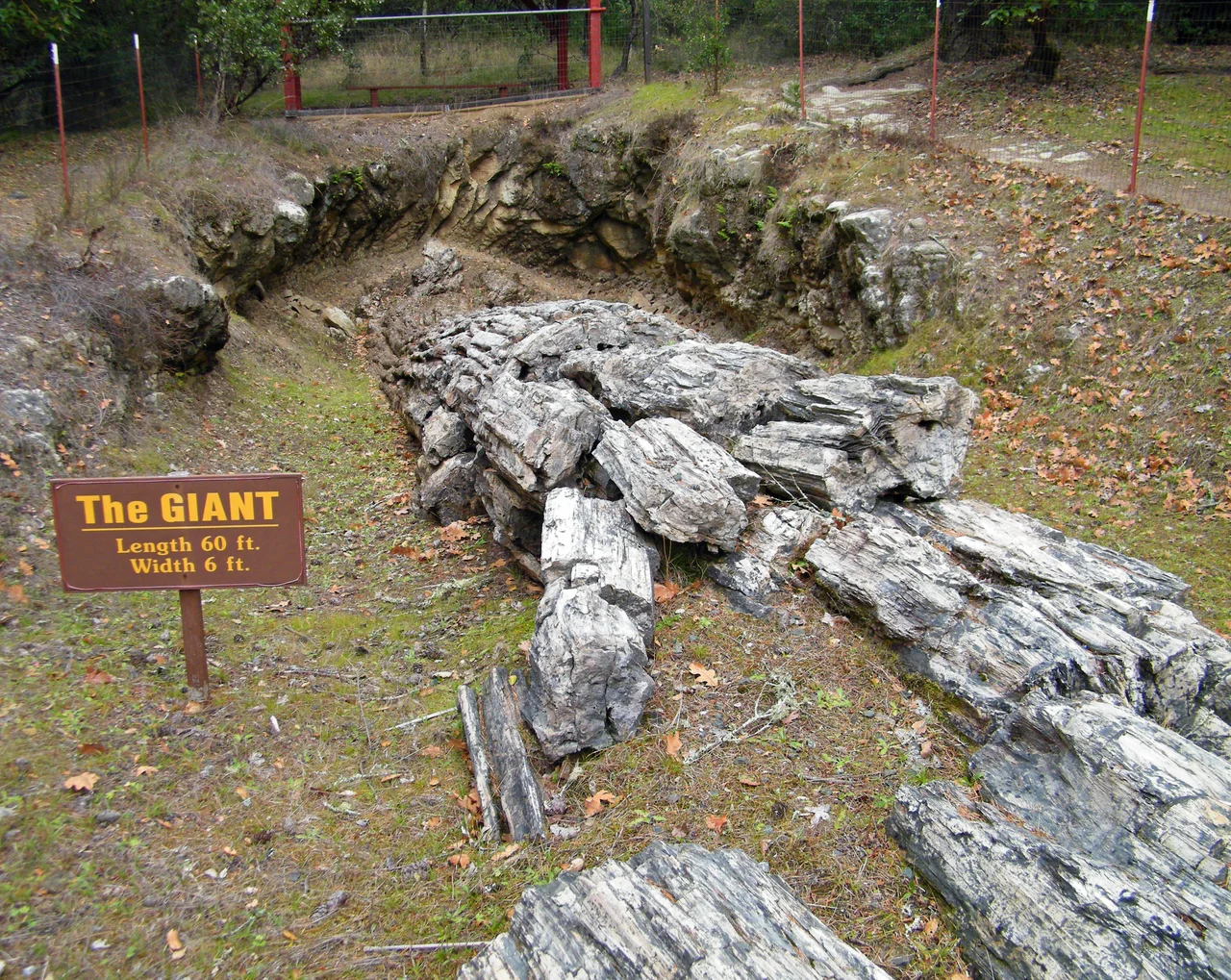
The forest's petrified trees have acquired names over the years, lending personality to what might otherwise feel like a geology exhibit. The Queen remains the centerpiece: eight feet wide, sixty-five feet long, her stone surface polished by weather and time into something that looks more like sculpture than accident. The Giant and The Pit Tree draw their own clusters of visitors. A group of trees honors Ollie Orre Bockee herself, and another carries Robert Louis Stevenson's name. The 2017 Napa and Sonoma wildfires damaged the surrounding landscape, but the forest has since been restored and reopened to the public. Walking the trails, visitors move between the living oaks and manzanitas of modern Sonoma County and the stone remnants of a forest that predates humanity by millions of years. The contrast is the point: the living trees will decay, but these stone ones have already outlasted everything that came after them.
From the Air
The Petrified Forest sits at 38.5564N, 122.639W in the hills northwest of Calistoga, Sonoma County. The site is nestled in hilly, forested terrain and is not easily distinguished from the air, but the surrounding wine country landscape of vineyards and oak-studded hills is distinctive. Best viewed at 2,000-4,000 feet AGL. The nearest airports are Sonoma County Airport (KSTS) approximately 20 nautical miles southwest and Napa County Airport (KAPC) approximately 18 nautical miles southeast. Mount Saint Helena rises prominently to the north. Morning fog can blanket the valleys below while the hilltop site remains clear.
Nearby Stories
- Bodega Head: Where Two Plates Meet 1.9 km away
- Austin Creek State Recreation Area 2 km away
- The City of San Francisco 4.4 km away
- Vallejo's Sonoma: Where California Changed Hands 5.6 km away
- The Rocky Fire: When a Water Heater Burned 69,000 Acres 5.7 km away
- From Radio Towers to Tribal College: D-Q University 9.3 km away
- The People of the Roundhouse 15 km away
- The Day Two Nuclear Bombs Fell on Yuba City 31 km away