
Four Names, Three Wars, Nine Missiles
Few military units have reinvented themselves as completely as the 851st. Activated in January 1941 as the 78th Bombardment Squadron, it flew Douglas A-20 Havocs out of Savannah, Georgia, before the United States had even entered the war. By the time it was inactivated for the last time in March 1965, it had hunted submarines in the Caribbean, bombed targets across Nazi Germany, and stood guard over nine Titan I intercontinental ballistic missiles buried in silos beneath the rolling hills north of Sacramento. The unit's story is the story of American air power itself -- improvised, reorganized, and perpetually adapting to threats that kept changing shape.
Submarine Hunters Over Warm Water
After Pearl Harbor, the squadron pivoted from training to action. German U-boats were devastating Allied shipping along the Atlantic seaboard and in the Gulf of Mexico, and the Army Air Forces scrambled every available aircraft into the antisubmarine role. The 78th traded its light bombers for Douglas B-18 Bolos and began flying patrols out of Langley Field, Virginia, then Jacksonville, Florida. In November 1942, the unit was redesignated the 7th Antisubmarine Squadron and placed under the newly created Army Air Forces Antisubmarine Command. For months, the squadron's crews flew long, monotonous patrols over the Caribbean and Gulf, scanning endless ocean for the telltale wake of a periscope. They even operated from Edinburgh Field in Trinidad. By mid-1943, the AAF and Navy reached an agreement: the coastal antisubmarine mission would transfer to the Navy entirely. The 7th's submarine-hunting days were over.
From Idaho to England
Reassigned and redesignated again -- now the 851st Bombardment Squadron -- the unit moved to Mountain Home Army Air Field in Idaho, where it formed the nucleus of the new 490th Bombardment Group. The crews trained on Consolidated B-24 Liberators through the winter of 1943-44, preparing for the strategic bombing campaign over Europe. In April 1944, the ground echelon sailed from Camp Shanks, New York, aboard the SS Nieuw Amsterdam, while the air echelon flew the southern ferry route. By late April, the squadron had settled into RAF Eye in Suffolk, England -- Station 134, its combat home for the next year and a half. From those English fields, the 851st flew missions deep into occupied Europe as part of the Eighth Air Force's relentless campaign to destroy German industrial capacity and transportation networks. The group later transitioned to Boeing B-17 Flying Fortresses. After V-E Day, the squadron returned stateside and was inactivated in November 1945.
Cold War Resurrection
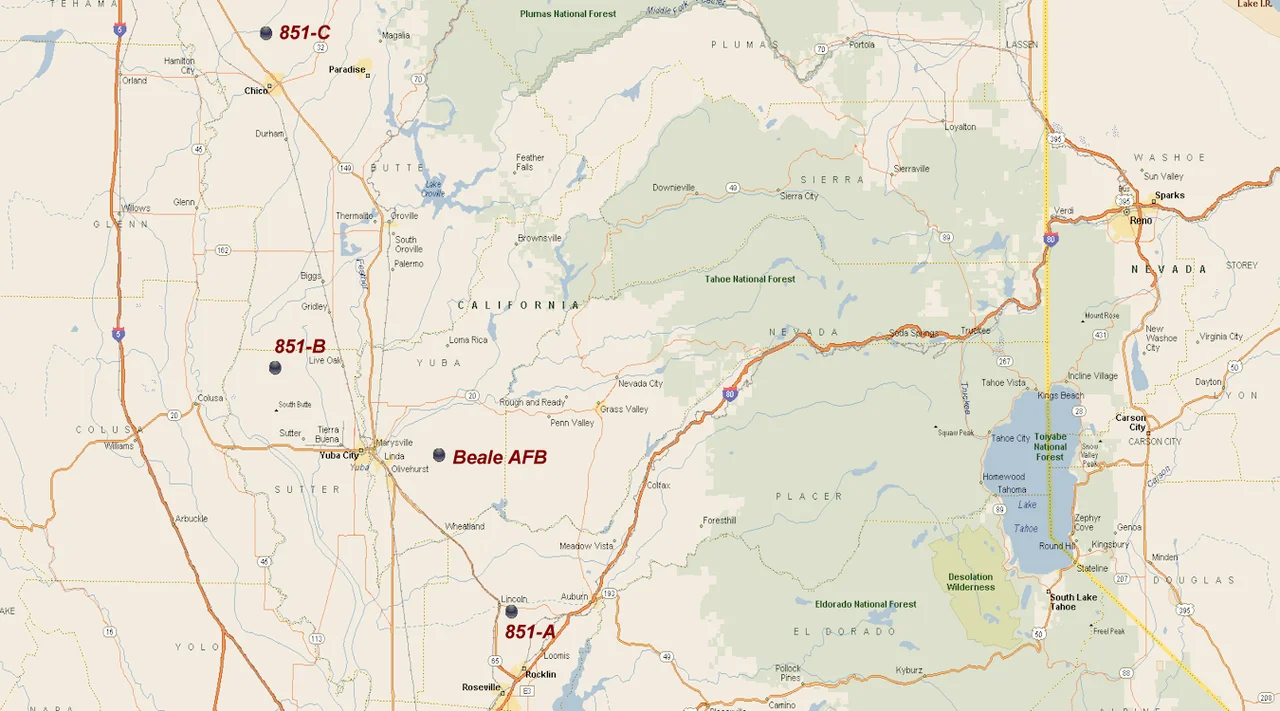
Fifteen years of silence followed. Then, in August 1960, the unit was redesignated the 851st Strategic Missile Squadron and assigned to the 456th Strategic Aerospace Wing at Beale Air Force Base, California. The mission could not have been more different: nuclear deterrence with the HGM-25A Titan I, America's first-generation intercontinental ballistic missile. Construction of the silo complexes had begun on January 22, 1960, with contractor Peter Kiewit Sons' Company winning the bid at approximately $30.2 million. Four hundred modifications later, the final cost exceeded $40 million. The squadron's nine missiles were distributed across three sites in a 3x3 configuration -- complexes near Lincoln, in the Sutter Buttes, and outside Chico, each housing three ICBMs in underground silos.
Alert Status and Accidents
The 851st was the last Titan I squadron in the Air Force to achieve full alert status, but it became the first to pass an Operational Readiness Inspection -- a point of pride for the crews who maintained and guarded these weapons. The work was dangerous. On May 24, 1962, during a contractor checkout at the Chico complex, an explosion destroyed a Titan I missile and heavily damaged its silo. Less than two weeks later, on June 6, a flash fire at another silo killed a worker. These were not abstract weapons. Each missile required a team of technicians to fuel, maintain, and keep ready for a launch order that everyone hoped would never come. The Titan I was a liquid-fueled missile, which meant it could not sit fueled in its silo indefinitely -- it had to be raised to the surface and fueled before launch, a process that took roughly fifteen minutes, an eternity in nuclear war planning.
Obsolete Before Its Time
By the early 1960s, the Titan I was already being overtaken by newer technology. The Minuteman missile used solid fuel, could be launched directly from its silo, and was ready in seconds rather than minutes. On November 19, 1964, Defense Secretary Robert McNamara announced the phase-out of all remaining first-generation Titan I missiles by June 1965. The 851st's missiles were taken off alert on January 4, 1965. The last missile shipped out on February 10. The Air Force inactivated the squadron on March 25, closing the final chapter of a unit that had spanned the entire arc of American military aviation -- from fabric-skinned attack planes to thermonuclear warheads. The silo complexes remain scattered across the Sacramento Valley, some flooded, some collapsed, all fenced off. They are Cold War ruins in the California sunshine, monuments to the years when deterrence lived underground.
From the Air
Beale Air Force Base is located at 38.88N, 121.27W, approximately 40nm north of Sacramento in Yuba County. The base's long runways are clearly visible from altitude. The three former Titan I silo complexes are dispersed across the region: 851-A near Lincoln to the south, 851-B in the Sutter Buttes to the west, and 851-C near Chico to the north. The Sutter Buttes themselves -- often called the world's smallest mountain range -- are a prominent visual landmark rising from the flat Sacramento Valley floor. Beale AFB (KBAB) is the nearest military airfield; Sacramento Mather (KMHR) and Sacramento Executive (KSAC) are to the south.
Nearby Stories
- The Only Home She Ever Owned 4.7 km away
- The Gate Between Two Rivers 10 km away
- The Middle Mountains Nobody Can Reach 15 km away
- The Image That Would Not Be Erased 17 km away
- Sutter National Wildlife Refuge 19 km away
- Donner Pass 48 km away
- New Melones Dam 81 km away