
The Roadside Stand That Fed a Queen
On March 4, 1983, California Governor George Deukmejian needed someone to cater a luncheon for Queen Elizabeth II and Prince Philip at the State Capitol in Sacramento. He chose a roadside restaurant in Vacaville. This was not as strange as it sounds. By 1983, the Nut Tree had spent six decades evolving from a humble fruit stand on the Lincoln Highway into something that defied easy description - part restaurant, part amusement park, part design showcase, part aviation hub. It was the kind of place where you could eat fresh-baked bread in a dining room with a floor-to-ceiling aviary, buy a personalized frosted honey cookie for your child, ride a miniature train to the airport, and sit in furniture designed by Charles Eames. By 1978, food critics had already declared it 'the region's most characteristic and influential restaurant.'
From Walnut to Empire
The Nut Tree's origin story stretches back further than its 1921 opening. The black walnut tree that gave the place its name grew from a nut that pioneer Sallie Fox had picked up along a trail in Arizona before arriving in Vacaville in 1859. Decades later, Helen Power grew up near that tree in Harbison House, an 1907 home on the property. After marrying Ed 'Bunny' Power in 1920, Helen opened a small fruit stand on the Lincoln Highway - then the main road across America - on July 3, 1921. By its second year, the stand was serving 950 cars per day. As U.S. Route 40 became Interstate 80, the Nut Tree grew alongside it, adding a restaurant, bakery, gift shop, toy shop, and eventually the Nut Tree Airport and the Nut Tree Railroad that connected them.
The Celebrity Table
The Nut Tree's location on the highway between Sacramento and San Francisco made it a natural rest stop, but its quality made it a destination. Ronald Reagan visited when he became California governor in 1967. Richard Nixon came through. Danny Kaye, Shirley Temple Black, Chuck Yeager, and Bing Crosby all stopped at Vacaville to eat at a place that could have been just another roadside diner but stubbornly refused to be. The guest book read like a cross-section of mid-century California: politicians, movie stars, test pilots, musicians. Beginning in 1980, the Nut Tree hosted an annual October Pumpkin Patch festival, with scarecrow contests, giant pumpkin weigh-ins, and carving competitions that drew families from across Northern California.
Designed for Delight
Ed Power took the Nut Tree's design as seriously as its menu. He hired Charles Eames - the Eames, whose molded plywood chairs are in the Museum of Modern Art - to design the furniture. Don Birrell served as design director from 1953 until his retirement in 1990, shaping the property's distinctive midcentury aesthetic. A 1957 trip to Denmark inspired Power and Birrell to model the Nut Tree's patio after the Tivoli Gardens in Copenhagen, with decorative lighting and kiosks. The Coffee Tree building, designed by architects Dreyfuss and Blackford in 1965, featured a curved roofline distinctive enough to earn coverage in Architectural Record and an AIA Central Valley Merit Award in 1967. Inside, its signature items included the 'Buddy Burger' - an oversized elongated hamburger - and the 'Ice Cream Clown,' a scoop of ice cream wearing an ice cream cone as a hat with a candy face.
The Family Feud
The Nut Tree ceased operations in 1996, brought down not by competition or changing tastes but by a family feud that ended up in court. After 75 years, the Powers' creation went dark. The closure was a genuine loss for Northern California travelers who had grown up stopping at the Nut Tree as a ritual of any Sacramento-to-San Francisco drive. The Coffee Tree - a sister restaurant where many Nut Tree employees migrated - survived until its building was demolished in 2005. Between closure and demolition, the Northern California Renaissance Fair occupied the grounds for several years, an odd afterlife for a place that had once fed a queen.
Walnut Reborn
The Nut Tree reopened in 2006 as a mixed-use development by Snell & Company, reimagined as the Nut Tree Plaza. The restored Harbison House - Helen Power's childhood home, which the original Nut Tree had opened for public tours during its final years - became a centerpiece of the development. The Nut Tree Railroad was brought back, fulfilling a condition the City of Vacaville had imposed on every would-be developer. A carousel was added. Retailers moved in. The $255 million, 71-acre master plan envisions nearly 400,000 square feet of retail, 140,000 square feet of offices, and 216 apartments. It is a lifestyle center now, which is the modern word for what happens when a place outgrows its original purpose but refuses to be forgotten. The black walnut tree is long gone, but the name it gave to a fruit stand in 1921 still marks the spot where Interstate 80 meets Interstate 505.
From the Air
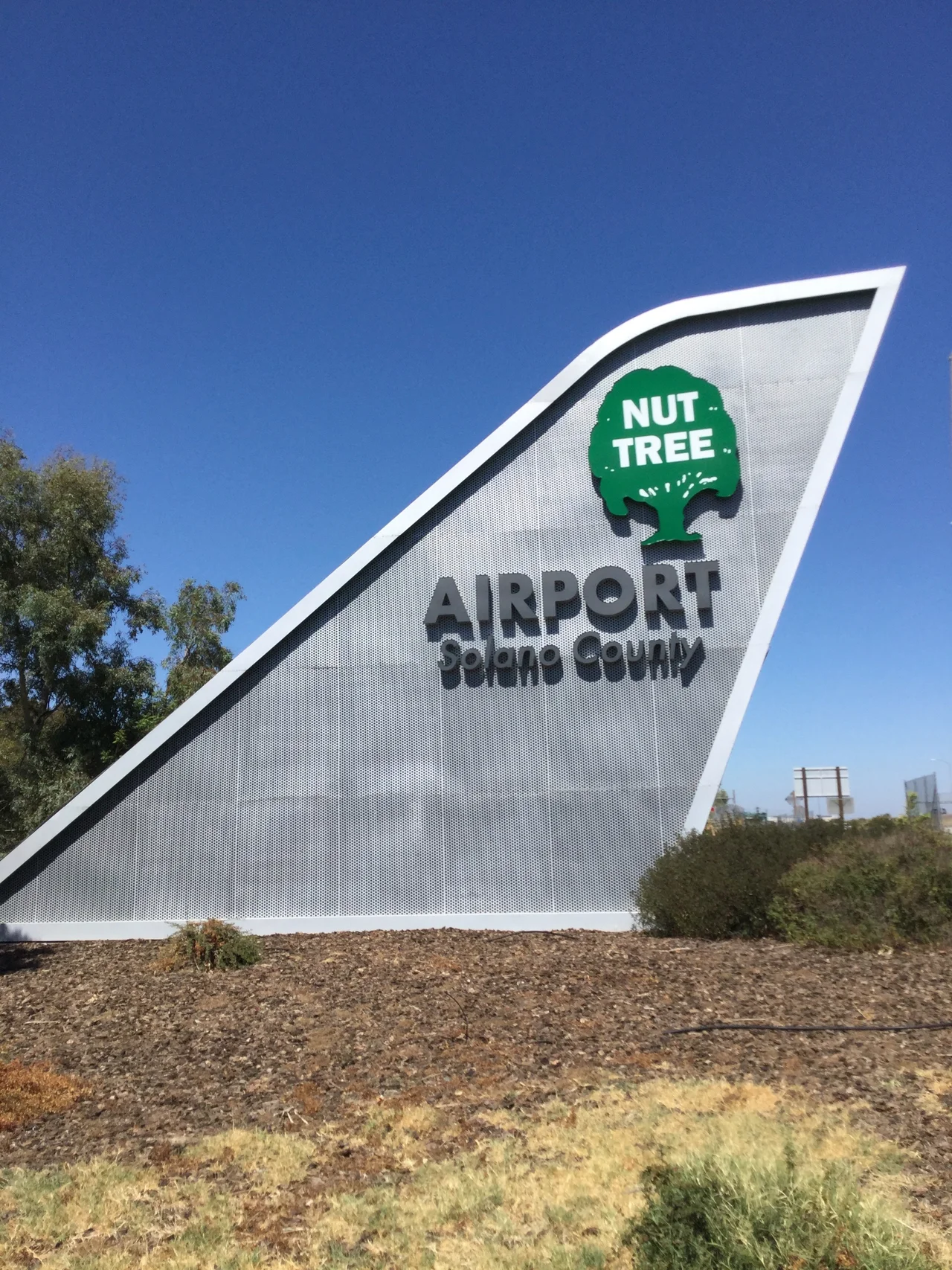
Located at 38.37°N, 121.96°W in Vacaville, California, directly adjacent to the Nut Tree Airport (VCB) at the intersection of Interstate 80 and Interstate 505. From altitude, the Nut Tree Plaza appears as a commercial development cluster along the I-80 corridor, roughly midway between Sacramento and the San Francisco Bay Area. The flat agricultural landscape of the Sacramento Valley extends in all directions, with the Vaca Mountains rising to the west. Travis Air Force Base (KSUU) is approximately 8 nm to the south. The adjacent airport, originally built to serve Nut Tree restaurant customers arriving by private plane, remains operational under Solano County management.
Nearby Stories
- Where the Linens Became Legends 1.9 km away
- Postlegate: The Scandal That Shook Poker's Trust 2.3 km away
- Griffith Mansion 6.5 km away
- California's Holland 8.8 km away
- The Canyon That Burned on Independence Day 8.9 km away
- The Shallow Sea Between Four Counties 12 km away
- Gwen Araujo and the Law She Changed 14 km away
- Emery Worldwide Airlines Flight 17 17 km away