
Where the Linens Became Legends
The signature dish arrives looking like an ice cream cone. It is not ice cream. It is a tiny tuile cornet filled with smoked salmon and creme fraiche, and Thomas Keller conceived it after a trip to Baskin-Robbins -- watching customers eat waffle cones and wondering what would happen if the cone were savory instead of sweet. That playful inversion captures something essential about The French Laundry, a restaurant where rigorous French technique meets the California instinct to question every assumption. Housed in a stone building that dates to 1900 in the tiny town of Yountville, this three-Michelin-star restaurant has been called "the best restaurant in the world, period" by Anthony Bourdain. But the building's story begins not with food at all, but with soap and steam.
Steam, Stone, and a Dry County
In 1906, a law banned the sale and consumption of alcohol in the area surrounding the Veterans Home of California in Yountville -- an irony not lost on anyone who considers the Napa Valley today. The stone building sat within this dry zone, and in 1920 John Lande bought it and converted it into a French steam laundry, the kind of commercial wash house where linens were cleaned using pressurized steam in the French tradition. The laundry operated for decades, and long after it closed, locals still called the building by that name. When Don and Sally Schmitt purchased the structure and renovated it into a restaurant in 1978, they kept the name because the building had already named itself. The French Laundry was listed on the National Register of Historic Places that same year -- recognized not for what it would become, but for the century of ordinary life its walls already contained.
Sally Schmitt's Quiet Revolution
Before Thomas Keller, before the Michelin stars and the month-long reservation waitlists, there was Sally Schmitt. She opened The French Laundry in 1978 and ran it for seventeen years with her husband Don, serving prix-fixe dinners built around whatever was local and seasonal. This sounds unremarkable now, but in the late 1970s it was radical. Most fine dining in America still looked to France for its ingredients as well as its techniques -- importing what could be imported, approximating what could not. Schmitt looked instead at the farms and gardens of the Napa Valley and built her menus from what grew there. She was a pioneer of what would become known as California cuisine, and her approach -- respecting the ingredient more than the recipe -- laid the philosophical foundation that her successor would build upon. The Schmitts sold the restaurant to Keller in 1994, passing along not just a building and a name but an idea about how food and place should relate to each other.
The Keller Years
Thomas Keller transformed The French Laundry into one of the most celebrated restaurants on earth. Every day, the kitchen produces two different nine-course tasting menus -- a Chef's Tasting Menu and a vegetarian Tasting of Vegetables -- and Keller's cardinal rule is that no single ingredient appears more than once across all nine courses. The discipline is relentless. In 1999, he published The French Laundry Cookbook, which won three International Association of Culinary Professionals awards including Cookbook of the Year. The kitchen became a proving ground for an extraordinary generation of chefs: Grant Achatz went on to open Alinea in Chicago, Rene Redzepi founded Noma in Copenhagen, Corey Lee launched Benu in San Francisco. In 2004, Keller opened Per Se in Manhattan as an East Coast counterpart, and the two kitchens remain connected by a live video feed -- a constant, silent conversation between coasts.
Thieves, Fires, and a Pandemic
Greatness attracts trouble. In July 2014, The French Laundry celebrated its twentieth anniversary under Keller with a six-hour feast, then closed for an ambitious renovation. That December, while the building stood empty, thieves broke into the wine cellar and stole an estimated $500,000 worth of wine. Most was eventually recovered, and the restaurant reopened on April 7, 2015, with staff working out of a temporary kitchen while construction continued around them. Then came the pandemic. The French Laundry closed and reopened several times under COVID-19 restrictions, navigating the same uncertainties that shuttered restaurants with far less cushion. Through it all, the stone walls of the old laundry held. The building has now outlived its original purpose by more than a century, proving more durable than any single use its owners have imagined for it.
A Very Small Town, a Very Long Wait
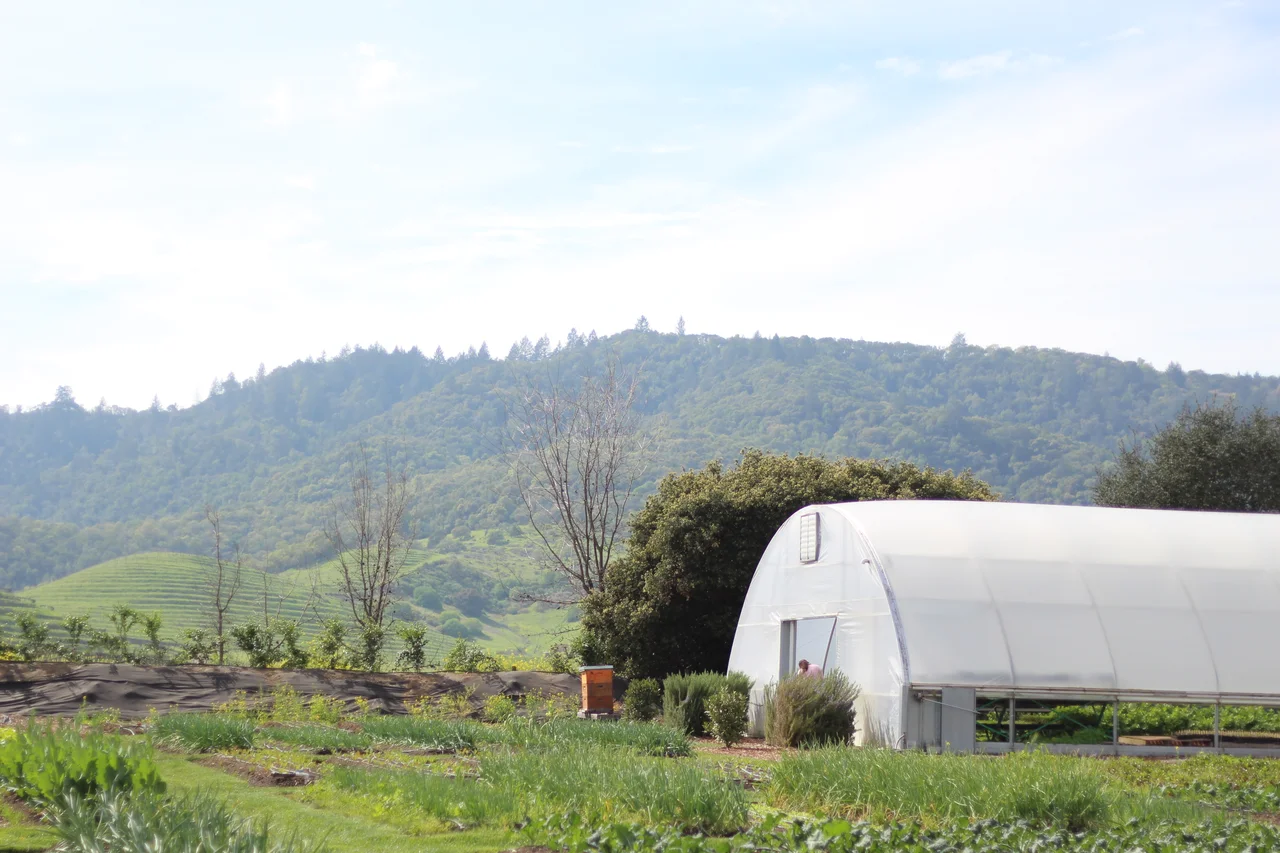
Yountville has a population of roughly 3,000 people, and on any given evening The French Laundry seats about sixty of the diners who managed to secure a reservation -- a process that requires planning weeks or months in advance. The town itself is barely a mile long, set in the heart of the Napa Valley between the Mayacamas Mountains and the Vaca Range. From the air, the vineyards stretch in orderly rows toward the valley's edges, and the restaurant is invisible among them -- just another stone building on a quiet street. That anonymity is part of the point. The French Laundry does not announce itself. It does not need a view or a skyline or a grand entrance. It trusts that the food is reason enough to come to a place most people would otherwise drive through without stopping.
From the Air
Located at 38.404N, 122.365W in Yountville, in the heart of the Napa Valley. The restaurant sits along Washington Street in a small town visible as a cluster of low buildings amid vineyard rows. Nearest airports: Napa County Airport (KAPC) approximately 8 nm south, and Angwin-Parrett Field (2O3) to the northeast. The Napa Valley corridor runs northwest-southeast between the Mayacamas Range and the Vaca Mountains, often filled with morning fog in summer that clears by midday. Yountville is identifiable from altitude by its position roughly one-third of the way up the valley from Napa.
Nearby Stories
- Sonoma Coast State Park 5 km away
- Engine Number 5 and the Tunnel That Kept Its Secret 5 km away
- The Canyon That Burned on Independence Day 6.5 km away
- Museum of the American Indian 8 km away
- California's Holland 16 km away
- Griffith Mansion 17 km away
- Where the Sheep Rancher Planted Stars 29 km away
- Cordell Bank: The Invisible Island 29 km away