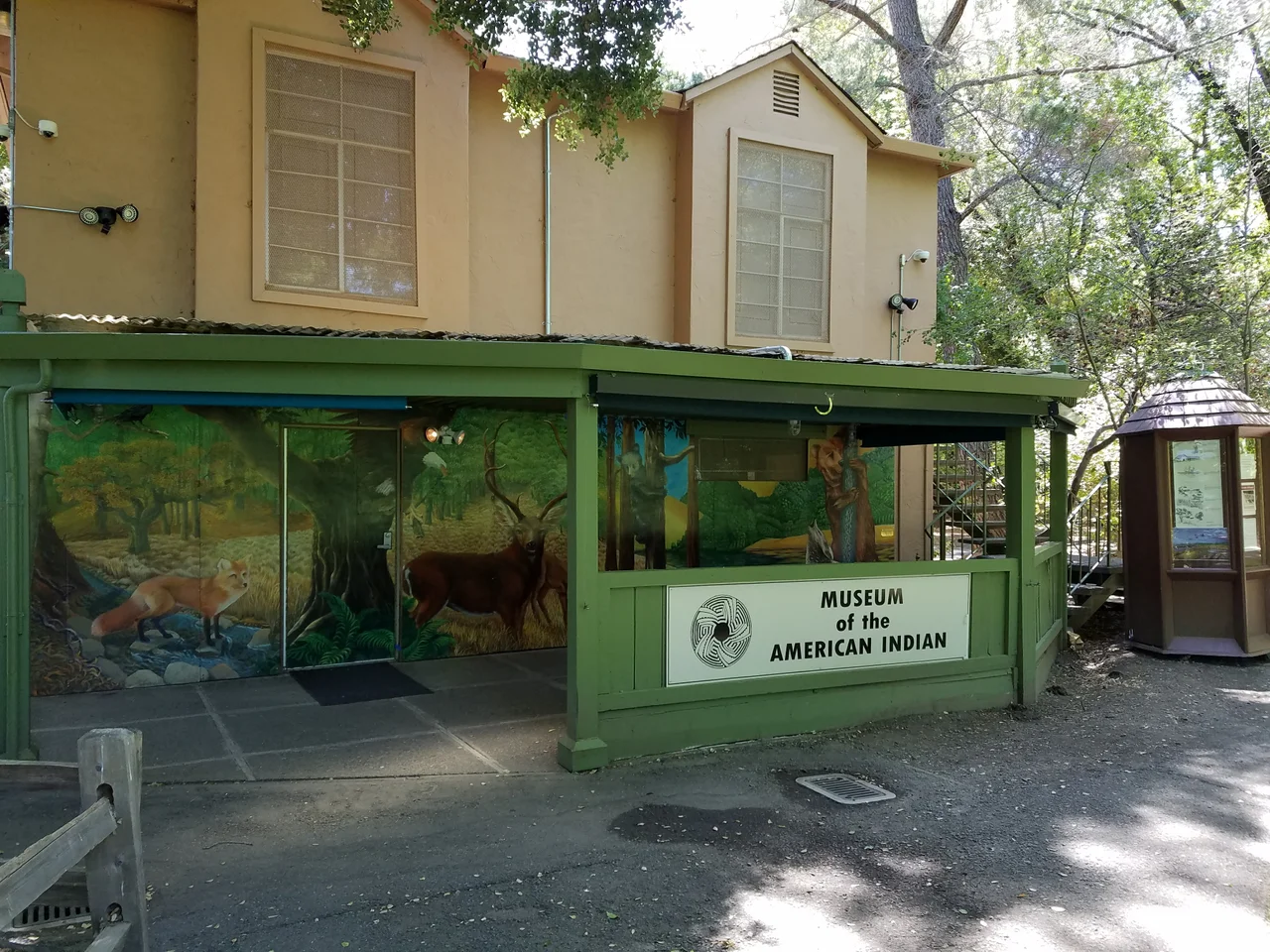

Museum of the American Indian
It started with teenagers digging in the dirt. In the mid-1960s, members of the Novato High School Archaeology Club were uncovering artifacts from a Coast Miwok settlement in northern Marin County when they realized the objects they were finding had no legal protection. Arrowheads, shell beads, bone tools -- any of it could be carted off by collectors or bulldozed by developers. So the students did something unusual: they petitioned the Novato board of supervisors to pass an antiquities ordinance. The board approved it. The club published their findings as the "Report on the Excavation of Marin-374," which earned a write-up in the December 1967 issue of Scientific American. And club member Pete Moore pushed for a permanent home for the artifacts. By the end of 1967, the Museum of the American Indian had opened its doors -- on the very site where the Miwok had lived.
Ground Beneath Your Feet
The museum sits within Miwok Park, a 35-acre stretch of grassland and oak woodland in Novato, the northernmost city in Marin County. The park's name is not decorative. The Coast Miwok people inhabited this region for thousands of years before European contact, living in villages along the coast and inland waterways of what is now Marin and southern Sonoma counties. The site designated Marin-374 in the archaeological record was one such settlement -- a place where people cooked, crafted tools, buried their dead, and conducted the daily business of living. When the Novato High School students began excavating here, they were not uncovering a distant abstraction. They were sifting through the domestic life of a community that had called this exact ground home. The museum's location gives it a quality most museums lack: the artifacts in the cases came from the soil underfoot.
From Classroom Project to Cultural Institution
The leap from high school club to functioning museum was neither obvious nor easy. The Archaeology Club's 1967 report documented their excavation methods and findings with enough rigor to catch the attention of Scientific American -- no small feat for a group of teenagers working under the supervision of their faculty advisor. Pete Moore's advocacy for a permanent collection space found support in a community that was beginning to recognize the cultural significance of what lay beneath Novato's suburban development. The museum opened modestly, focused on the local Miwok artifacts that had prompted its creation. Over the decades, the collection expanded to include Native American artifacts, paintings, and photography from across the continent. The institution has gone through name changes -- it was long known as the Marin Museum of the American Indian before adopting its current name, the Museum of the American Indian -- but its mission has remained rooted in the original impulse: preserve what the students found, and teach others why it matters.
Seven Thousand Visitors and a Trade Feast
Today, more than 7,000 people visit the museum annually. Roughly 4,000 of those visitors are school children from around the San Francisco Bay Area, arriving on field trips that connect California's fourth-grade mission unit and broader indigenous history curriculum to physical objects and living traditions. The museum is open Friday through Sunday, from 12:30 to 4:30 in the afternoon, and hosts free activities throughout the year. Its centerpiece community event is the annual Trade Feast, held in Miwok Park. The Trade Feast is not a reenactment -- it is a gathering that features indigenous dancers, basket weaving demonstrations, arrowhead knapping, children's activities, and native foods. The event draws participants from multiple tribal communities and functions as both a cultural celebration and an educational experience. In a region where the Coast Miwok presence has been largely paved over by suburban growth, the Trade Feast is a reminder that the land's longest story is not written in English.
The Miwok World That Was
The Coast Miwok were one of several Miwok-speaking peoples who occupied territories stretching from the Pacific Coast to the western slopes of the Sierra Nevada. The Coast Miwok specifically inhabited what is now Marin County and southern Sonoma County, living in small villages of dome-shaped dwellings made from willow poles and tule reeds. They fished, hunted, and gathered acorns that they processed into flour using stone mortars -- the kind of tools that turned up in the Novato High School excavation. Spanish colonization, beginning with Mission San Rafael Arcangel in 1817, devastated the Coast Miwok population through disease, forced labor, and displacement. By the time California became a state in 1850, the Coast Miwok had been largely dispossessed of their homeland. The museum in Miwok Park does not flinch from this history. It holds artifacts from a people who thrived here for millennia, and it sits on land where their presence is not metaphorical but geological -- layered into the earth itself.
From the Air
Located at 38.115N, 122.603W in Novato, within Miwok Park in northern Marin County. The park is a green expanse visible amid suburban development. Best viewed at 2,000-3,000 feet AGL. Nearest airports: Gnoss Field (KDVO) 4nm east, San Rafael Airport (CA35, private) 8nm south, Sonoma County Airport (KSTS) 20nm north, Oakland International (KOAK) 30nm southeast.
Nearby Stories
- Lands End (San Francisco) 1.4 km away
- The House That Burned Before He Could Live in It 3.9 km away
- Sonoma Coast State Park 5.9 km away
- The Roadside Stand That Fed a Queen 6.1 km away
- From Ammunition Bunkers to Cattle Country 7 km away
- Niles Canyon Railway 24 km away
- The Hole in the Head 28 km away
- ʻAkaka Falls State Park 3681 km away