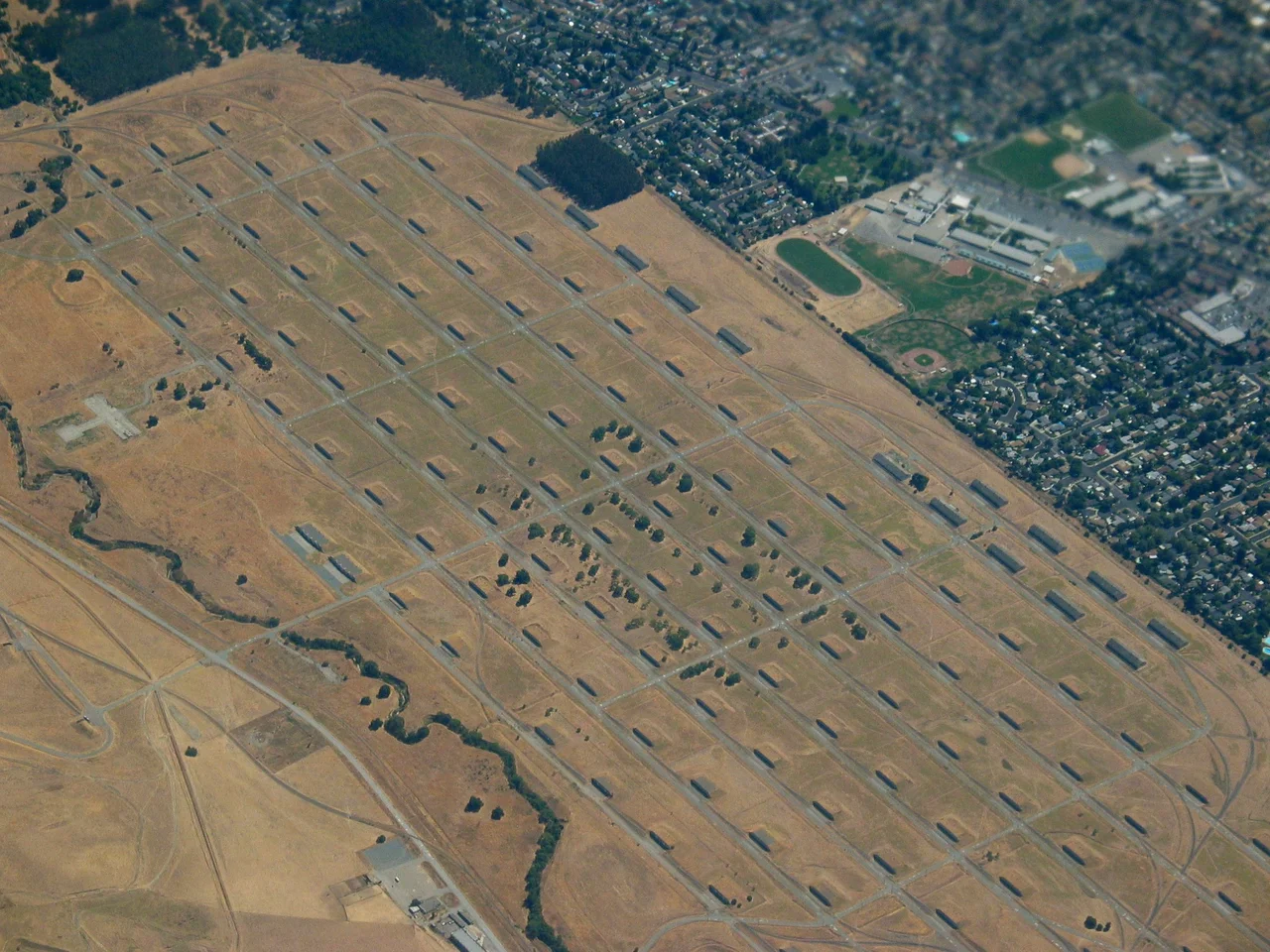

From Ammunition Bunkers to Cattle Country
On September 1, 1987, a Navy munitions train rolled toward the gates of Concord Naval Weapons Station and ran over a man sitting on the tracks. Brian Willson, a U.S. Air Force veteran turned peace activist, lost both legs below the knee, suffered a fractured skull, and became a symbol of the anti-war movement protesting American weapons shipments to Central America. In the days that followed, Jesse Jackson and Joan Baez joined thousands of demonstrators outside the base. Protesters tore up several hundred feet of Navy railroad track while police and Marines watched. It was one of the most dramatic moments in the station's history -- and the station had no shortage of dramatic moments across its six decades of operation, contamination, protest, and slow transformation into something no one who built it in 1942 could have imagined.
Arsenal on the Bay
The station opened in 1942 on the shore where the Sacramento River widens into Suisun Bay, north of the city of Concord. Its purpose was straightforward: store ammunition and supply the ships loading at nearby Port Chicago. During World War II, the base also operated a Naval Outlying Field along its southern edge, though the airfield closed after the war ended. The station's role persisted through every major American conflict of the twentieth century's second half. During the Korean War, the Vietnam War, and the Gulf War, Concord NWS processed and shipped thousands of tons of materiel across the Pacific.
By the 1990s, changes in military operations began to hollow the base out. Ammunition bunkers emptied. Warehouses stood vacant. Support structures fell into disuse. By 1999, only a minimal contingent of military personnel remained, overseeing a sprawling landscape of concrete and grass that had once hummed with wartime urgency. In 2007, the federal government announced the closure of the base's Inland Area, while the Tidal Area was reorganized as Military Ocean Terminal Concord -- MOTCO -- still operating today as the Department of Defense's primary ammunition seaport supporting the Pacific.
Tracks of Dissent
The anti-war protests of the 1980s gave Concord NWS a place in the history of American civil disobedience. Beginning in 1982, during the peak of U.S. involvement in the Central American Crisis, demonstrators staged daily protests against weapons shipments to the region, including white phosphorus munitions. The protests escalated steadily, culminating in the incident that maimed Brian Willson in 1987.
The crew of the munitions train was never criminally prosecuted; Willson filed a civil suit that ended in an out-of-court settlement. But the confrontation galvanized the movement. Throughout 1987 and 1988, protesters maintained a twenty-four-hour vigil at the tracks, blocking trains on an almost daily basis in opposition to U.S. support of the Nicaraguan Contras and Salvadoran death squads. The resulting arrests led to three separate court trials. One defendant was acquitted outright, and thirty-one others saw their cases collapse through hung juries. Many more arrests led to no charges at all -- just varying lengths of jail time with no formal prosecution.
Contaminated Ground
Decades of weapons storage left a chemical legacy. On December 16, 1994, the Environmental Protection Agency listed Concord NWS as a Superfund cleanup site. Investigators identified thirty-two contaminated areas across the facility, tainted with heavy metals -- zinc, copper, lead, cadmium, arsenic -- along with semi-volatile organic compounds and organochlorine pesticides. The contamination threatened more than human health: the endangered salt marsh harvest mouse and the California clapper rail, both dependent on the station's wetland margins, faced particular risk.
Environmental remediation began and continues, with some sites undergoing soil removal and others being capped to prevent contaminant spread. The Superfund designation would later complicate every attempt to repurpose the land, from housing developments to a 2018 proposal to build detention facilities for up to 47,000 migrants. Concord's mayor declared the site "not suitable for public habitation," and Congressman Mark DeSaulnier called the detention plan "madness." Within days, the proposal was withdrawn.
Second Lives
The base's emptiness, paradoxically, made it valuable. In 2014, the Intelligent Transportation Society of America designated the station's GoMentum Station proving grounds as a test site for self-driving cars. With 2,100 acres and 19.6 miles of paved roadway, it became the largest secure autonomous vehicle test bed in the United States. Mercedes-Benz obtained licenses to test driving technology there, including smart infrastructure like traffic signals that communicate with vehicles. The old ammunition depot roads, designed for military logistics, found new purpose guiding algorithms.
During the Cold War, parts of the station had been used for cattle grazing, and cattle still roam portions of the land today. Meanwhile, 2,216 acres were transferred to the East Bay Regional Park District in 2019, forming the core of what will become Concord Hills Regional Park. An additional 2,300 acres are slated for transfer to the city of Concord for housing, businesses, and a college campus -- though the development has stalled repeatedly, cycling through multiple developers. The weapons are gone, but the question of what replaces them remains unresolved.
From the Air
Located at 37.994N, 121.983W along the south shore of Suisun Bay, north of Concord, California. The former base is an enormous tract visible as open grassland dotted with rows of ammunition bunkers, contrasting sharply with the surrounding suburban development. MOTCO piers are visible along the waterfront. Buchanan Field Airport (KCCR) lies approximately 5 nm to the south. The Sacramento River/Suisun Bay waterway and the Benicia-Martinez Bridge provide prominent navigation references. Port Chicago, site of the 1944 explosion memorial, is immediately adjacent to the east. Best viewed at 2,000-4,000 ft AGL to appreciate the scale of the base and its rows of bunkers.
Nearby Stories
- Pier 24 Photography 4 km away
- The Shallow Sea Between Four Counties 5.5 km away
- The Pathway Home 8.4 km away
- The Spinach Riot 8.6 km away
- The Roadside Stand That Fed a Queen 14 km away
- Rancho Seco Recreational Park 17 km away
- Niles Canyon Railway 23 km away
- From Aluminum to Ammunition to Aviation Fuel 34 km away