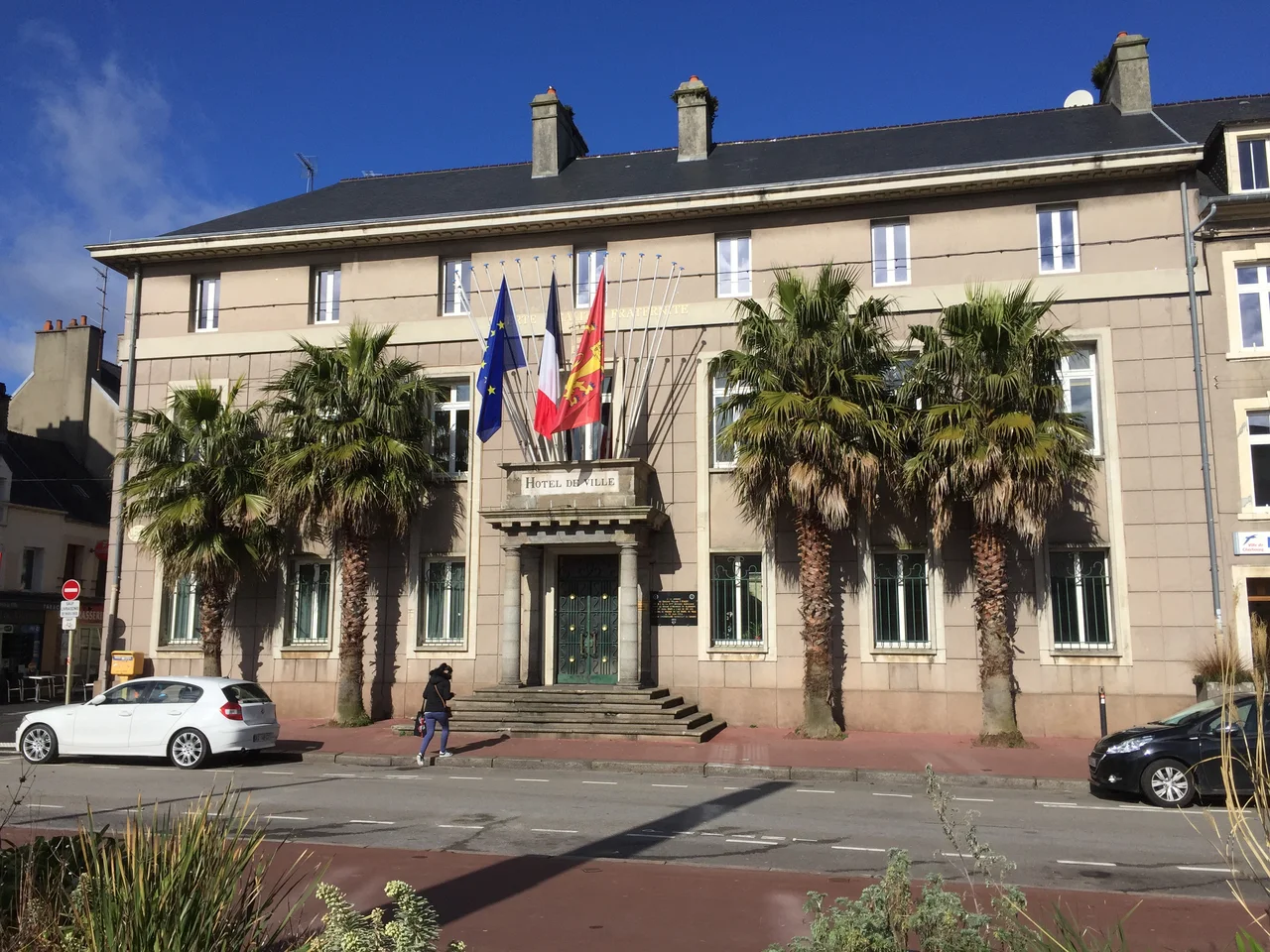

Hotel de Ville, Cherbourg
The flag came from a parachute. On 2 July 1944, six days after Cherbourg fell, Major General J. Lawton Collins climbed the steps of the Hotel de Ville and presented Mayor Paul Renault with a French tricolour his soldiers had sewn together from American parachute silk. The German colors had been hauled down. The flagpole on the building's roof needed something to fly. So American paratroopers had spread out their canopies, sorted them by color, and cut a flag.
From Basilica to Council Chamber
Cherbourg's aldermen used to meet in the Basilique Sainte-Trinite, the Holy Trinity basilica, until they moved into the Chateau de Cherbourg in 1590. The castle did not last. In 1688 Louvois, the war minister of Louis XIV, ordered it demolished, and the city's elected men spent the next century improvising. They met sometimes at the basilica, sometimes at the Hotel-Dieu, sometimes in the auditorium of the royal jurisdiction. After the Revolution they finally decided to build themselves a town hall on the west side of Place de la Republique. The building was finished in 1804, plain in its first incarnation, seven bays across the front with paired Doric columns supporting a balcony where future history would happen.
The Empress's Room
Joseph Cachin's twenty-five-foot granite obelisk went up in front of the building in 1817, commissioned by Mayor Nicolas Collart to commemorate the return of Charles Ferdinand, Duke of Berry, who had landed at Cherbourg aboard the British frigate Eurotas in April 1814. The town hall itself grew. Francois Dominique Geufroy extended it southwest along Rue de la Paix in the mid-nineteenth century, adding the council chamber, a grand salon for balls, an octagonal room, and a small salon de l'Imperatrice for the use of Empress Eugenie. She and Napoleon III visited on 7 August 1858 to open the Napoleon III basin in the harbor. The town hall hosted them. Seven years later, during the International Naval Festival of 1865, a ball at the Hotel de Ville drew about twelve hundred guests. That same year a finely carved fireplace from around 1500, salvaged when the Abbey of Notre-Dame du Voeu was demolished in 1841, was finally installed in the council chamber, where it remains.
The First American In
On the morning of 26 June 1944, the day Cherbourg surrendered, Sergeant William Finley of the US 9th Infantry Division became the first Allied soldier to reach the town hall. He was killed in subsequent fighting in the city, in the last days of resistance from Fort du Roule and the breakwater forts. A plaque inside the building remembers him by name. A week later General Collins arrived with his parachute-silk flag. Then on 20 August 1944, with the liberation of Paris three days away, General Charles de Gaulle came north. He stood on the balcony where Doric columns frame the doorway and spoke to a crowd of Cherbourgeois packed into Place de la Republique. The chairman of the Provisional Government of the French Republic, the future president of the Fifth Republic, looked out over a square that had been renamed Place du Marechal-Petain during the occupation and renamed again, on 14 July 1944, Place General de Gaulle. He was speaking from his own square.
What the Concrete Hid
In 1951 a police station inside the building closed, and the city took the opportunity to modernize the facade. The original stone front got concrete cladding. The casement windows that had looked onto Place de la Republique since 1804 were replaced. It was the kind of decision that 1950s town councils made all over France and later regretted. But the interior survived, and in 2004 the French government designated parts of it a monument historique, protecting the empress's salon, the council chamber with its fifteenth-century fireplace, and the rooms that had hosted Eugenie, Collins, de Gaulle, and a great many ordinary Cherbourgeois who had come to be married or to register a birth. The balcony is still there. So is the obelisk.
From the Air
The Hotel de Ville stands on Place de la Republique in central Cherbourg at 49.64 deg N, 1.63 deg W, two blocks back from the harbor. Cherbourg-Maupertus Airport (LFRC) lies eight kilometers east. From altitude the building reads as one element in the dense old-town grid south of the inner basin. The Cite de la Mer, the maritime museum housed in the former Art Deco transatlantic terminal, is visible along the waterfront.
Nearby Stories
- Abbey of Saint-Sauveur-le-Vicomte 4.3 km away
- Alderney Society Museum 9.3 km away
- Channel Islands 18 km away
- Operation Donnerkeil 31 km away
- German Submarine U-672 31 km away
- D-Day: The Longest Day 59 km away
- Fishbourne Roman Palace 103 km away
- Basilica of Sainte-Therese, Lisieux 110 km away