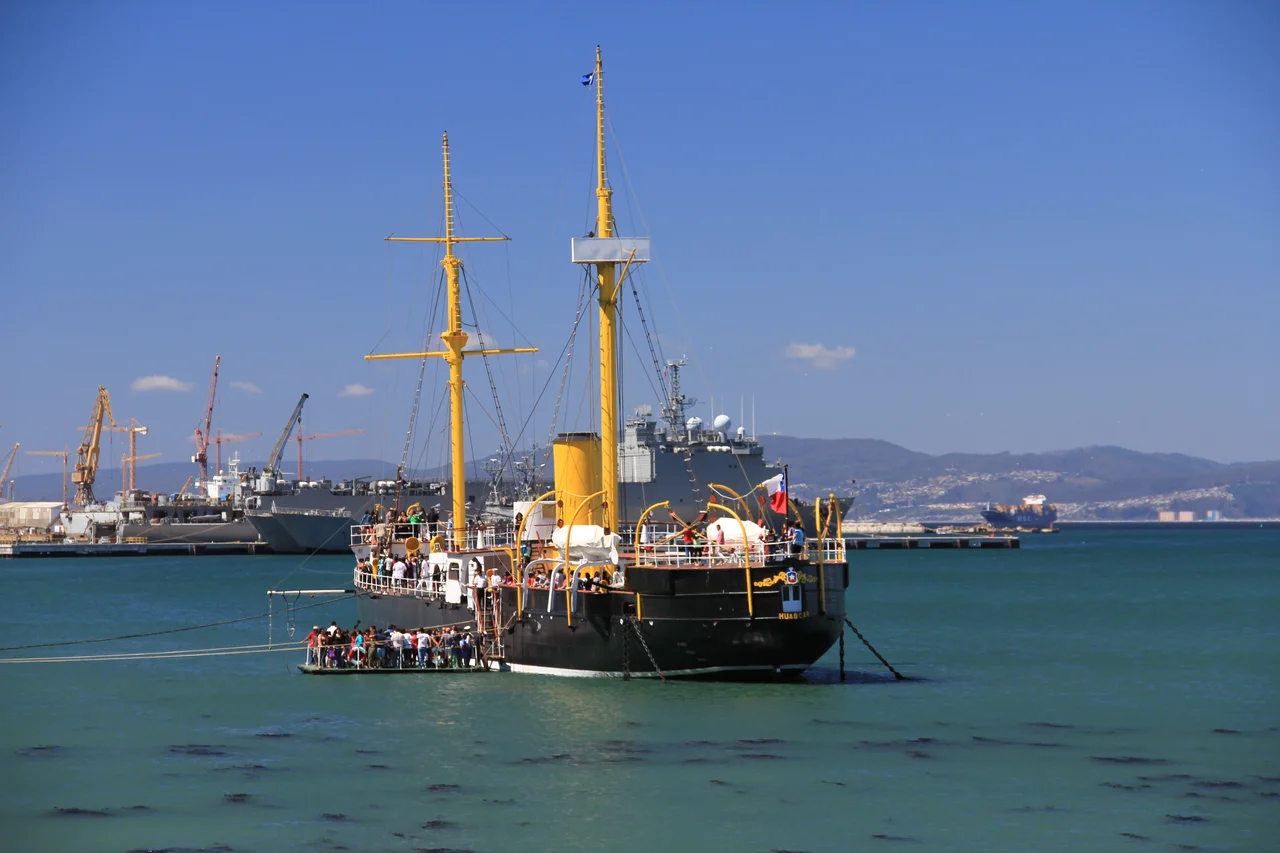

Huáscar (ironclad)
Three men died commanding her, and two countries claim her honor. The Huáscar floats today in the harbor at Talcahuano, painted in Victorian colors, her single turret and tripod foremast unmistakable against the Chilean coast. She is one of the last warships of the early ironclad age still afloat, older than nearly any armored vessel on water. But sailors do not come to see the engineering. They come because of what happened on this deck during a war the Pacific has never quite forgotten, and because the men who killed each other here are now remembered side by side.
Iron From the Mersey
She was born on the River Mersey, ordered by Peru in 1864 from the Birkenhead shipbuilders Laird Brothers for a war against Spain, and launched on October 7, 1865. For just over £81,000 Peru got something formidable for its time: an iron-hulled turret ship of roughly 1,100 tons, armored with four and a half inches of plate over a backing of teak, carrying two enormous 300-pounder Armstrong guns in a single revolving turret. Her freeboard was barely five feet, so she rode low and mean in the water, and she could make around eleven knots when her boilers were clean. The British engineer who designed her turret system, Captain Cowper Coles, praised her openly. When she finally reached Chile in June 1866, the war with Spain was already ending, and the fight she was built for passed her by.
Grau and the Knight of the Seas
In February 1868, a Peruvian officer named Miguel Grau took command and held it for eight years, longer than any captain she ever had. Those years aboard taught him every quirk of the ship, knowledge that would matter enormously when war returned. When the War of the Pacific broke out in 1879, Grau and the Huáscar became a legend in motion, raiding Chilean ports, scattering transports, and delaying a ground invasion by nearly six months while a whole navy hunted them. Grau earned a name that has outlived the war: el Caballero de los Mares, the Knight of the Seas. He earned it not only by fighting well, but by how he treated the people on the other side.
The Death of Arturo Prat
On May 21, 1879, off Iquique, the Huáscar met the old wooden Chilean corvette Esmeralda. The match was hopelessly uneven. Rather than surrender, the Esmeralda's captain, Arturo Prat, leapt onto the ironclad's deck as she rammed his ship, calling his men to follow. In the chaos almost none could; a sergeant, Juan de Dios Aldea, was among the very few who managed it, and he too was cut down. Prat was killed there, on the Huáscar, in a gesture so doomed and so brave that it made him Chile's greatest naval hero overnight. What happened next defines the ship's memory as much as the ramming. Grau ordered his crew to pull Esmeralda's survivors from the water, and later sent Prat's sword and personal effects home to the widow with a letter of condolence. Two enemies, and one act of grace between them.
Angamos
The hunt ended at Punta Angamos on October 8, 1879. Chilean ships under Commodore Galvarino Riveros Cárdenas and Captain Juan José Latorre cornered the Huáscar and pounded her for nearly three hours. A grenade struck the command tower, pierced its armor, and exploded, killing Rear Admiral Grau and the young lieutenant beside him almost instantly. With Grau dead and his crew falling, the battered ship was boarded and taken; thirty-two of her roughly two hundred sailors had died. Chile had won the sea. Yet the victors did not gloat over Grau. His memory was treated, then and since, as something both nations could mourn. Captured, repaired, and recommissioned, the Huáscar now sailed under the Chilean flag, and the war went on.
A Shrine to Three Flags' Grief
She kept fighting for Chile, and a third commander, Manuel Thomson, fell on her deck during the bombardment of Arica. Decades of service followed, then a boiler explosion, then a long second life as a museum. Restored in the 1950s to her 1897 condition and maintained ever since, she became a deliberate shrine to the glory of both navies. In the commander's quarters hang portraits of all three men who died leading her, two Chileans and one Peruvian. When the 2010 earthquake and tsunami devastated the Talcahuano naval base around her, the old ironclad rode it out undamaged and reopened within a year. She remains, in both Peru and Chile, less a trophy than a meeting place for grief and respect that crosses a border the war once drew in blood.
From the Air
The Huáscar is moored at the naval base in Talcahuano, Chile, at approximately 36.705°S, 73.111°W, on the sheltered bay just northwest of Concepción. The nearest field is Carriel Sur International Airport (ICAO: SCIE, IATA: CCP), only a few kilometers southeast on the Talcahuano isthmus, which doubles as Concepción's airport and a Santiago alternate. From the air, look for the Talcahuano naval harbor and shipyards on the bay; the ironclad sits berthed among naval facilities, a small dark hull with a single central turret and a distinctive tripod mast, painted in light Victorian-era colors. The Bío Bío coast, the bay of Concepción, and the San Vicente peninsula are strong orienting features. Coastal stratus and winter fronts often limit visibility, so a clear, post-frontal day is best; recommended viewing altitude 1,500 to 3,000 feet AGL over the harbor.
Nearby Stories
- Battle of El Roble 12 km away
- Santa María Island, Chile 16 km away
- El Chiflón del Diablo 26 km away
- 2010 Chile Earthquake 30 km away
- HMS Monmouth (1901) 43 km away
- Tucapel 59 km away
- Parral, Chile 59 km away
- 1687 Peru Earthquake 2366 km away