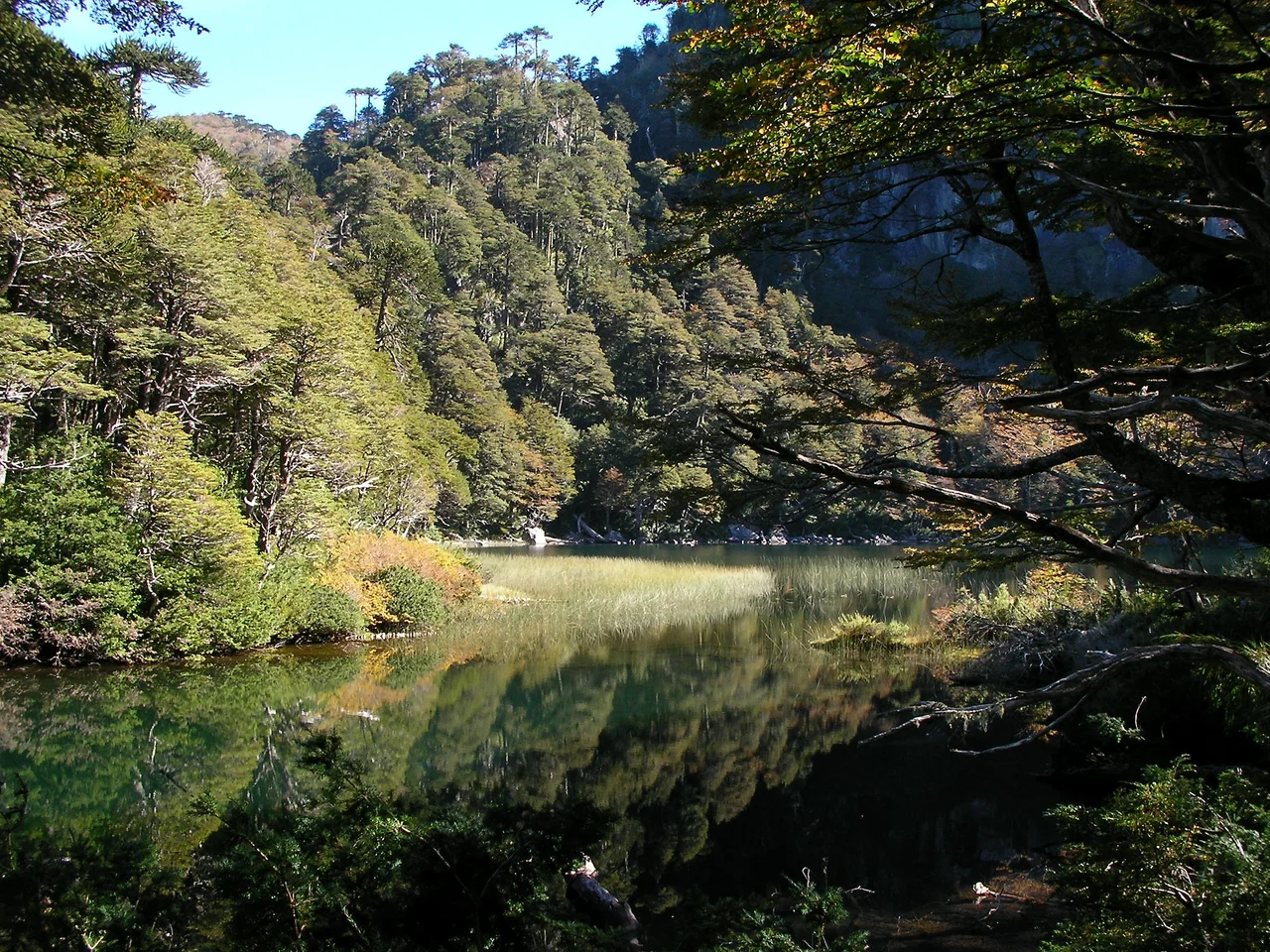

Huerquehue National Park
Huerquehue means "the place of the messenger" in Mapudungun, the language of the Mapuche. It is a fitting name for a park that feels like a dispatch from a much older world. Climb its trails above Lake Tinquilco and the forest changes around you, until you are standing among monkey puzzle trees that were already ancient when the Spanish first reached these mountains, their stiff reptilian crowns held against the Andean sky.
Above the Lake District
The park lies in the foothills of the Andes, about 33 kilometres east of the resort town of Pucon and deep in the Valdivian temperate rainforest. It covers 125 square kilometres of mountainous terrain east of Caburgua Lake, climbing from around 720 metres to 2,000 metres above sea level. That vertical sweep is the whole story here. Lower down, the forest is dense and dripping; higher up, it opens into stands of araucaria and the clear cold lakes that give the park its character. Tinquilco Lake sits in the lower reaches, the gateway through which most visitors enter.
A Park Older Than Its Founding
Huerquehue was formally created on June 9, 1967, but its conservation roots reach back further. In 1912 Chile established the enormous Benjamin Vicuna Mackenna Park, also called Colico, which sprawled across 265,000 hectares of this region. Over the following decades that vast holding was carved up into the various parks and reserves that protect the area today, and Huerquehue is one of its descendants. The land has, in other words, been valued and guarded for more than a century, even as the lines on the map were redrawn around it again and again.
The Ancient Pewen
The park's defining feature is its forest of araucaria, the tree the world calls monkey puzzle and the Mapuche call pewen. These are living fossils. Plants nearly identical to them grew 200 million years ago, in the age of dinosaurs, and a single tree can live more than a thousand years. Their seeds sustained the Pehuenche people for generations, whose name means "people of the pewen" and who held the tree as sacred. Today the araucaria is classified as endangered, its forests thinned by logging, fire, and grazing across its range. Standing among Huerquehue's ancient pewen, you are looking at survivors of one of the longest-running stories in the plant kingdom.
Water Everywhere
Huerquehue is a park of water as much as of trees. Rain falls heavily from May through September, more than two metres of it in a year, feeding twenty separate lakes and ponds scattered across the heights. Beyond Tinquilco and Verde lie the small lagoons the locals named one by one, Los Patos, Escondida, Clara, Las Avutardas, Los Condores. Streams thread between them and drain eventually into the Tolten River system. The effect, on a still morning, is a landscape of mirrors, each pool holding a reflected stand of araucaria and a doubled patch of sky.
Small Survivors
The forest shelters creatures as rare as its trees. The pudu, the world's smallest deer, picks its way through the undergrowth, and the guina, a small spotted wildcat, hunts unseen. Overhead the Andean condor and the Magellanic woodpecker share the airspace, while the choroy parakeet chatters through the canopy. Most precious of all is Darwin's frog, a tiny amphibian in which the male carries the developing young inside his vocal sac until they emerge fully formed. To hike Huerquehue's trails, open all year, is to move through a refuge for the small, the ancient, and the easily lost.
From the Air
Huerquehue National Park lies at 39.14 degrees south, 71.67 degrees west, in the Andean foothills of Chile's La Araucania Region, about 33 km east of Pucon and 145 km southeast of Temuco. Elevations range from roughly 720 to 2,000 meters. The best visual reference is the glacier-capped cone of Villarrica volcano (2,847 m), one of Chile's most active, about 30 km to the southwest; Caburgua Lake sits just west of the park. A viewing altitude of 7,000 to 9,000 feet captures the lake-dotted high forest and the surrounding peaks. The nearest major airport is La Araucania International (ICAO: SCQP) near Temuco, roughly 130 km west-northwest. Expect heavy rainfall and low cloud from May through September; clearest conditions come in the austral summer, December through March.
Nearby Stories
- Villarrica National Park 20 km away
- Villarrica 21 km away
- Conguillío National Park 22 km away
- Cerro Ñielol Natural Monument 43 km away
- Riñihuazo 56 km away
- Vaca Muerta 76 km away
- Zapala 85 km away
- Kelenken 195 km away