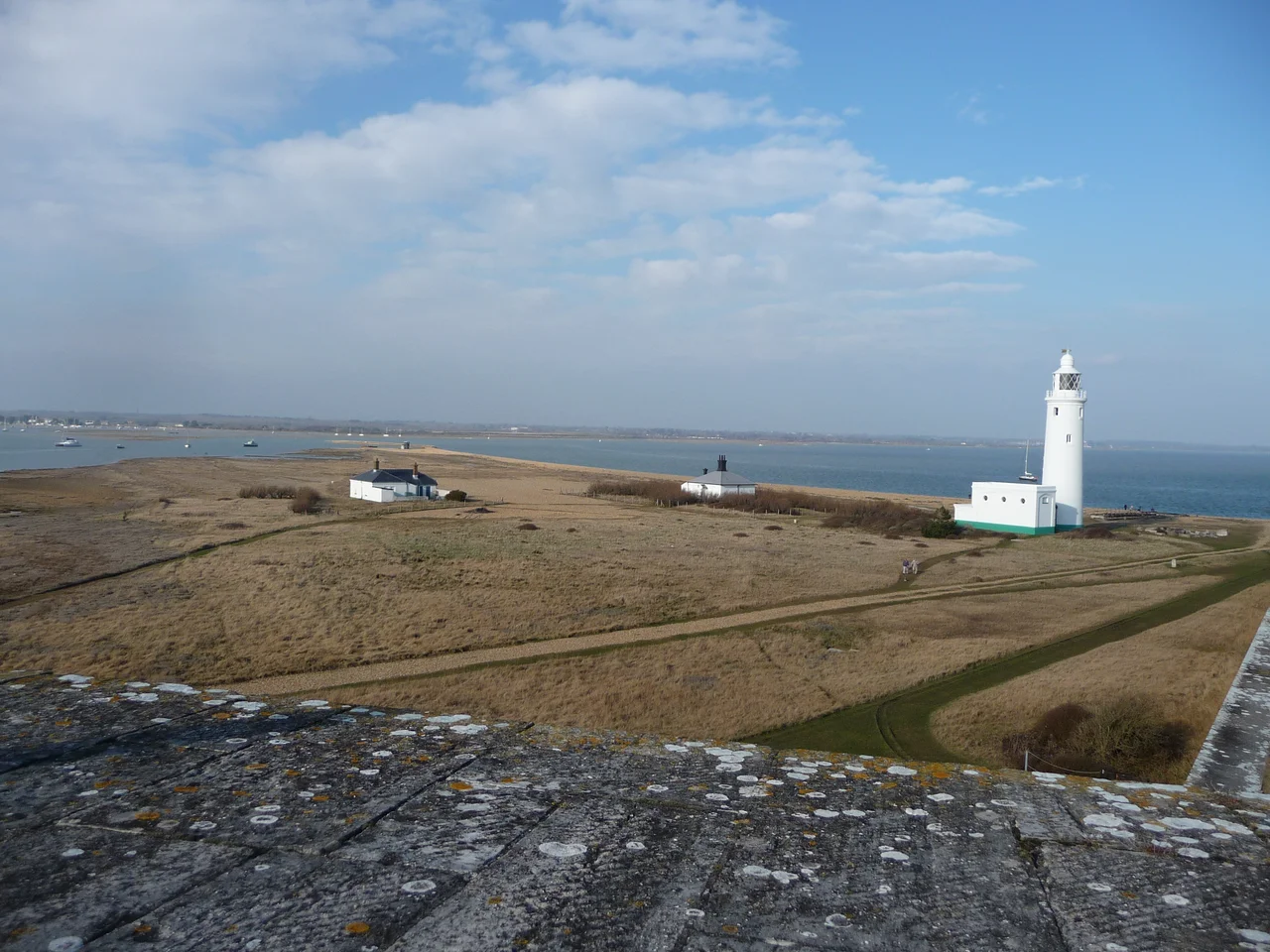

Hurst Point Lighthouse
On the night of 29 September 1786, three Trinity House lighthouses were lit for the first time along the western approaches to the Solent: one on the clifftop above The Needles, one on St Catherine's Down, and one at Hurst Point on the long shingle spit reaching out from the Hampshire coast. The Hurst Tower was a red brick lighthouse designed by Richard Jupp, sited just south-west of the medieval Hurst Castle. Sailors heading into Portsmouth or Southampton, navigating one of the most dangerous channels in southern England, finally had something to steer by. The principle was sound. The execution, the Trinity Brethren soon discovered, needed work.
The Problem of the Needles
From certain angles in the channel, the Hurst Tower's light was obscured behind the chalk pinnacles of The Needles themselves. A lighthouse hidden by the rocks it was meant to warn you about is not much use. In 1812, a second tower was built at a higher level above the original. Together, the two functioned as leading lights: two beacons stacked vertically, which a navigator on the bridge of an approaching ship could line up to know they were on the safe course through the Needles Channel. Both towers were equipped with three Argand lamps and reflectors. The Low Lighthouse had its main lamp angled toward the channel, while a separate lamp in its lantern room shone the other way to guide vessels along The Solent. Each tower had a keeper's cottage attached. For half a century the system worked.
Rebuilt for the Castle
Between 1865 and 1873, Hurst Castle itself was substantially expanded, partly to defend against a feared invasion by Napoleon III's France. The lighthouses had to come down. In 1865 a new Low Light was built, a white circular granite tower with a red lantern, this time attached directly to the new curtain wall of the castle. In 1867 a new High Light followed, designed by the great Victorian lighthouse engineer James Douglass. The lights were similar in character to the old ones, but now the light directed up the Solent shone from the High rather than the Low lighthouse. The geometry of the leading line remained: line up High above Low, and you were safe.
Borrowed Lenses
In the 1890s the High Light was given a complex new array of fixed first-order Fresnel lenses, with a Douglass-designed six-wick lamp at the centre. The contemporary plans displayed in the small museum inside Hurst Castle show something extraordinary: the new lenses were not new at all. One panel had been taken from the first-order dioptric apparatus formerly used at St Catherine's Lighthouse, on the Isle of Wight. Another came from the central section of the old Bishop's Rock apparatus, far out among the Isles of Scilly. Three sets of upper prisms also came from St Catherine's. All these lenses had been replaced at their original lighthouses by newer technology a few years earlier, and rather than discard the older glass, Trinity House had moved it to Hurst. One panel was positioned to align with the Low Light and provide the transit through the Needles Channel; another covered the arc between the outer Needles Rock and Sconce Point. The light from the panel inland was eclipsed for two seconds every ten seconds by a complex occulting mechanism.
Acetylene and the Sun Valve
In 1923 both Hurst lights were automated. An acetylene lamp was installed, controlled by a sun valve: a brilliant Swedish invention that used the differential absorption of sunlight by blackened metal to open the gas supply automatically at dusk and close it at dawn. Calcium carbide and rainwater were fed into a producer plant near the lighthouse, generating acetylene gas on site. The plant ran until 1968, when it was decommissioned and replaced by bottles of gas brought in by Trinity House vessels. By that time, the lighthouse keepers who had lived in the attached cottages for over a century were gone. A small museum is maintained in the casemates of Hurst Castle by the Association of Lighthouse Keepers, preserving the history of an occupation that has now been almost entirely automated away.
Three Towers on a Spit
Both the 1866 Low Light and the 1911 Low Light remain in place, decommissioned but standing. They have been painted grey, to camouflage them against the granite of the castle wall and prevent confusion for mariners trying to identify the working light. The 1911 lantern still contains its old lamp and lens. The High Light continues to operate. The arrangement at Hurst Point is a layered archaeology of British lighthouse engineering: an 1867 high tower lit through 1890s lenses scavenged from earlier lighthouses, with two superseded low towers preserved in place as silent witnesses, all clustered against a Tudor castle expanded for a Victorian invasion that never came. Ships still line up the lights to thread the Needles Channel. The principle that Richard Jupp tried to apply in 1786 still works, after two and a half centuries of trial and refinement, on the spit that reaches out toward the Isle of Wight.
From the Air
Located at 50.71 degrees North, 1.55 degrees West, at the end of the Hurst Spit reaching south-westward from the Hampshire coast toward the Isle of Wight. The lighthouse stands attached to Hurst Castle, with the Needles Channel and The Solent immediately to the south. Bournemouth Airport (EGHH) is 12 nm west. Southampton (EGHI) is 14 nm northeast. From 2,000 to 4,000 feet on a clear day the long shingle spit, the castle and the lighthouse stand out clearly against the open water.
Nearby Stories
- Romsey Abbey 5.8 km away
- Shaftesbury Abbey 7 km away
- The Tank Museum 9.7 km away
- HMS Warrior (1917) 12 km away
- Fishbourne Roman Palace 22 km away
- Farnham 32 km away
- Operation Donnerkeil 58 km away
- D-Day: The Longest Day 145 km away