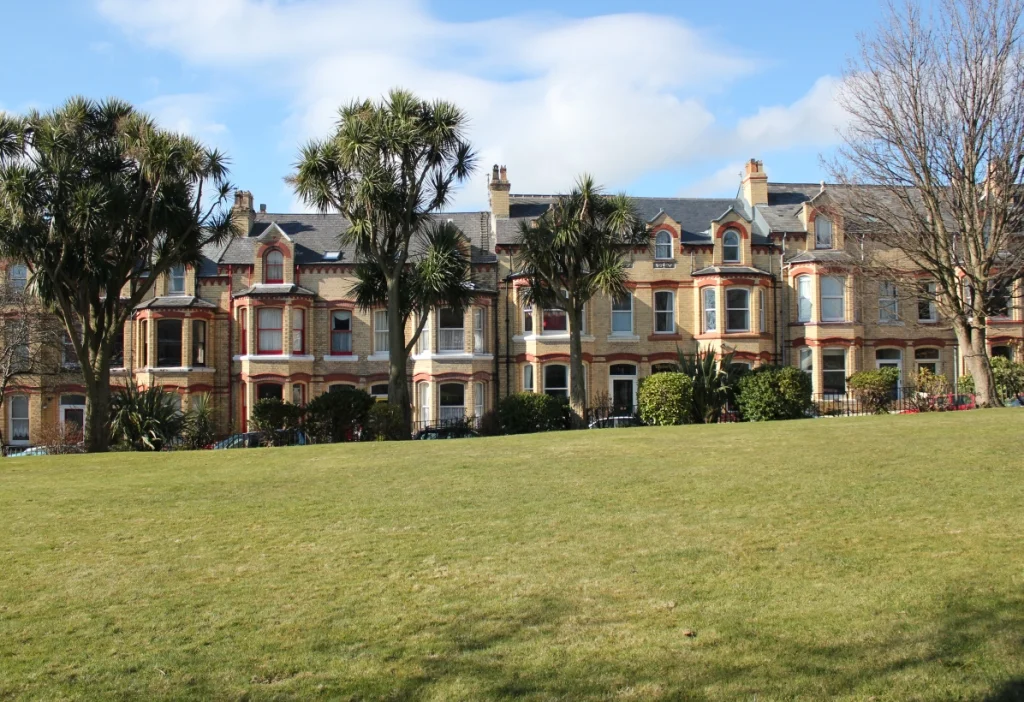

Hutchinson Internment Camp
In the summer of 1940, with Britain expecting invasion, the government interned thousands of so-called 'enemy aliens' on the Isle of Man. Most were German and Austrian. Many had fled Hitler. Some had been in Britain for years. They were rounded up almost indiscriminately, anti-Nazis and Jewish refugees alongside the actual handful of fascist sympathisers, and shipped to Douglas. There they were housed behind barbed wire on Hutchinson Square: 39 ordinary boarding houses around a small green, with their tenants compulsorily evicted to make room. By the end of July, 1,205 men were sharing beds inside that fence. Among them were some of the most important artists, scholars, and intellectuals of mid-century Europe.
Behind the Wire
Hutchinson Camp opened in the second week of July 1940. Two barbed wire fences ringed the square, an arrangement first developed at Mooragh Camp in Ramsey. The houses were given administrative roles: leaders, cooks, cleaners, kitchen staff. Hutchinson made one quiet refusal of military language. Where the British guards proposed the title 'Camp Captain,' the internees insisted on 'Camp Leader' or 'Camp Father.' Major H. O. Daniel commanded the camp until he was promoted elsewhere, and was, by the testimony of internees themselves, a humane figure who made much of the camp's later cultural life possible. He took most of the surviving 150-odd photographs of camp life, now in the Tate Archive. The unusually high proportion of Jewish and anti-Nazi internees at Hutchinson would shape what happened next.
A University Behind the Fence
Within weeks of the camp opening, the internees set up their own university. The men inside were scientists, mathematicians, lawyers, philosophers, writers, artists, linguists, and much else. Most had been carrying their disciplines as identity for decades and saw no reason to stop. A lecture house was set up on the north side of the square; in good weather classes were held on the lawn. One observer remembered the daily ritual: 'Every evening one could see the same procession of hundreds of internees, each carrying his chair to one of the lectures, and the memory of all these men in pursuit of knowledge is one of the most moving and encouraging that I brought back from the strange microcosm in which I lived for so many months.' Working with locally sourced ingredients, they ate Manx kippers, which someone, with very dark humour, took to calling 'Yom Kippur.'
Painting With Sardine Oil
Hutchinson is now best known as the camp where Kurt Schwitters lived for sixteen months, where Fred Uhlman produced almost a painting a day, and where Klaus Hinrichsen ran the cultural department. Materials were scarce. The internees improvised: brick dust mixed with the oil from sardine cans for paint, clay dug up on supervised walks for sculpture, lino ripped from floors and pressed through clothes mangles to make linocut prints. Schwitters, the great Dadaist, built three sculptures out of porridge for want of plaster of Paris. The porridge developed mildew and the figures sprouted greenish hair and 'bluish excrements of an unknown type of bacteria,' as one room-mate remembered. The camp's first art exhibition took place that summer; a second, in November, included Schwitters and others selling work to fellow internees for modest fees. Major Daniel eventually obtained proper supplies and gave Schwitters and the sculptor Paul Hamann studio space. Music was scarce but loved. Bach, Mozart, Schubert, Beethoven, and Brahms ran through the rooms.
What the Show Concealed
The energy of camp life made it easy for outsiders to assume the internees were enjoying themselves. They were not. Helmuth Weissenborn, the painter, later said simply: 'Internment was a continuous torment.' Schwitters in particular tried hard to project cheer; in private with his son he revealed his real disillusionment. An epileptic condition that had not surfaced since his childhood returned. His son recorded the strain: 'For the outside world he always tried to put up a good show, but in the quietness of the room I shared with him, his painful disillusion was clearly revealed to me. Kurt Schwitters worked with more concentration than ever during internment to stave off bitterness and hopelessness.' These were men whose homes had already been taken once by the Nazis, now confined again by the country that had supposedly given them refuge.
Closed, Remembered
The camp produced its own English-language newspaper, The Camp, written by and for the internees. It carried stories, reviews, editorials, and news from the island and the wider war. There were no illustrations, despite the artistic wealth a few houses away, unlike the Onchan Pioneer produced at the camp further north. Hutchinson closed in March 1944, its remaining 228 inmates transferred to Peveril Camp in Peel so that Hutchinson could be turned over to prisoners of war. Many internees had already been released long before that; others would not see Britain proper again for years. The story has been told properly in Simon Parkin's 2022 book The Island of Extraordinary Captives, which won the 2023 Wingate Prize and follows Peter Midgley, born Peter Fleischmann, who was interned at seventeen and learned to paint at Hutchinson under Schwitters' eye. The square is still there. The houses are still there. The fence is gone.
From the Air
Hutchinson Square sits at 54.1603°N, 4.48°W in central Douglas, a few blocks inland from the promenade and close to Broadway. Best viewed from 1,500–2,500 feet AGL; the square is a small green ringed by Victorian terraced houses, north-east of the Sea Terminal and harbour. Nearest airport is Isle of Man / Ronaldsway (EGNS), about 8 nm south. Onshore winds and frequent rain are typical of the Irish Sea coast.
Nearby Stories
- St Bees Lighthouse 15 km away
- Celtic Array 22 km away
- Kirkmaiden 23 km away
- Isle of Whithorn 23 km away
- Seascale Lifeboat Station 31 km away
- German submarine U-1024 36 km away
- SS Georgetown Victory 40 km away
- Blackpool Illuminations 56 km away