
Ilkurlka Community, Western Australia
To win their country back, the Spinifex People painted it. In 1997, senior men and women of the Pila Nguru sat down to two enormous canvases - one worked by the men, one by the women - and laid out their homeland in ochre and line: birthplaces, waterholes, and the Tjukurrpa, the ancestral law written into the land itself. These were not gallery pieces. They were evidence, prepared for a court, an argument that this desert had never stopped being theirs. Near the centre of the country those paintings described stands Ilkurlka: a roadhouse, an outstation, and a cultural centre - small enough to miss, and standing for something very large.
A People of the Great Victoria Desert
The Spinifex People - Pila Nguru, the people of the spinifex grass - have belonged to this stretch of the Great Victoria Desert for thousands of years, among the longest continuous human connections to any landscape on Earth. They are a desert people in the fullest sense, with knowledge of water and country tuned to one of the harshest environments on the planet. Ilkurlka takes its name from a large U-shaped rockhole nearby, a feature so significant it was painted into the works that would later hang in the British Museum. For the Pila Nguru, the desert was never empty space to be crossed. It was home, mapped in memory and song long before any surveyor came to draw a line across it.
Driven Out, and the Long Road Home
In the 1950s, the Spinifex People were forced from their lands. The British nuclear tests at Maralinga and Emu Field, on the desert's southern edge, made parts of the country dangerous and the authorities moved people away - many to Cundeelee Mission, far to the west. It was a displacement they had not chosen, from a homeland they had never relinquished. Among the last to leave were people who walked out of the desert as late as the 1980s, some of the final Aboriginal Australians to make first contact with the settled world. But they did not forget the way back. Beginning in the 1980s, Spinifex families turned around and went home, establishing outstations, sinking bores for water, and re-rooting themselves at Tjuntjuntjara - now one of the remotest communities in the country - and here at Ilkurlka.
The Land Returned
The painted canvases did their work. The Spinifex People lodged a native title claim in 1995, and on 28 November 2000, at Tjuntjuntjara in the heart of their own country, the Federal Court recognised their rights over roughly 55,000 square kilometres of the Great Victoria Desert - an area larger than many nations. The two collaborative paintings were woven into the formal land agreement itself, a rare moment in which a people's art became, quite literally, the legal record of their belonging. Ilkurlka sits near the centre of those recognised lands. The roadhouse you can drive to today is built on country that the law now affirms was never anything but Spinifex - a recognition that arrived late, but arrived.
Open on the Anne Beadell
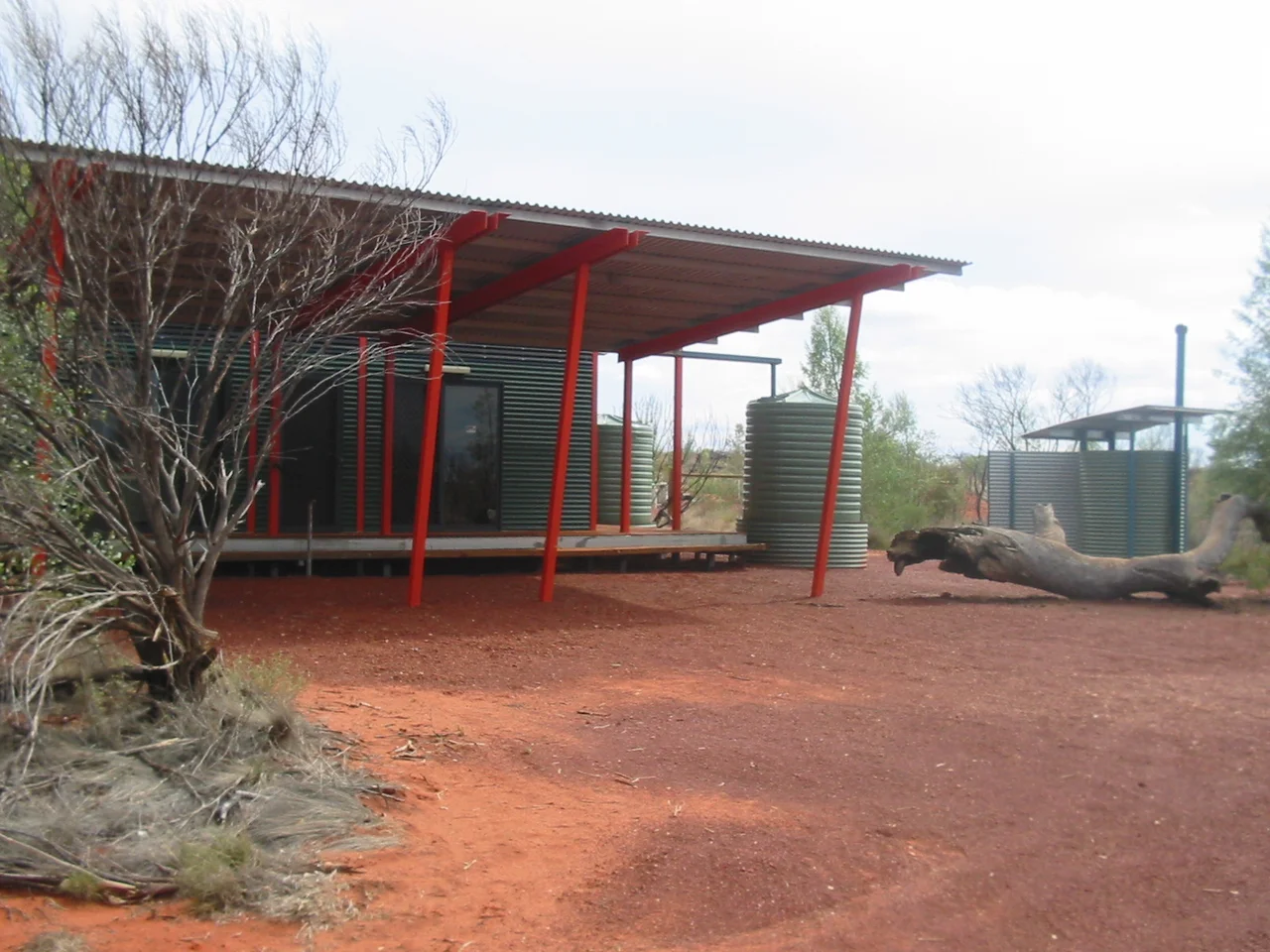
The Spinifex People built the Ilkurlka roadhouse in 2003, planting an outpost of fuel, water and welcome on the lonely Anne Beadell Highway - the rough desert track surveyed in the 1950s and 60s by Len Beadell and named for his wife. Run by the Ilkurlka Aboriginal Corporation on behalf of the traditional owners, the roadhouse exists chiefly to serve the Aboriginal communities to the north and south, Tjuntjuntjara among them, though the occasional dusty traveller crossing the desert is glad of it too. There is a studio for visitors built on a hilltop, a campsite with a hot shower and a covered barbecue, an airstrip, and a small gallery. On its wall hangs a photograph of the Spinifex artist Simon Hogan shaking hands with King Charles - then a prince - a quiet emblem of how far this desert people's art has travelled, and how firmly they have come home.
From the Air
Ilkurlka lies at 28.38°S, 127.50°E in the Great Victoria Desert, on the Anne Beadell Highway in remote eastern Western Australia. There is a small airstrip at the community itself; confirm its serviceability and obtain the traditional owners' permission before any visit, as this is recognised Spinifex (Pila Nguru) native title land. From the air, look for the thin scratch of the Anne Beadell Highway crossing endless red dunefields and spinifex - the roadhouse cluster is one of the only built features for hundreds of kilometres. This is some of the most isolated country in Australia, with no nearby alternates; carry full fuel reserves, water, and survival equipment. Expect clear skies, intense visibility, high summer heat, and the occasional thunderstorm typical of the desert.
Nearby Stories
- Neale Junction 108 km away
- Serpentine Lakes 112 km away
- Great Victoria Desert 152 km away
- Forrest 233 km away
- Trans-Australian Railway 260 km away
- Cosmo Newbery 395 km away
- Kata Tjuta 419 km away
- Uluru-Kata Tjuta National Park 470 km away