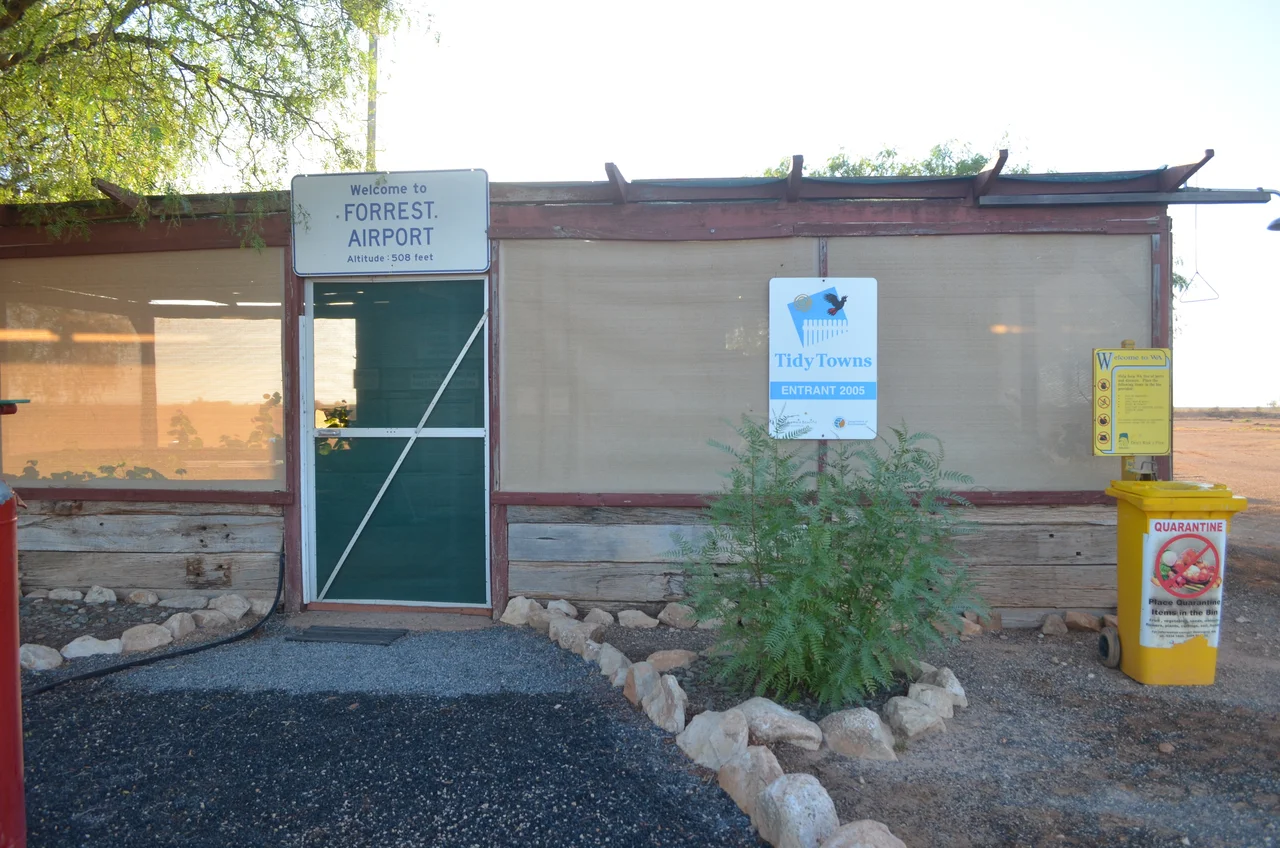

Forrest
The documentary about this place is called "The Big Wait," and the title says almost everything. Forrest is a settlement on the Nullarbor Plain with a population you can count on one hand - two people, by some accounts - tending half a dozen empty cottages and a pair of runways that stretch out into the saltbush. Once, this tiny outpost was a crucial pause in the long haul across Australia, a place where trains stopped and aircraft refuelled and weather balloons rose twice a day. Today it mostly waits: for a plane on the horizon, for a traveller off the track, for something to break the enormous quiet of the plain.
Born of a Railway
Forrest exists because of a line on the ground. It was established in 1916 during the building of the Trans-Australian Railway, the steel ribbon that finally joined the eastern colonies to the west and helped knit the new nation together. The settlement sits squarely on the most extraordinary stretch of that line - the longest dead-straight section of railway anywhere in the world, running 478 kilometres without the faintest curve. It was named for Sir John Forrest, the explorer who became Western Australia's first Premier and who, more than anyone, championed the railway as the iron promise that would bind the west to the rest of Australia at federation.
The Refuelling Stop in the Sky
The land here is so flat and the skies so clear that Forrest found a second purpose overhead. Its airfield opened in 1929 as the overnight stop on the first scheduled passenger air service between Perth and Adelaide, flown by West Australian Airways. For aircraft with short range and long distances to cross, this lonely strip became indispensable - a guaranteed place to land, refuel, and rest in the middle of a continent that offered almost nowhere else to do so. The role never entirely faded. The airfield has stayed in continuous use ever since, and to this day its two sealed runways, parking hangar, and Avgas and Jet A1 pumps make it a vital fuel stop for light aircraft tackling the long flight across the Nullarbor.
Reading the Weather for the Nation
For decades, Forrest did important work that few ever saw. A Bureau of Meteorology office operated here, and right up until the 1990s its staff released weather balloons twice every day, sending instruments up into the sky to measure the atmosphere over one of the most data-sparse regions of the country. Those readings fed forecasts for aircraft and for the nation. The last balloon went up in March 1995, when the office finally closed - one more function quietly switched off in a place that has spent a century slowly emptying out. The plain itself is unforgiving: though Forrest sits only about 120 kilometres from the cooling influence of the Southern Ocean, on 13 January 1979 the thermometer here reached 49.8 degrees Celsius, among the hottest temperatures ever recorded anywhere in Australia.
The Big Wait
What remains is a study in beautiful isolation. The great passenger train that still crosses the line, the Indian Pacific, rolls straight past without stopping. By road, Forrest can be reached only along rough unsealed tracks branching off the Eyre Highway near Eucla and Mundrabilla, more than a hundred kilometres away over rugged country. The cottages can be booked by the rare overnight visitor, and the runway lights still wait for traffic. In November 2024, the filmmaker Yannick Jamey captured all of this in a short documentary about the few residents who keep the place alive, and gave it the title that fits Forrest best of all - the long, patient wait of an outpost that the modern world has very nearly, but not quite, left behind.
From the Air
Forrest sits at roughly 30.74 degrees S, 127.69 degrees E, on the Nullarbor Plain about 85 km west of the Western Australia / South Australia border. Forrest Airport (ICAO: YFRT) is the defining landmark - two sealed runways, 1,350 m and 1,520 m long, with a parking hangar and Avgas / Jet A1 refuelling, set against an otherwise featureless plain and paralleled by the Trans-Australian Railway. It remains a genuine working fuel stop for light aircraft crossing the Nullarbor. Recommended viewing altitude is 2,000-4,000 ft AGL to pick out the runways, township, and the perfectly straight rail line; the longest dead-straight section of railway in the world runs right past. Larger diversion airports are distant: Kalgoorlie-Boulder (YPKG) far to the west and Ceduna (YCDU) to the east. Visibility is normally excellent, but summer brings extreme heat - temperatures here have approached 50 degrees Celsius - so expect significant density-altitude effects and strong thermal turbulence on hot afternoons.
Nearby Stories
- Reid, Western Australia 19 km away
- Loongana railway station 22 km away
- Old Homestead Cave 29 km away
- Trans-Australian Railway 66 km away
- Abrakurrie Cave 82 km away
- Great Victoria Desert 167 km away
- Serpentine Lakes 228 km away
- Neale Junction 273 km away