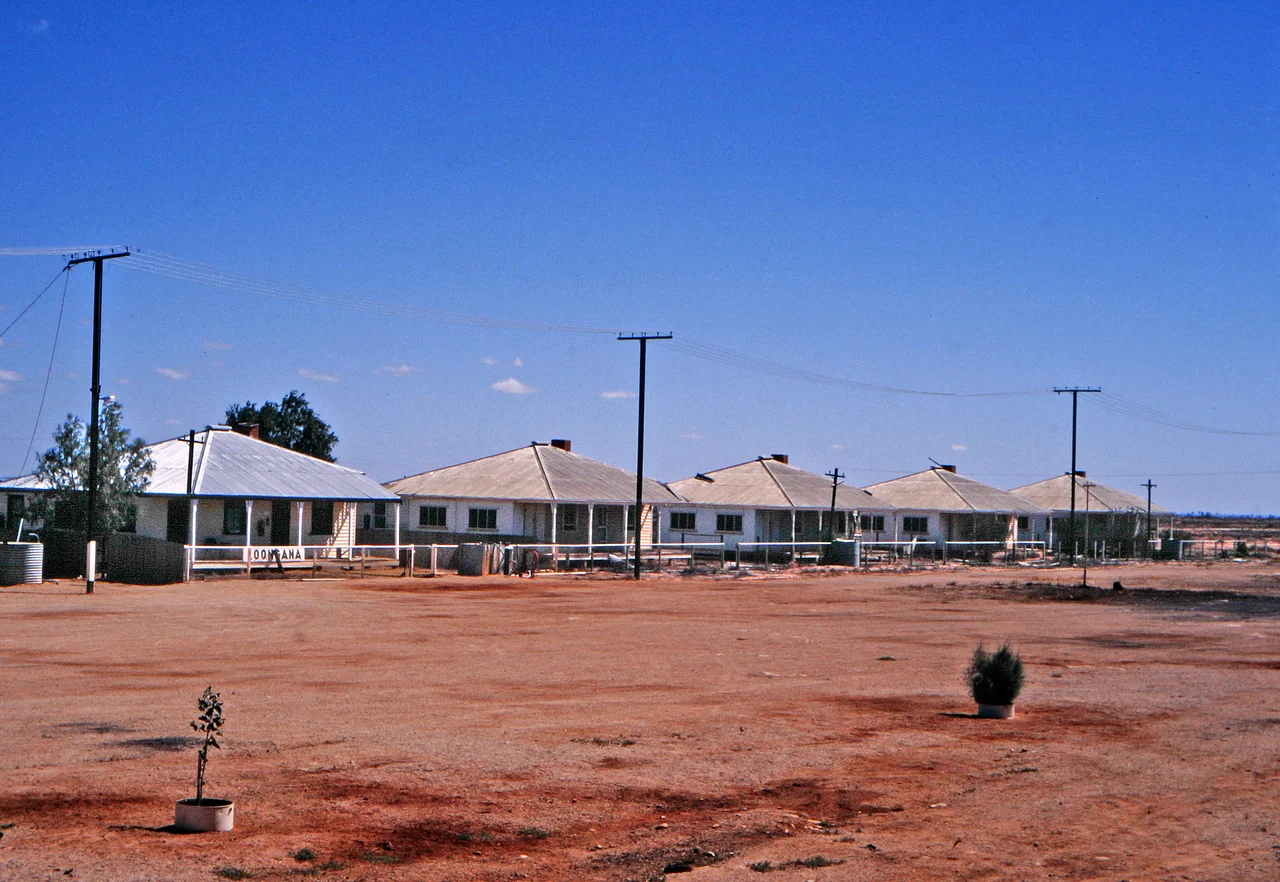

Loongana railway station
Stand on the platform at Loongana and look east, and the rails do something they do almost nowhere else on the planet: they refuse to turn. From here the Trans-Australian Railway runs dead straight for 478 kilometres, all the way to a point past Ooldea in South Australia, without so much as a gentle curve. There is nothing to curve around. The Nullarbor is the largest single slab of limestone in the world, flat to the horizon in every direction, and the engineers who laid this line in the 1910s simply pointed it east and kept going.
The Longest Straight
Loongana sits at the western threshold of a record that has no real rival. The straight section, beginning near here between Nurina and Loongana, measures 478 kilometres, the longest perfectly straight stretch of railway anywhere on Earth. It is not, however, level. The land beneath rises and dips in long shallow swells, so a driver can watch the headlight of an approaching train wink below the curve of the world before the train itself appears, minutes later, still impossibly far away. On a line this straight, distance stops behaving the way it does anywhere else.
A Town That Came by Train
Loongana was never a town in any ordinary sense. It began as a lime mine with a processing plant, a cluster of railway cottages, and the people needed to keep the track in repair. Out here, nothing arrived by road. Everything came by rail, including the water, the mail, and the groceries, delivered by the legendary Tea and Sugar Train that worked its slow way along the Nullarbor sidings until it was withdrawn in 1996. When the supply train stopped coming, the reason for a settlement largely stopped with it. The cottages that once housed the maintenance crews have since been demolished.
The Train That No Longer Stops
The Indian Pacific still passes through, the only passenger service that runs the entire Trans-Australian line between Perth and Sydney. But it does not stop at Loongana anymore. It slides past at speed, a long silver thread crossing a plain so empty that the train can feel like the only moving object in the world. For the handful of people who keep the railway running, the passing of the Indian Pacific is less an arrival than a kind of weather, predictable, brief, and gone again into the shimmer of the eastern straight.
Living on the Nullarbor
The name Nullarbor comes from Latin, nullus arbor, no trees, and the plain earns it. There is no shade here, no river, no relief from a sky that fills the entire view. Summer heat hammers the limestone; winter nights turn sharply cold. What the surface hides is just as strange as what it shows: beneath this treeless tabletop runs one of the world's great cave systems, dark rivers of air and ancient water threading through the rock. Above ground, though, Loongana offers only the essentials of survival and the company of a railway that never quite leaves and never quite stays.
From the Air
Loongana lies at roughly 30.95 degrees south, 127.04 degrees east, near the middle of the Nullarbor Plain in Western Australia. From altitude the single most striking feature is the railway itself: a ruler-straight line scored across an otherwise featureless expanse of pale limestone, running east-west with no settlements, roads, or vegetation to break it. There are no major airports nearby. The closest sealed strip is Forrest Airport (YFRT), an old Nullarbor airfield to the north; Eucla Airport (YECL), used mainly by the Royal Flying Doctor Service, lies well to the southeast. Visibility over the plain is typically excellent, with the flatness making the rail line traceable for many kilometres in clear conditions.
Nearby Stories
- Forrest 6.9 km away
- Old Homestead Cave 36 km away
- Mundrabilla, Western Australia 66 km away
- Madura Station 66 km away
- Arubiddy Station 84 km away
- Kinclaven Station 101 km away
- Ilkurlka Community, Western Australia 268 km away
- Neale Junction 283 km away