
Reid, Western Australia
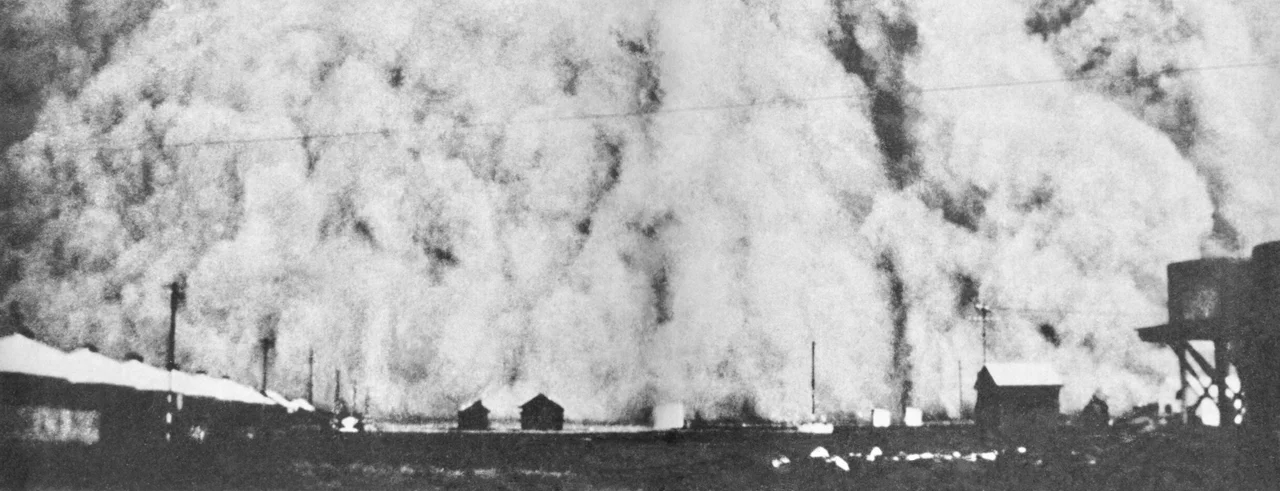
Around 1950, a photographer caught a wall of red dust bearing down on Reid - a Nullarbor storm rolling in across the flat, swallowing the horizon. In the foreground stand a few railway cottages; off to the side, the water tanks that were the whole point of the place. That photograph is one of the last clear pictures of a town that no longer exists. Reid was never meant to be charming or large. It was meant to keep the trains running, and for a while, against the odds, a community grew up around that single stubborn purpose.
A Name from Parliament, a Home on the Plain
Reid was established in 1916, while the Trans-Australian Railway was still being hammered together across the Nullarbor, and it took its name from Sir George Reid, who had served as Australia's fourth prime minister from 1904 to 1905. It is a curious habit of this railway: out on the emptiest terrain in the country, the sidings carry the names of the men who once ran the nation - Reid, Deakin, Cook, Hughes - a roll-call of early prime ministers scattered across hundreds of kilometres of saltbush. There was nothing prime-ministerial about the place itself. Reid was a working settlement on a working line, and its dignity came from the labour done there, not the name above the door.
Coal, Water, and a One-Teacher School
In the age of steam, a locomotive crossing the Nullarbor was a thirsty, hungry machine, and Reid existed to feed it. About a dozen railway families lived here, and most of the breadwinners spent their days refreshing engines with water and coal and keeping the track itself in repair. The water tanks beside the line were as vital as anything in town. Where there are families, there are children, and where there are children, there must be a school - so Reid had one, a single-teacher schoolhouse that in 1954 still had pupils enough to fill it. A teacher who worked there left behind photographs of those students, lined up and squinting in the desert light, the only faces that survive from a town now gone.
Undone by Progress
The thing that killed Reid was not drought or disaster but efficiency. When diesel locomotives arrived in 1951, the calculus of the railway changed overnight. A diesel engine did not need coaling stations strung every few dozen kilometres; the whole line could be served by a single fuel stop. The water - now needed only for the passenger carriages, not the engines - mattered less and less. Reid's reason for existing began to evaporate. The settlement clung on into the 1970s, when even track maintenance went mechanised, and then continuously welded rail and pre-stressed concrete sleepers made the old hand-labour obsolete. The jobs went. The families followed. There was nothing cruel in it, only the quiet arithmetic of a railway that no longer needed people standing in the heat to keep it alive.
What the Dust Reclaimed
The buildings were demolished, and by 2019 only a few scattered remnants remained on the plain - a concrete pad here, a rusted fitting there, the ghost of a township you could walk past without noticing. The Indian Pacific still rolls through, but it does not stop, and the passengers gazing out at the saltbush have no reason to know that a school once stood within sight of the track. Reid belongs now to the long list of Nullarbor sidings that flickered into being for the railway and faded when the railway changed its mind. The dust that once threatened the cottages has, in the end, simply taken the ground back.
From the Air
Reid lies at 30.82°S, 128.43°E on the Nullarbor Plain in Western Australia, hard against the Trans-Australian Railway. From the air there is almost nothing to mark it - a faint scar where buildings once stood and the unmistakable dead-straight line of the railway running east-west, here on the longest straight stretch of track in the world. Use the rail line itself as your navigation reference; the siding sits beside it roughly 25 km east of Forrest (YFRT), the nearest airfield, fuel, and emergency stop. Expect featureless terrain, brilliant visibility, and the same sudden dust storms the old photographs captured - a fast-moving red haze that can drop visibility to near zero with little warning.
Nearby Stories
- Old Homestead Cave 4.5 km away
- Forrest 30 km away
- Bunburra Rockhole Meteorite 31 km away
- Abrakurrie Cave 61 km away
- Koonalda Cave 102 km away
- Great Victoria Desert 161 km away
- Vokes Hill Corner to Cook Road 203 km away
- Ilkurlka Community, Western Australia 250 km away