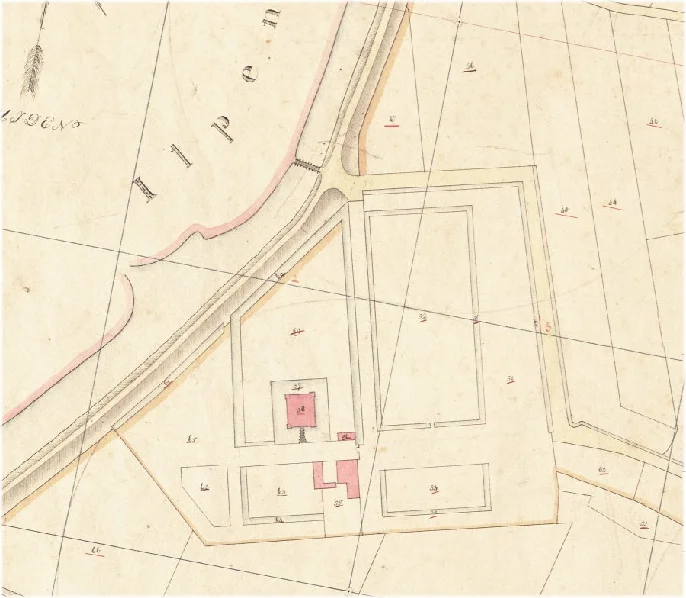

Ilpenstein Castle
Look for the castle on any modern map of Ilpendam, and you will not find it. The water it once reflected is still there, and the long flat polders that stretch toward the Zuiderzee still meet the horizon the way they did in the seventeenth century. But the stone walls, the gables, the wedding halls where Amsterdam's regent class once gathered for music and poetry, are gone. Ilpenstein was demolished in 1872, sold off and pulled down so completely that the village it overlooked now holds only a name and a footprint where one of the more storied estates of the Dutch Golden Age once stood.
A Knight Buys a Lordship
In 1618, an ambitious Amsterdam knight named Volkert Overlander bought the Free and High Lordship of Purmerend, Purmerland and Ilpendam from the Count of Egmond. Overlander was already a mayor and adviser to the city, part of the merchant aristocracy whose ships were stitching the world together with trade routes. Owning a lordship gave him something his counting-house could not: a title, a domain, and the right to call himself heer. Four years later, in 1622, he raised a castle on the property to match. Ilpenstein rose at the edge of the village of Ilpendam, on land that had been shaped by earlier wars. Spanish forces had thrown up an earthwork there during the long Eighty Years' War against the Dutch Republic, and Overlander's masons built atop that older bank, turning a defensive scar into a country seat.
The Captain in the Painting
When Overlander died, the lordship passed sideways through marriage. His daughter Maria had wed Frans Banning Cocq, and Cocq inherited not only the estates but the title Free Lord of Purmerland and Ilpendam. Cocq is a name most visitors to Amsterdam have seen without realising it. He is the figure in the broad black hat and red sash at the center of Rembrandt's Night Watch, the captain whose company commissioned the painting in 1642. While he posed for one of the most famous portraits in Western art, he was also riding north to Ilpenstein, where he served as lord of a country domain that ran across the dikes and dairy fields of Waterland. He was burgomaster of Amsterdam four times before his death in 1655. The castle, by then, was the country house of a man at the very center of the Dutch Republic.
Vondel at the Wedding
After Cocq, Ilpenstein passed to the De Graeff family, another dynasty of Amsterdam regents woven into the same dense web of cousins, marriages and political alliances that ran the Republic. In 1662, the castle hosted the wedding of Pieter de Graeff and Jacoba Bicker. Joost van den Vondel, the most celebrated Dutch poet of the age, wrote verses for the occasion. Among the guests was Johan de Witt, the Grand Pensionary then steering the country through its most prosperous and dangerous decade. For one summer evening, Ilpenstein held nearly every center of seventeenth-century Dutch power inside its walls: the merchant capital, the poets who praised it, and the statesman who would be lynched by an Orangist mob a decade later. The castle's rooms remembered them long after they were gone.
Demolition by Inheritance
Country estates outlive their reasons. By the nineteenth century the merchant patriciate had thinned, fortunes had fragmented across heirs, and a heavy old castle on heavy old earth was an expensive thing to keep up. The last residents were Christina Elisabeth de Graeff and her husband Jacob Gerrit van Garderen. In 1872, the property was sold and the castle pulled down. A new house was built on the site, a quieter, more modest building suited to a quieter age. The Spanish earthwork that had cradled Overlander's masonry vanished under it. Today the place keeps its memory in fragments: a street called Ilpensteinstraat carries the name in Nijmegen, more than a hundred kilometers south, and a seventeenth-century painting by Joris van der Haagen preserves the view of a castle that no one alive has ever seen.
What the Polder Holds
Flying over Ilpendam now, you see what Cocq saw when he rode out from Amsterdam: a village strung along a dike, a church tower, narrow drainage canals carving the green into long parallelograms, the dark line of the IJ canal cutting east toward the Zuiderzee. The countryside has been engineered for so long that the engineering has become the landscape. Somewhere beneath this patchwork of pasture and water, the foundations of Ilpenstein remain. The Netherlands is a country that builds atop its own past more than it preserves it, and Waterland, this watery shoulder of land north of the capital, is dense with vanished places. Ilpenstein is one of them. A castle that hosted Rembrandt's captain and a poet's wedding, gone in a single year, and barely missed by the dike it once watched over.
From the Air
Located at 52.46N, 4.95E in Ilpendam, North Holland, roughly 8 km north of Amsterdam's center across the IJ. Best viewed at 1,500-3,000 feet AGL: look for the village strung along the Noordhollandsch Kanaal between Landsmeer and Purmerend. Schiphol (EHAM) lies about 22 km southwest; Hilversum (EHHV) about 30 km southeast; Lelystad (EHLE) about 35 km east. The polder grid of Waterland is unmistakable in clear weather, and the canal makes a clean dark line through the green.
Nearby Stories
- 2008 Vintage Yachting Games 4.4 km away
- Museum Het Leids Wevershuis 7.2 km away
- Vechtstreek 8 km away
- 1973 Dutch Grand Prix 9.3 km away
- Lowlands Festival 10 km away
- HNLMS Johan Maurits van Nassau (1932) 11 km away
- Lemmer 13 km away
- Hoge Veluwe National Park 18 km away