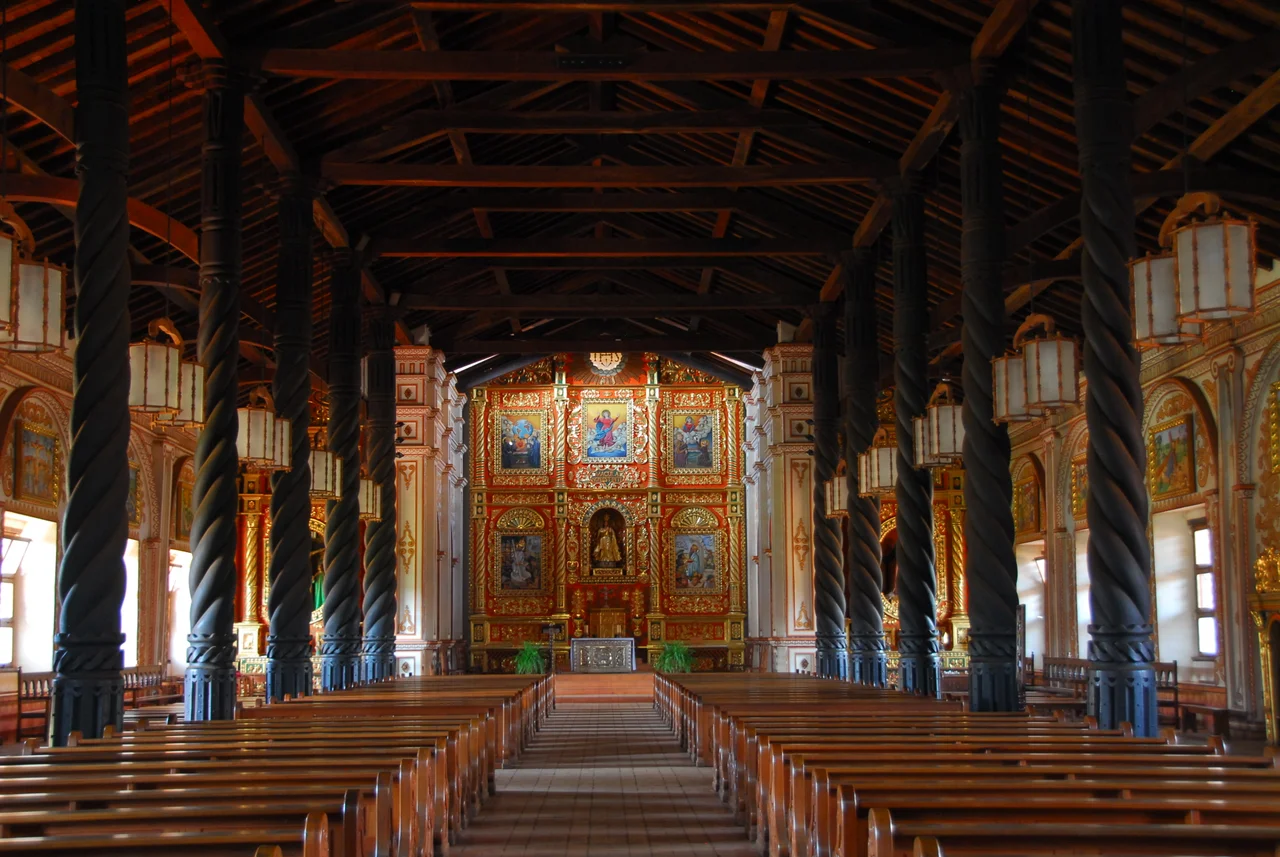

Immaculate Conception Cathedral, Concepción
Step through the doors and the forest seems to follow you inside. Columns of carved and turned wood rise toward a painted ceiling, the whole interior worked from timber rather than stone, more like the hull of some great inverted ship than a European cathedral. This is the Immaculate Conception Cathedral in Concepcion, the baroque heart of the Jesuit Missions of the Chiquitos and one of the most extraordinary religious buildings in South America. It was raised in the wilderness of eastern Bolivia by missionaries and indigenous craftsmen, lost to time, and brought back from the edge of ruin, a survivor that has outlived the empire that built it.
Raised in the Wilderness
The cathedral complex, comprising the church itself, its bell tower, and the parochial house, was built by the Jesuits between 1753 and 1756, in the closing years before the order's expulsion from Spanish America. It rose deep in the Chiquitania, hundreds of dusty kilometers from any colonial city, the work of missionaries and the Chiquitano people they had gathered into the reduction of Concepcion. There was no marble here, no quarried stone. Instead the builders turned to the great hardwoods of the surrounding forest, raising a baroque sanctuary out of carved timber and painted surface, a feat of craftsmanship that drew Europe's architectural language into the materials and skills of the lowland tropics.
From Ruin to Restoration
Recognition came in the twentieth century, long after the Jesuits had gone. Bolivia declared the cathedral a national monument in 1950, and in 1990 UNESCO inscribed it, together with its sister missions, on the World Heritage List. By then the building had endured generations of decay, the humid lowland climate steadily working at wood and paint. Its survival is owed to the sweeping restoration of the Chiquitos churches led by the Swiss architect Hans Roth, whose decades-long campaign returned these mission sanctuaries to their former glory. Without that work, the cathedral so admired today might have been remembered only in old photographs and faded accounts of vanished splendor.
A Living Cathedral
This is no museum piece kept behind ropes. The cathedral follows the Roman, or Latin, rite and serves as the principal church of the Apostolic Vicariate of Nuflo de Chavez, the Catholic jurisdiction created in 1951 by Pope Pius XII through the bull Ne sacri Pastores. It remains under the pastoral care of a bishop and continues to gather a congregation, just as it has, with interruptions, for more than two and a half centuries. The same carved columns that astonish visiting travelers still frame the prayers of the people of Concepcion. The building is at once a World Heritage monument, a working parish, and the spiritual anchor of a town built around its presence.
The Craft That Endures
What the Jesuits left behind in Concepcion was never only a building. They left a tradition of making, carving, sculpture, and music that the Chiquitano people carried forward through expulsion and the long decline. The town has become a custodian of that inheritance, home to a collection of original instruments and sculptures from the mission era and to the great music archive of the Chiquitania. The cathedral stands at the center of this living heritage, its carved interior the grandest expression of skills that still pass from one generation to the next in the workshops nearby. To enter it is to see, all at once, what indigenous hands and a Swiss missionary's vision made together, and what careful hands have since chosen to save.
From the Air
The Immaculate Conception Cathedral stands at 16.14 degrees south, 62.02 degrees west, on the main plaza of Concepcion in Nuflo de Chavez Province, Santa Cruz Department, Bolivia, at roughly 490 meters elevation. From the air the church and its bell tower are the dominant feature of the red-earth town grid, a bright landmark amid the rolling forest and ranchland of the Chiquitania. A viewing altitude of 2,500 to 4,500 feet AGL keeps the cathedral and its plaza in clear frame. The nearest major airport is Santa Cruz's Viru Viru International (ICAO SLVR) to the southwest; the airfield at San Ignacio de Velasco (SLSI) lies east along the missions route. Skies are clearest in the dry season from roughly May to October; wet-season afternoons bring building cumulus and reduced visibility over the lowlands.
Nearby Stories
- St. Ignatius Cathedral, San Ignacio de Velasco 60 km away
- San Ignacio de Velasco 68 km away
- Chiquitano Dry Forests 91 km away
- San Miguel de Velasco 122 km away
- Avion Pirata 171 km away
- Serra Ricardo Franco State Park 189 km away
- Santa Cruz (city, Bolivia) 201 km away
- Trinidad, Beni 272 km away