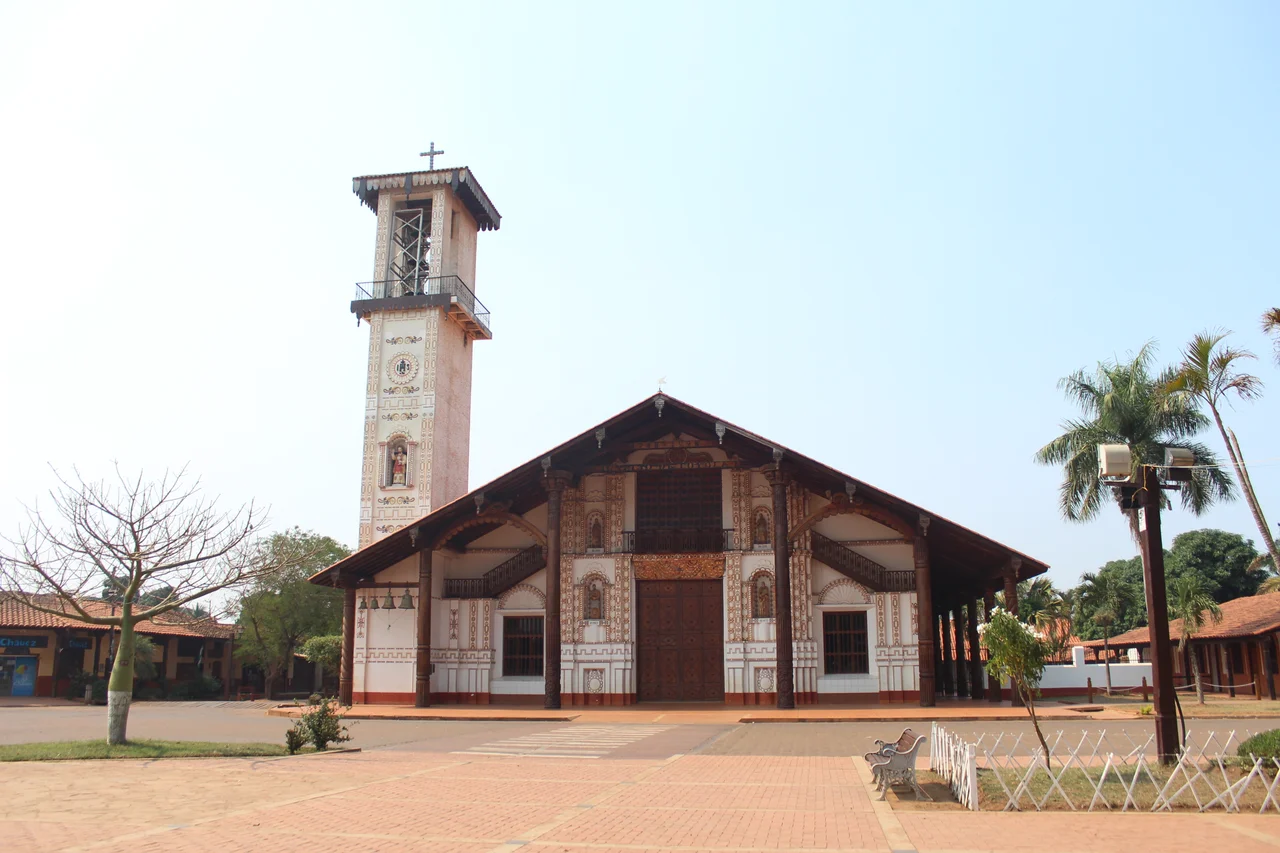

St. Ignatius Cathedral, San Ignacio de Velasco
Here is a church that was lost to fire and then rebuilt twice over. The original Jesuit mission church of San Ignacio de Velasco had stood for nearly two hundred years when fire destroyed it in 1948, leaving only photographs and a few salvaged treasures behind. A plain modern building replaced it, finished in 1968. The grandest mission church in the entire Chiquitania was simply gone, reduced to old images and living memory. Half a century later, those photographs would bring it back.
The First Church
Construction began in 1748, the same year Jesuit missionaries founded the town, and the church was completed in 1761. It followed the distinctive form of all the Chiquitos missions: a vast hall under a steep double-pitched roof, fronted by a deep porch carried on carved wooden columns, a design that married European church architecture to the materials and climate of the South American interior. For its first six years it was a Jesuit church. After Spain expelled the order from its colonies in 1767, it passed to the Chiquitano congregation that had built it and the diocesan clergy who served them. They kept it standing for nearly two centuries before fire finally took it in 1948.
What Survived the Demolition
Not everything was lost when the old church came down. The original main altar, carved from Spanish cedar and sheathed in gold leaf, was saved, along with the pulpit worked in the same gilded cedar by mission craftsmen. These pieces are the genuine article, the handiwork of eighteenth-century Chiquitano artisans who learned woodcarving in the Jesuit workshops and made it their own. When you stand before that altar today, you are looking at survivors. They outlived the building they were made for, waited out the decades in storage and in the modern church, and came home.
Rebuilt From Photographs
In 1998, Bishop Carlos Stetter set out to undo the loss. Working from photographs taken before the demolition, builders reconstructed the ancient mission church as faithfully as the old images allowed, completing the work by 2001. It rose again on the plaza, towered and timbered, the largest of all the mission churches restored to something close to its original silhouette. Because it was rebuilt from scratch rather than conserved in place, San Ignacio's church is the one mission of the six that UNESCO did not include in its World Heritage listing, an honest technicality that does nothing to diminish the sight of it filling the sky above the plaza.
A Living Cathedral
This is not a museum piece. The church is the seat of the Diocese of San Ignacio de Velasco, a jurisdiction Pope Pius XI created as an apostolic vicariate in 1930 and Pope John Paul II elevated to a full diocese in 1994. Bishops still preach here, the congregation still gathers, and during the region's celebrated Baroque music festival the building fills with the very sound it was built to hold, Chiquitano voices and violins performing scores that have survived in these missions for more than two centuries. The walls are new. Almost everything else about this place is very, very old.
From the Air
St. Ignatius Cathedral stands at 16.373°S, 60.960°W on the central plaza of San Ignacio de Velasco in eastern Bolivia. Its tall reconstructed bell tower and broad steep roof make it the most prominent structure for many kilometers and the clearest landmark in the otherwise flat Chiquitano plains. The town's airstrip, Capitán Av. Juan Cochamanidis Airport (ICAO SLSI, IATA SNG), lies within the town itself; the main regional gateway is Viru Viru International Airport at Santa Cruz de la Sierra (ICAO SLVR), about 400 km southwest. From the air the cathedral, the town grid, and the nearby Guapomo lake form a tight cluster of references against open savanna. Recommended viewing altitude is 2,000 to 4,000 feet over the town. Visibility is best in the dry season, May through September; the wet season brings haze and afternoon storms over the surrounding lowlands.
Nearby Stories
- San Rafael de Velasco 36 km away
- Immaculate Conception Cathedral, Concepción 54 km away
- Concepción (Bolivia) 63 km away
- Vila Bela da Santíssima Trindade 141 km away
- Chiquitano Dry Forests 169 km away
- Serra Ricardo Franco State Park 205 km away
- Avion Pirata 212 km away
- Pantanal Matogrossense National Park 348 km away