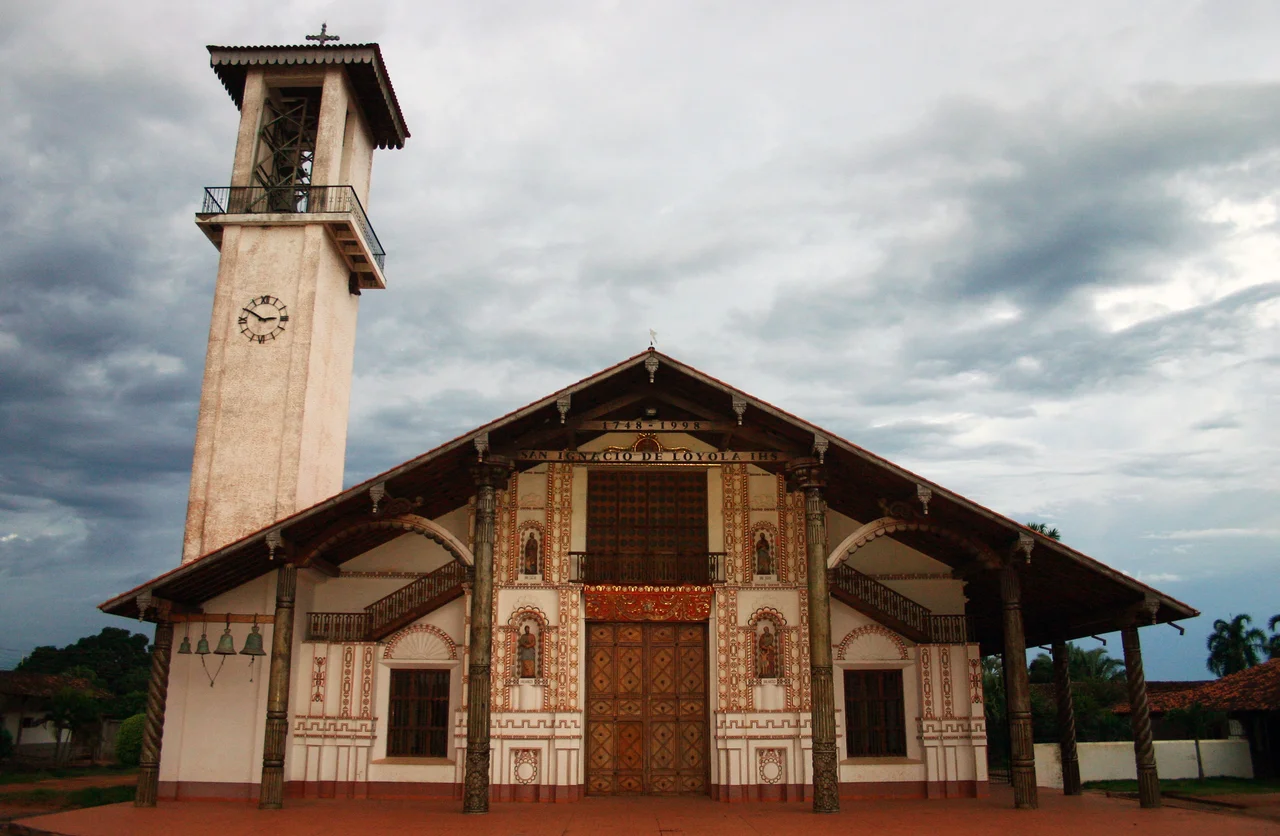

San Ignacio de Velasco
The road from Santa Cruz turns to dirt long before it reaches San Ignacio, and that is part of the point. This is the largest town in the whole stretch between the booming Bolivian lowlands and the Brazilian border, yet it sits almost two days' travel from a paved highway, perched on the shore of an artificial lake the locals call Guapomo. The town drinks from that lake, fishes in it, and watches the sunset over it. But the reason anyone outside the Chiquitania knows San Ignacio's name has nothing to do with the water. It has to do with a sound that was supposed to die in 1767 and somehow refused to.
A City Built From an Idea
In 1748, two Jesuit priests, Diego Contreras and the German-born Michael Streicher, founded a mission here on the edge of the known world. They were not building a fort or a trading post. They were building a reducción, one of a chain of six settlements the Jesuits raised across the Chiquitos plains between 1691 and 1755, each modeled on the 'ideal cities' that European philosophers had only ever sketched on paper. Indigenous Chiquitano and Ayoreo people, some of them arriving from the abandoned mission of San Ignacio de Zamucos, gathered around a central plaza, a workshop, and a church. For a few decades, in the middle of the South American interior, a strange experiment in faith and self-government actually worked.
The Music That Outlived the Missionaries
When Spain expelled the Jesuits from its empire in 1767, the priests left behind something they had never meant to be permanent: a living musical tradition. The Chiquitano had learned to build violins and organs, to read European notation, and to compose. Long after the last Jesuit was gone, missions kept the sheet music in trunks and kept performing it. Thousands of pages of Baroque scores survived in the dry plains air. Today, every two years, San Ignacio and its sister missions host an international festival that draws more than a thousand musicians from around the world to play music written by eighteenth-century missionaries and the Chiquitanos who outlasted them.
Camba Country
Walk the streets now and you hear Camba Spanish, the warm, clipped dialect of the Bolivian lowlands, threaded with words from Chiquitano. Nearly everyone here is Indigenous or mestizo. There is a small community descended from Germans who arrived after the Second World War, and Mennonite farmers work the surrounding land, but the heart of San Ignacio is Camba and always has been. It is the seat of a Catholic diocese, a market town, and a place where the cedar-carving and metalworking crafts the Jesuits introduced never fully disappeared. The workshop, in a sense, is still open.
The Edge of the Map
Geography made San Ignacio remote and remoteness preserved it. To the east, an unpaved road runs toward Cáceres in Brazil. To the west, the dirt track to San Javier is the only way out before the pavement finally begins. This is the threshold between two worlds, the last real town before the Pantanal wetlands and the Amazonian frontier swallow the roads entirely. People here have always lived with that isolation, and it has shaped a culture that looks inward, toward the plaza and the church bell, rather than outward toward the distant capital.
From the Air
San Ignacio de Velasco sits at 16.37°S, 60.96°W in eastern Bolivia's Santa Cruz Department, on the shore of the man-made Guapomo lake. The town's own airfield, Capitán Av. Juan Cochamanidis Airport (ICAO SLSI, IATA SNG), has a single airstrip set right against the town grid. The major gateway is Santa Cruz de la Sierra's Viru Viru International Airport (ICAO SLVR), roughly 400 km to the southwest. From the air, look for the lake's distinctive shape and the bright reconstructed mission church at the town center, ringed by the flat, seasonally flooded Chiquitano plains. Recommended viewing altitude is 3,000 to 5,000 feet for the town and lake; the surrounding savanna offers few other landmarks, so the water and the church spire are your best references. Skies are clearest in the dry season from May through September.
Nearby Stories
- San Rafael de Velasco 36 km away
- Immaculate Conception Cathedral, Concepción 54 km away
- Concepción (Bolivia) 63 km away
- Vila Bela da Santíssima Trindade 141 km away
- Chiquitano Dry Forests 169 km away
- Serra Ricardo Franco State Park 205 km away
- Avion Pirata 212 km away
- Pantanal Matogrossense National Park 348 km away