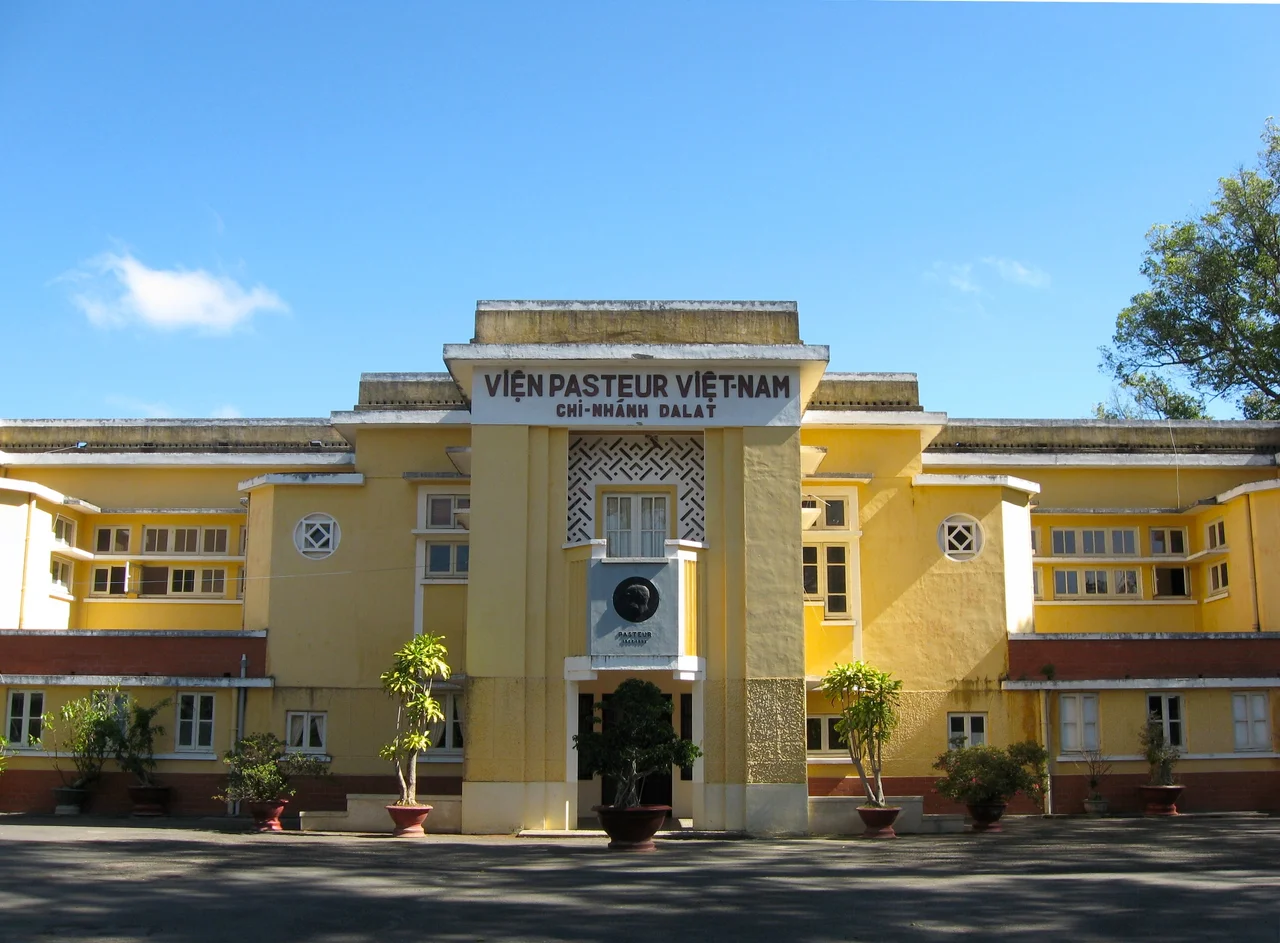

Institut Pasteur de Dalat
In 1956, scientists at the Da Lat Pasteur Institute captured a gecko in the town of Phanrong and isolated from its fecal matter a bacterial strain that no one had catalogued before. Working with colleagues at the Pasteur Institute in Paris, they identified it as a new type of salmonella. They called it S. dalat — later also known as Salmonella ball. It is a minor footnote in the history of microbiology, and yet it encapsulates something important about the place: a research institute in the Vietnamese highlands, staffed at that time by French doctors, quietly doing the kind of work that makes the names of cities permanent in scientific literature. Da Lat, a highland resort built for colonial leisure, had also become — through the laboratory Yersin established in 1936 — a place where science was made.
Yersin's Fourth Institute
Alexandre Yersin needs little introduction in Vietnam. The Swiss-French bacteriologist who co-discovered the plague bacillus in 1894 spent most of his adult life in Indochina, identifying the region's geography and diseases with the same systematic attention he brought to everything. By 1936, when he established the Da Lat facility, he had already founded Pasteur Institutes in Nha Trang and Hanoi. Da Lat was the third. The institute's high-altitude location in the Central Highlands was not incidental: the cool climate and relative isolation made it suitable for laboratory work and provided a distinct environment for studying the diseases endemic to the highland populations. Yersin was in his seventies when the Da Lat institute opened. He died in Nha Trang in 1943, but the network of institutions he built continued operating — and expanding — long after him.
Three Million Vaccines in a Year
The scale of the institute's output in its early years is striking. In a 1937 report to the Grand Council of Economic and Financial Interests, the Da Lat institute reported producing over three million vaccines in a single year. The majority were anti-cholera, but the list extended to anti-plague, anti-typhoid, anti-staphylococcal, anti-gonococcal, anti-streptococcal, and anti-meningococcal vaccines, along with tetra-vaccines and various Besredka filtrates. The institute maintained a reserve of one million cc of anti-cholera vaccine for emergency epidemic response. Beyond production, the Da Lat laboratory performed 1,838 medical examinations that year for local populations in Da Lat and the Upper Donnai regions, identifying cases of dysentery, diphtheria, leprosy, malaria, typhoid fever, and typhus. It also monitored water purification for the city. For a single facility in a highland city of modest size, the reach was extraordinary.
The Transition
French doctors ran the institute until the 1960s. One of the last, Jean Louis Colbert, worked in Da Lat from 1962 to 1968, overseeing large-scale vaccine production for human use. The facility was still publishing research articles in French as late as 1959. When the Vietnamese government assumed control in 1975, the institute was already one of the largest vaccine production facilities in Southeast Asia, shipping vaccines across Indochina. The Ministry of Health took over operations; after full national integration in 1978, the institute was used for public health and disease prevention. In 2010, the facility was incorporated as the Dalat Pasteur Vaccines Company Limited — DAVAC — with a mandate to produce vaccines and biological products and to maintain ties with international research and health organizations.
Science in the Highlands
The Institut Pasteur de Dalat sits at an unusual intersection: a place associated with colonial-era French leisure and grand hotel architecture that also contains, quietly, a century of serious medical science. The institute's contributions to vaccine production and disease surveillance shaped public health outcomes across Vietnam and wider Indochina in ways that the tourist brochures of Da Lat rarely mention. The gecko-derived salmonella strain named for the city is one small symbol of that invisible legacy — research conducted in an upland laboratory, shared with Paris, and catalogued in the permanent record of microbiology. The work continues today under DAVAC, imperfectly funded and still wrestling with production challenges, but present on the same site where Yersin's institute first opened its doors ninety years ago.
From the Air
The Institut Pasteur de Dalat sits at 11.9330°N, 108.4272°E in the central-southern area of Da Lat, at an elevation of approximately 1,475 meters. The compound is not visually distinctive from altitude but lies close to the cluster of colonial-era buildings that define central Da Lat. The nearest airport is Lien Khuong Airport (VVDL), approximately 28 kilometers south-southwest. From the air, Da Lat presents as a densely vegetated highland city with scattered European-style rooflines visible through the pine canopy. The Langbiang massif to the north provides the primary visual reference for orientation at altitude. Morning fog is frequent below 1,600 meters; the city typically clears by mid-morning in dry-season conditions.
Nearby Stories
- Tà Đùng National Park 3.1 km away
- Phan Rang–Tháp Chàm 4.2 km away
- Cam Ranh 18 km away
- Bao Loc 18 km away
- Operation Byrd 23 km away
- Nha Trang Air Base 25 km away
- Bidoup Núi Bà National Park 34 km away
- Duc Lap Camp 43 km away