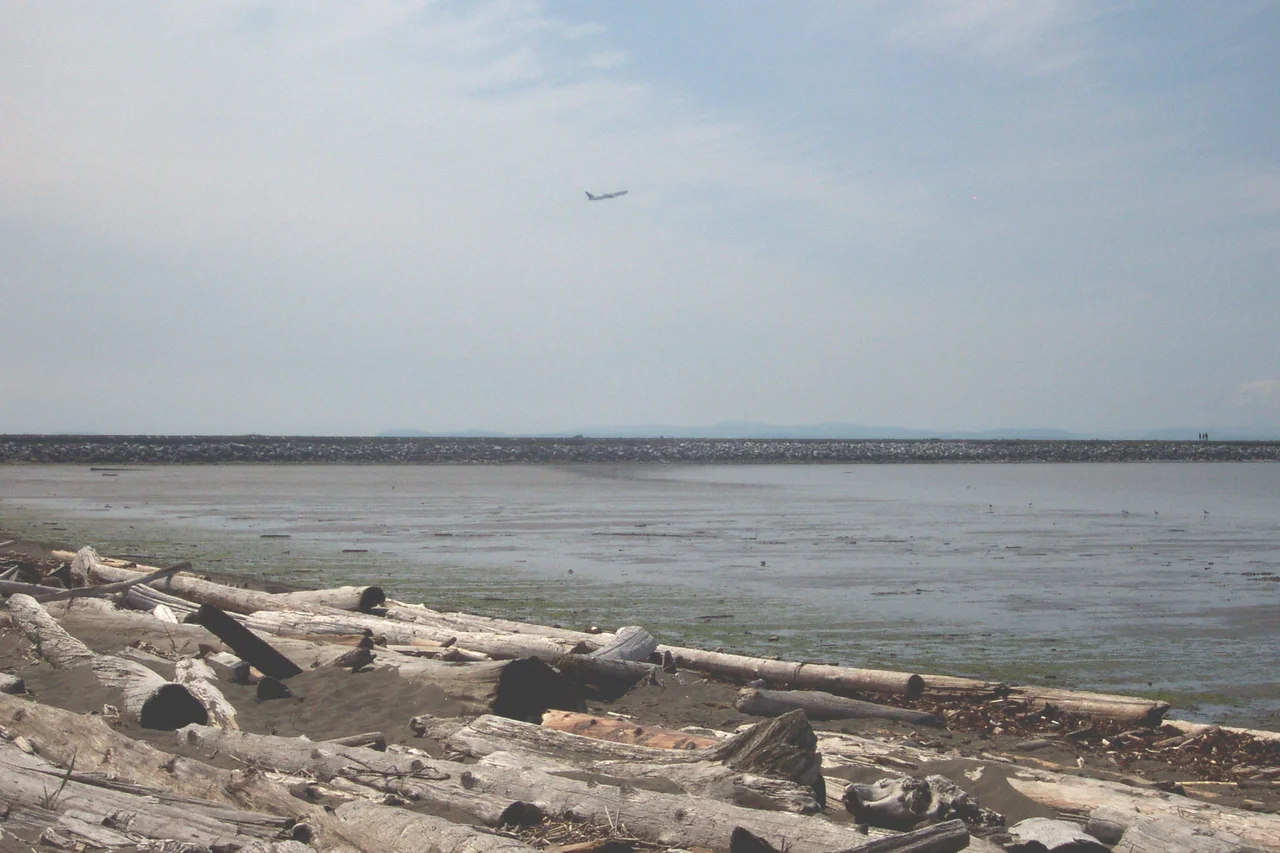

Iona Island (British Columbia)
In the summer of 1978, a spoon-billed sandpiper stood in a sewage lagoon in Richmond, British Columbia, for five days while birders from across the continent came to look at it. The species breeds on the Russian Arctic coast and winters in Southeast Asia; it should never have been within four thousand kilometres of the Fraser River. It remains the only confirmed record anywhere on the west coast of North America south of Alaska. That is Iona Island in one anecdote: a working piece of municipal wastewater infrastructure, wedged between an international airport and the Strait of Georgia, that happens to be one of the best places in Canada to see birds.
An Island That Stopped Being One
Iona was genuinely an island once, one of the low sandy bodies deposited at the mouth of the Fraser as the river drops the mountains it has been carrying. A causeway and Ferguson Road now tie it to Sea Island, so it is a peninsula in fact and an island only in name and in the paperwork. In the middle sits a primary sewage treatment plant, which runs public tours. Around it are settling ponds, an animal refuge, and Iona Beach Regional Park, managed by Metro Vancouver. Vancouver International Airport occupies the land immediately next door. It is difficult to think of a stranger assemblage of neighbours, and the birds do not appear to mind any of them.
Why the Ponds Work
The reason has to do with tide and timing. The Fraser delta is one of the most important shorebird staging grounds in the hemisphere -- a Ramsar wetland of international importance and a hemispheric reserve in the Western Hemisphere Shorebird Reserve Network -- and hundreds of thousands of birds refuel on its mudflats during migration. When the tide comes in and covers those flats, the birds need shallow water somewhere else, immediately. The Iona ponds are exactly that: warm, shallow, nutrient-heavy, and dependably wet no matter what the ocean is doing. Rarities turn up here that have no business being on this continent at all -- great knot and red-necked stint alongside the spoon-billed sandpiper, all Asian species blown or navigated far off course. Close to 300 species have been recorded, the second-longest list of any single location in western Canada. Public access to the inner ponds has been restricted in recent years to reduce disturbance.
Four Kilometres on Top of a Pipe
Two jetties, both owned by the Government of Canada, run out from Iona into the Strait of Georgia. The south one, Iona Jetty, reaches nearly four kilometres offshore, and it is genuinely one of the strangest walks in the Lower Mainland. Twin gravel trails run along the top of and beside the large pipe that carries treated effluent out to deep water, so you are walking on the infrastructure, straight out to sea, with the river's silt plume on one side and open strait on the other. By the far end the shore is a distant line and aircraft are turning overhead on final. The North Arm Jetty is longer and far less used: a sandy bar rather than gravel and concrete, angling northwest parallel to the Vancouver shoreline, ending at the University Endowment Lands almost directly opposite the UBC campus and plainly visible from Wreck Beach below.
Under the Approach
The proximity to the airport gives the place its particular texture. Widebodies come over low and constant, landing gear down, and the noise arrives in waves that the sandpipers ignore entirely. Beyond the jetties the delta opens west into the strait, with the North Shore mountains standing behind Vancouver to the northeast and, on a clear day, Mount Baker off to the southeast. Iona Beach itself is a long gravel and driftwood shore that gets a steady traffic of dog walkers and cyclists who have no idea they are sharing it with birds that flew in from Siberia. Nobody designed this. A city built a place to process its waste, a river kept building land, and a continent's worth of migratory birds decided the result was exactly what they needed.
From the Air
Located at 49.22 N, 123.20 W at the mouth of the North Arm of the Fraser River, immediately northwest of Vancouver International Airport (CYVR) in Richmond, British Columbia. This is inside CYVR's control zone -- do not transit without clearance. From the air Iona is unmistakable: a flat green-and-grey peninsula with a grid of rectangular settling ponds in the centre and two long straight jetties projecting into the Strait of Georgia, the southern one running nearly 4 km offshore and the northern sandbar angling northwest toward the UBC headland at Point Grey. The brown silt plume of the Fraser spreads west across the strait and is visible for many kilometres. The North Shore mountains rise behind Vancouver to the northeast; Mount Baker stands to the southeast on clear days. Best viewed at 1,500-2,500 ft AGL where airspace permits, or from the approach itself. Expect heavy commercial traffic, and note that large flocks of shorebirds and waterfowl use this area intensively during spring and fall migration -- a genuine bird strike consideration.
Nearby Stories
- Mudge Island 3 km away
- Mayne Island 4.9 km away
- Canadian Museum of Flight 6.1 km away
- Hovander Homestead Park 8.5 km away
- St. Augustine's Indian Residential School 8.8 km away
- Paldi, British Columbia 11 km away
- Golden Ears Provincial Park 20 km away
- Britannia Mine and the Mountain That Bleeds 25 km away