
Island Eddy
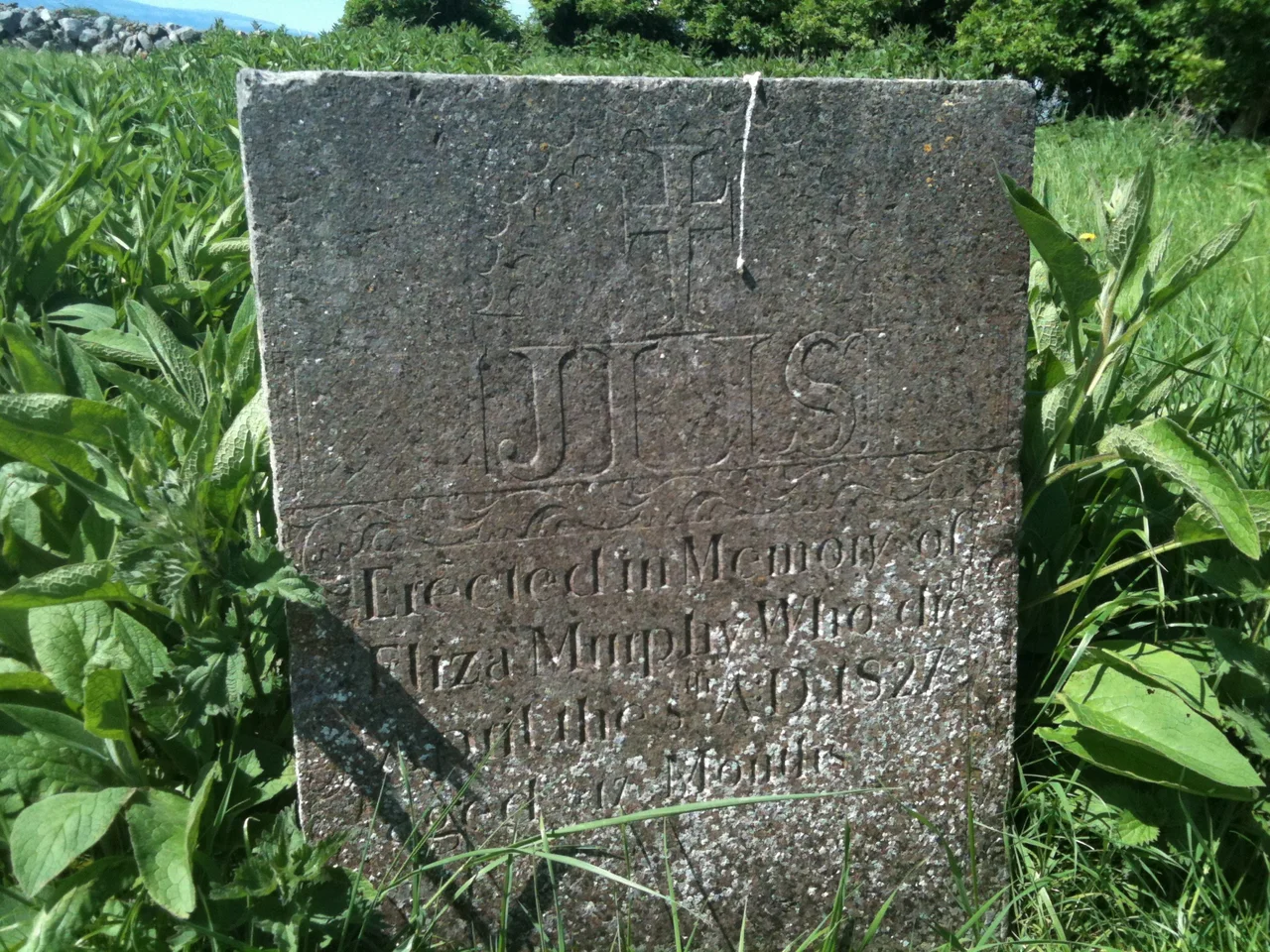
Two people were still living on Island Eddy in early December 1980. Then there were none. The last residents of a community that had been there since at least the early Middle Ages walked off the island and the houses went quiet. Forty-one roofed buildings stood in the village at the eastern end in 1842. Today the stone walls stand without roofs, the eastern stump of a sixteenth-century castle is buried in a boundary wall, and Eliza Murphy's gravestone - seventeen months old when she died in April 1827 - still leans in the small Children's Burial Ground at the village edge.
Not Eddy Island
Always Island Eddy, never the other way round. The official placenames commission of Ireland enshrines it - Oileán Eide, Island Eddy, no debating the word order. The island sits in the inner reaches of Galway Bay, on the eastern side, seven kilometres north-north-west of Kinvara. It is not a true island all the time. A long sinuous sand-spit called the cush stretches from the eastern tip toward the mainland, and at certain spring tides you can walk across. Galway County Council pointed this out in 1926, during a dispute with the islanders over land valuations - Eddy, the council reported, was not a true island. The islanders thought this was beside the point. They were paying rates higher than the best land in the county, on soil that would not grow much beyond oats and wheat.
A Village by the Sea
The earliest documented reference comes from 1225, when Murtogh O'Brien and the English of Desmond raided Hy-Fiachra so thoroughly that the chronicler claimed they left not a four-footed beast from Island Eddy to Athenry. A castle was here by 1552 - a property deed between Richard fitz James Skeret and the Perrell family names it explicitly, and the Perrells were on the island for at least four generations. By the 1860s a Mr Wray was leasing the oyster beds; the Atlantic Oyster Fisheries Company took over later. In 1877 the Redington family of Clarinbridge built a National School - a single-room thatched building twenty feet by fourteen, earthen floor, walls plastered but no ceiling. Thirty-four students were on the rolls in May 1879. Kate Madden, aged nineteen, was the first teacher. The school closed around 1901.
Famine and the Long Decline
The 1841 census recorded 125 people on Island Eddy. Ten years later, after the Great Famine of 1845-49, that community had been halved. National pattern, local tragedy. The population recovered a little through the 1870s, then began the long slow contraction that took most of the small Irish islands. The school's closure was a blow. The community remained viable until the eve of the Second World War, then went into terminal decline. Walsh's 2004 guide to the Irish islands claims Island Eddy was abandoned in 1947, but the census disagrees - two people lived there into December 1980. The principal families across the past two centuries were Berminghams, Conlons, Keanes and Hynes; the Corless family in the early nineteenth century; Fitzgeralds and Finnegans in the 1901 returns. Their descendants are scattered now, in contact through Facebook and the diaspora's other thin filaments.
The Nausts of North Mallmhuir
On the south shore of a narrow inlet known as North Mallmhuir, archaeologists have identified fifteen definite boat nausts - hollows in the shoreline carved to cradle and protect wooden boats - along 115 metres of coast. Plus a possible sixteenth. Four jetties, numerous mooring posts, a series of ballast dumps. The islanders called them cloches. They held the village's fleet of punts, of small sail-driven pucans, of the larger bad mors. The numbers, the scale, the layout - nothing else in Ireland matches this concentration. The 2010 survey reported them in Archaeology Ireland as a unique maritime heritage monument. Along the shore of South Mallmhuir, numbered limestone slabs called seaweed mearing stones still mark out the boundaries of the seaweed rights that mattered enormously to the island economy when seaweed was harvested for fertiliser, food, and kelp ash. Stones numbered 5, 9, 10, 11, 16, 20, 21, 22 and 23 have been identified.
Eliza Murphy's Grave
The Children's Burial Ground sits at the southern fringe of the ruined village. One gravestone bears an inscription: Eliza Murphy Who died 8 April AD 1827 aged 17 Months. The poet Moya Cannon, working out of Kinvara, wrote two poems for her collection Hands in 2011 - 'Nausts' and 'Eliza Murphy.' Both poems work from the physical particulars of the island, from the carved boat-cradles and the small headstone in the rough grass. The Celtic-folk group Island Eddy takes its name from the place. The ruined castle stump, the village walls, the burial ground, the nausts and the mearing stones - this is what is left when a community walks off. Sheep and horses still graze the fields. Otters keep at least one holt. A common pipistrelle bat was detected foraging around the abandoned village in June 2010. Pipistrelle, sheep, otter, ghost.
From the Air
Island Eddy lies at 53.20 N, 8.99 W on the inner eastern end of Galway Bay, off the coast of County Galway. Galway Airport (EICM) is roughly 18 km north-east; Shannon (EINN) about 50 km south. Visual identification: a low elongated island, 2.85 km east-to-west by just over a kilometre north-to-south, with a maximum elevation of only 8 metres - so it shows as a flat green shape just above the water. The sinuous sand-spit at its eastern end is distinctive. Best viewed in oblique light when the spits and isthmuses cast shadow. The inner Galway Bay is sheltered relative to the open Atlantic, but mist and low cloud are common.
Nearby Stories
- Connemara Railway 3.8 km away
- Ennis 7.2 km away
- Headford 10 km away
- Inishmaan 12 km away
- Ballygar 12 km away
- Ardgraigue Bog 13 km away
- Nenagh 17 km away
- Kilkee 27 km away