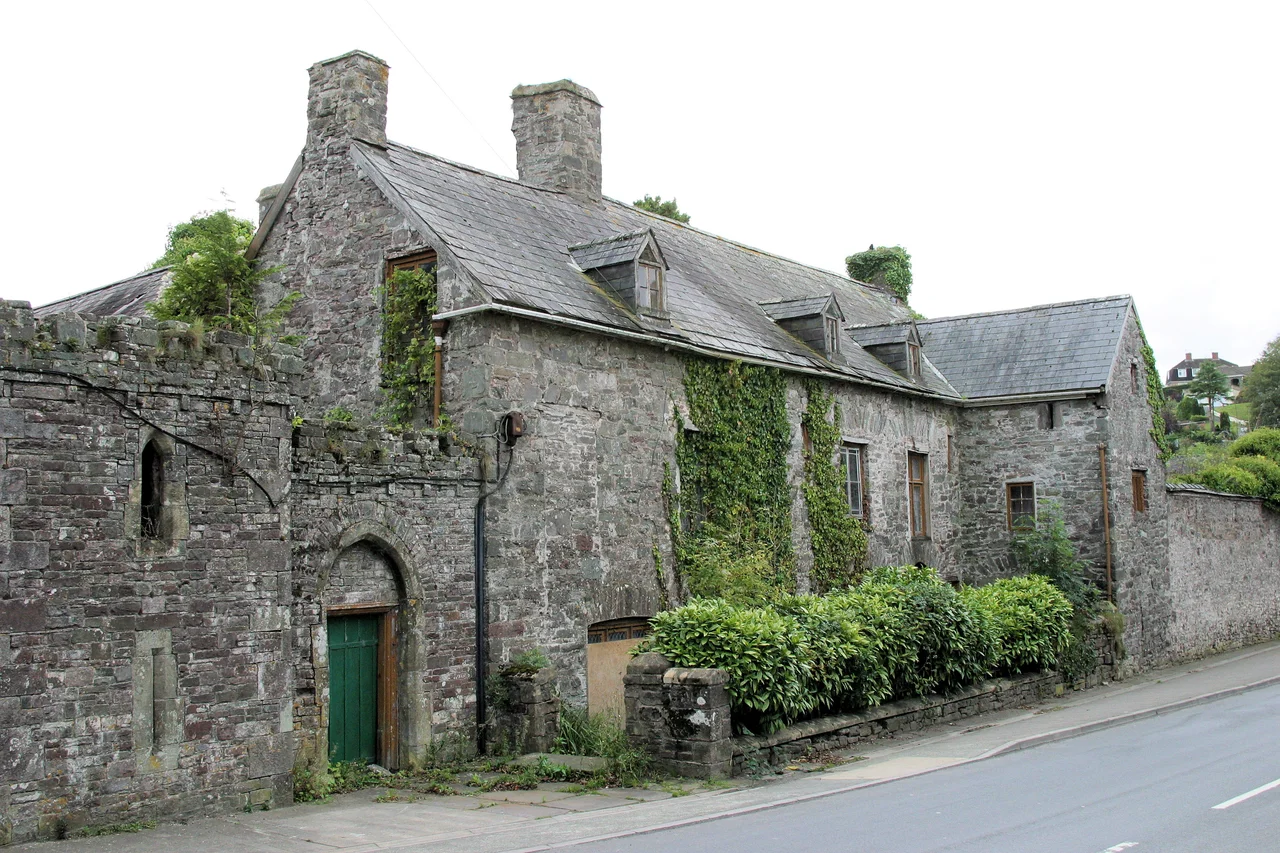

Island House, Laugharne
Sometime in 1644, during the parliamentary siege of Laugharne Castle, a cannonball aimed at the castle gatehouse went a little wide and struck Island House next door. Half the house came down. The owner at the time may or may not have been a Royalist sympathiser, but accident or not, a part of his home was demolished by Cromwell's gunners. The ball itself was kept on the premises until 1823 as a kind of souvenir. The half-house was rebuilt - a lintel above the yard door is dated 1658 - and the result is the building you still see slumped on the corner of Wogan Street: walls in places as thick as the castle's, a probable priest hole in the masonry, and a history older than almost any other surviving townhouse in Wales.
Island Between Two Mouths
The name is literal. Island House sat, originally, between the two mouths by which the River Corran enters the Taf estuary - channels known locally as Earth Lake and Mill Orange. In the early Middle Ages those channels formed Gosport Harbour, the working port of Laugharne, deep enough to shelter 350-ton vessels right up against the house's quay. Goods passed straight from boat to merchant. Over the centuries the tidal prism shrank, silt built up at the basin entrance, and saltmarsh crept across the foreshore. By 1950 the channels were no longer navigable. They survive now as moorings for pleasure boats - thin slivers of water snaking through grass where once the working sail of west Wales tied up to load and unload. The house remained but its harbour became a meadow.
The White Family and the First Records
The earliest documented owner is Elizabeth White, recorded in 1584 - widow of Thomas Rhys ap Rhydderch of Hawksbrook and heiress of Jasper White of Laugharne, whose family had held land in the parish since the 14th century. The Whites may have been the original builders; the earliest masonry dates from the 15th century. Through the 16th and 17th centuries the house passed through families whose names read like a who's who of Tudor and Stuart Carmarthenshire - the Vaughans of Golden Grove, the Mansels of Margam, the Prydderchs, the Thomases. Rhys Prydderch served as High Sheriff in 1608. His descendants were known to be Catholic during a century when that was dangerous, which may explain the tradition of a priest hole hidden somewhere inside the structure - a small concealed chamber where a hunted priest could be hidden from the search parties. There is also a tradition of a secret tunnel running from the cellars to the castle. Both stories may be true. Neither has been fully proved.
Chandler's Hill
By the mid-18th century Wogan Street was known locally as Chandler's Hill because three generations of the Skyrme family ran a marine chandler's from the property, supplying rope, sailcloth and tar to the ships at Gosport. All three were called William. All three were elected portreeve under the medieval town charter - the first in 1742, his son in 1775, his grandson in 1801. The grandson was born at Island House in 1778 and died there in 1823. His wife Mary stayed on with her second husband; she died in 1856 and the property passed to her daughter Mary Abra Hughes, the last of the Skyrme line, who married Frederick Wienholt of Laugharne in 1858. Mary's account book for 1835-36 records the cost of hiring a sedan chair to attend an assembly at The Globe Inn, a hundred yards down the street - the kind of detail that captures both the prosperity of the town and the fixed ceremony of its social life.
Roman Coins in the Garden
Sometime in the 19th century a Roman bath was found in the grounds of Island House. Then in 2006 a hoard of more than 2,000 Roman coins came out of the same earth. The discoveries fit a broader picture of Laugharne in the Roman period: not a recognised town, not even an officially documented site, but evidently a high-status native settlement wealthy enough to attract imported finewares from across the empire. Whatever stood on this corner before the medieval foundations was already two thousand years deep. The current frontage along Wogan Street is itself relatively recent - it used to be set back behind a walled garden - and the house has been steadily peeled back, layered, rebuilt and added to in every century since Elizabeth I.
Saved, Just
Caleb Rees, writer and Deputy Chief Inspector of Schools for Wales, lived at Island House from 1943 until his death in 1970. His widow, Dr Laura Rees, was Medical Officer to the Welsh Board of Health. They opened the gardens for community events. After the last private owner died in 2004 the house went empty. The roof leaked. The walls bowed. By 2015 the County Council was considering compulsory purchase to prevent collapse. In 2019 a public campaign launched to save it, by which point the structure was on the brink of falling. New owners took it on in 2020, shored it up immediately, and have been working on a full restoration ever since - bringing back into use a building that has watched Laugharne for six centuries and has only just survived the seventh.
From the Air
Island House sits at 51.77N, 4.46W on the corner of Wogan Street in Laugharne, immediately below Laugharne Castle and beside the Taf estuary. From the air it appears as the substantial slate-roofed building hard against the castle ruins. Best viewed from 1,500 to 3,000 feet. EGFP Pembrey is 7 nautical miles east; EGFH Swansea about 21 nautical miles east-southeast. The Taf estuary opens out to the south into Carmarthen Bay.
Nearby Stories
- Teifi Valley Railway 1.2 km away
- Haverfordwest 5.1 km away
- Mumbles Lifeboat Disaster 8.1 km away
- Neath and Tennant Canal 12 km away
- Strata Florida Abbey 27 km away
- HMS H47 31 km away
- Ilfracombe Lifeboat Station 38 km away
- HMHS Glenart Castle 44 km away