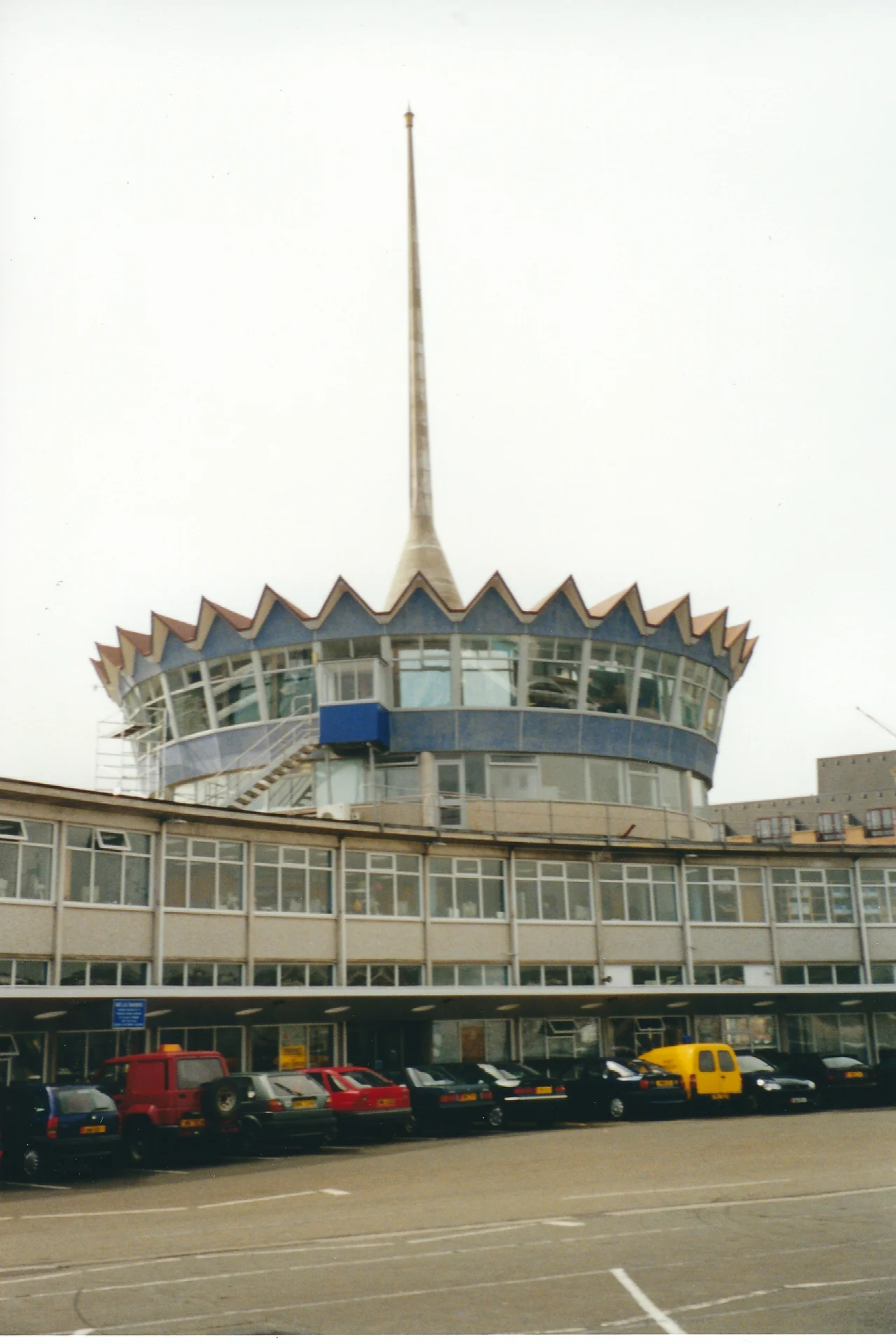

Isle of Man Sea Terminal
Before 1965, ferry travel to the Isle of Man was almost casual. You bought a ticket, climbed aboard a Steam Packet ship at Liverpool or Heysham, and stepped off at Douglas. There were no security procedures, no required identification, no gate. By the mid-1960s, the holiday rush that had built up since the war and the changing security expectations of an era of jet hijackings demanded something more structured. The result is a Modernist building on the near side of Douglas Harbour, built by McCormick and Davies and opened in 1965, that has been the island's seaward front door ever since.
A Modernist Outlier
Modernism was not common on the Isle of Man, which had largely built itself in Victorian brick, slate, and cast iron. The Sea Terminal is one of the few examples of mid-century concrete and glass to stand on the island, the other notable one being All Saints Church in Douglas. Its low horizontal mass and curved corners reflect the era it came from: an age of confident state architecture and high passenger volumes. At the time the building was put up, the Isle of Man was still a major British and Irish holiday destination, and thousands of summer visitors poured through Douglas every week. The architects designed for crowds. They got them.
Inside the Departure Lounge
Only the ground floor is used by passengers. The main departure lounge holds a Costa Coffee café, a WHSmith, a Steam Packet ferry travel shop, a play area for children, toilets, the foot passenger check-in desk, and, for civic decoration, a scale model of the Laxey Wheel. Beyond the departure lounge is the arrivals hall with its baggage belt, and next to that the Isle of Man Welcome Centre, the main visitor centre for the island. Upstairs are offices and the Douglas Harbour Control Unit, which manages shipping in and out of the harbour. Once, the top floor held a restaurant called the Crow's Nest with views over the main harbour. That space is now the harbour control unit, which has views that look excellent but contains very little wine.
Where the Ferries Go
Every passenger ferry and car ferry to the Isle of Man comes through here. The Sea Terminal is the main hub for the Isle of Man Steam Packet Company, the world's oldest continuously operating passenger shipping company, founded in 1830. Year-round sailings run between Douglas and Heysham on the Lancashire coast, the shortest crossing. In summer, the route opens out to Liverpool, Belfast, and Dublin, drawing in tourists from three different countries. On winter weekends, sailings shift to Birkenhead. The fleet's flagship Manannan, a high-speed catamaran, ties up at the Victoria Pier directly outside the terminal. Next to the terminal sits the vehicle check-in and marshalling area, where every car queues until the ship is ready to load.
Karina to Port Soderick
Tucked into the building's history is a small ghost of older island leisure. The Sea Terminal was once the waiting room for passengers heading out on the Karina, a pleasure cruiser run by the Laxey Towing Company. The Karina made daily summer trips to Port Soderick, Laxey, and other coastal stops from the cruise ship landing stage next to the Victoria Pier. The era of round-the-coast day cruises has mostly passed, but the photographs of the Karina alongside the Manannan are part of why the terminal feels less utilitarian than its lines suggest. It was always meant for both serious freight and small holidays.
Onward by Rail, Tram, or Horse
The Sea Terminal is also the connection point for every other Manx public transport mode, although you have to walk a little. Lord Street, five minutes away, is the terminus for the island's government bus network, Bus Vannin. Douglas no longer has a bus station; the buses just stop on the street. In summer the Douglas Bay Horse Tramway runs from the Sea Terminal along the promenade to Derby Castle, where the Manx Electric Railway takes over and continues all the way to Ramsey on the north coast. The Isle of Man Railway runs steam services from Douglas Station, a ten-minute walk away, down to Port Erin in the south. Step off a ferry at Douglas and you can be on a horse tram in two minutes, an electric tram in fifteen, a steam train in twenty, all of them Victorian or near enough. The Modernist box at the harbour edge is the entry point to a transport network nearly all of its older self.
From the Air
The Isle of Man Sea Terminal sits at 54.148°N, 4.474°W on the near side of Douglas Harbour, at the southern end of Douglas Bay. Best viewed from 1,500–2,500 feet AGL; the curved Modernist building stands at the harbour mouth with Victoria Pier and the cruise landing stage just to the east. Nearest airport is Isle of Man / Ronaldsway (EGNS), about 7 nm south. Tides, sea fog, and onshore winds shape ferry operations year round.
Nearby Stories
- St Bees Lighthouse 15 km away
- Celtic Array 22 km away
- Kirkmaiden 23 km away
- Isle of Whithorn 23 km away
- Seascale Lifeboat Station 31 km away
- German submarine U-1024 36 km away
- SS Georgetown Victory 40 km away
- Blackpool Illuminations 56 km away