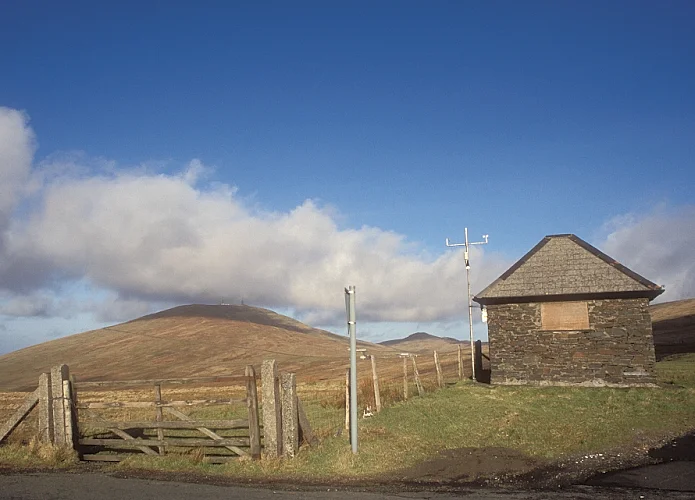

Isle of Man TT Mountain Course
Two hundred and nineteen corners. That is what separates the start line on Glencrutchery Road from the start line on Glencrutchery Road. The Snaefell Mountain Course is no oval, no purpose-built track ringed by gravel traps and run-off. It is the everyday road network of the Isle of Man, swept clean of traffic for a fortnight in late spring, and a rider who leaves the throttle pinned through every one of those bends covers the lap in just over sixteen minutes. Peter Hickman's outright record stands at 16 minutes 36.115 seconds, an average of 136.358 mph through hedgerows, stone walls, village high streets, and the broad open shoulder of a mountain.
An Accident of Geography
The course exists because mainland Britain wouldn't allow it. The Motor Car Act of 1903 capped speed at 20 mph across the United Kingdom, so the Auto-Cycle Club went looking for sympathetic ground. The Manx parliament, Tynwald, obliged with the Highways (Light Locomotives) Act of 1904, opening the island's roads to motor sport. The first attempt at a motorcycle race in 1905 had to dodge the steepest climb because the bikes of the day simply couldn't haul themselves up Snaefell. By 1911 the machines had improved enough to take on the full Mountain Course, and they have done so almost every year since. The name 'Four-Inch Course' came from a 1908 car-racing rule that limited cylinder diameter to four inches; the title outlived the cars and stuck to the motorcycles.
The Lap, Corner by Corner
Roughly sixty of those 219 corners have names, and most names hide a story. Birkin's Bend at Kirk Michael remembers Archie Birkin, who in a 1927 practice session swerved to avoid a fish-van on an open road and struck a wall; from 1928 onward practice was held only on closed roads. Handley's Corner recalls Wal Handley, hurt there on his Rudge in 1932. Guthrie's Memorial marks the spot where, in 1939, a stone monument was raised to Jimmie Guthrie at a cost of £1,500. Hailwood's Rise honours Mike Hailwood; Joey's, the 26th Milestone, honours Joey Dunlop and his 26 TT wins. Some names belong to the living: in 2013 the Manx government took the unusual step of naming a corner after John McGuinness, then a 20-time winner, and another after Dave Molyneux, the most successful Manxman on the course with 17 wins. A few corners belong to no rider at all. Caley's Corner remembers Ray Caley, who ran the shop and post office at the Sulby junction until his death in 2017.
The Weight of the Numbers
Between 1911 and 2025, two hundred and seventy competitors have died on this course in official practice or racing. The first was Victor Surridge, a Rudge-Whitworth works rider, who crashed near Glen Helen during practice for the 1911 TT and died of his injuries. Each subsequent death rewrote the course in some small way. Compulsory crash helmets followed Frank Bateman's fatal crash in 1913. The end-of-race flag followed Fred Walker's death in 1914. The closing of practice sessions to public traffic followed Archie Birkin's death in 1927. The TT Travelling Marshals, motorcycle-mounted first responders who still patrol the course today, were created after fatalities in heavy fog during the 1935 Lightweight TT. Six riders died in 1970, including world championship contender Santiago Herrero. The names go on. Each one was a person who came here knowing the risks and chose to ride anyway, and behind each is a family who watched them go.
Speed, Inch by Inch
What the riders chase is measured in fractions. The first 90-mph average lap came in 1957. The first 100-mph car lap came in 1990, when Tony Pond drove a Rover 827 Vitesse around in 22 minutes and 9.1 seconds. The first 100-mph cycling lap fell to Peter Kennaugh, Isle of Man-born, who in 2015 took the cycling record from Chris Boardman by six seconds. New Zealander Bruce Anstey clocked an unofficial 206 mph at the end of Sulby Straight in 2006 practice, the kind of speed normally reserved for closed tracks with several layers of catch fencing. On this course there are stone walls, garden gates, and the wooden marker board behind which Harold Leece used to offer garden hospitality to spectators. They named the 170-mph right-hander before Gorse Lea after him in 2019.
A Road That Keeps Changing
The course has been rebuilt under the riders' wheels for over a century. The hump-backed bridge at Ballig went in the 1930s. The Verandah was cut deeper into the hillside in the early 1970s after Gilberto Parlotti died there in heavy rain. The Quarterbridge has been reshaped repeatedly, most expensively in 2008 when a £4 million scheme rebuilt the junction and demolished the Quarterbridge Hotel. Air fencing has replaced exposed stone in the most dangerous spots. Newcomers must now complete a speed-control lap and hold a specific TT Mountain Course licence. Course inspection cars carry GPS trackers. Each measure was bought at a price, and the riders who come back every year ride knowing exactly what that price has been.
From the Air
The Mountain Course traces a triangle across the Isle of Man: Douglas on the east coast (start/finish near 54.17 N, 4.48 W), out along the A1 to Peel, north past Kirk Michael and Ballaugh, into Ramsey, then up over the A18 Snaefell Mountain Road back to Douglas. Cruising at 2,500-4,000 feet AGL gives a clean view of the whole island, which is only about 33 miles long. Ronaldsway (EGNS) sits at the southern tip; Ronaldsway VOR aids navigation. Expect maritime cloud and the famous 'Manannan's Cloak' draping the high ground.
Nearby Stories
- St Bees Lighthouse 15 km away
- Celtic Array 22 km away
- Kirkmaiden 23 km away
- Isle of Whithorn 23 km away
- Seascale Lifeboat Station 31 km away
- German submarine U-1024 36 km away
- SS Georgetown Victory 40 km away
- Blackpool Illuminations 56 km away