
Jamestown Settlement
Three small ships rock at their lines in the James River shallows - the Susan Constant, the Godspeed, and the Discovery, full-size replicas built for the 350th anniversary in 1957. Boarding the Susan Constant, you understand why the original voyage took 144 days. The hold smells of tar and oak. The crew quarters are cramped low spaces where a hundred and four men crossed the Atlantic in the winter of 1606-07. Walk uphill from the ships and the past gets harder to bear. A reconstructed Powhatan town stands beside the reconstructed James Fort, and the relationship between them is the central, terrible fact of the place: on May 14, 1607, English colonists landed here on Powhatan land, and almost nothing about the next four centuries was good for the people who already lived along the James.
Festival Park, 1957
Jamestown Settlement opened in 1957 as Jamestown Festival Park, built for the 350th anniversary of the founding of the Virginia Colony. The Commonwealth of Virginia and the National Park Service collaborated on the reconstructed Glasshouse, the Memorial Cross, a visitors' center, and full-sized replicas of the three colonists' ships, built at a Portsmouth, Virginia shipyard and moved to nearby Glass House Point. The celebrations ran from April 1 to November 30 with more than a million participants. Vice President Richard Nixon spoke. The British ambassador attended. On October 16, 1957, with nearly 25,000 people present, Queen Elizabeth II and Prince Philip visited; the Queen lent a copy of Magna Carta to the exhibition. Army and navy reviews marched past, Air Force jets flew over, and an outdoor drama played at Cape Henry, where the colonists had first stepped ashore in April 1607 before sailing on up the James.
What the Reconstruction Shows
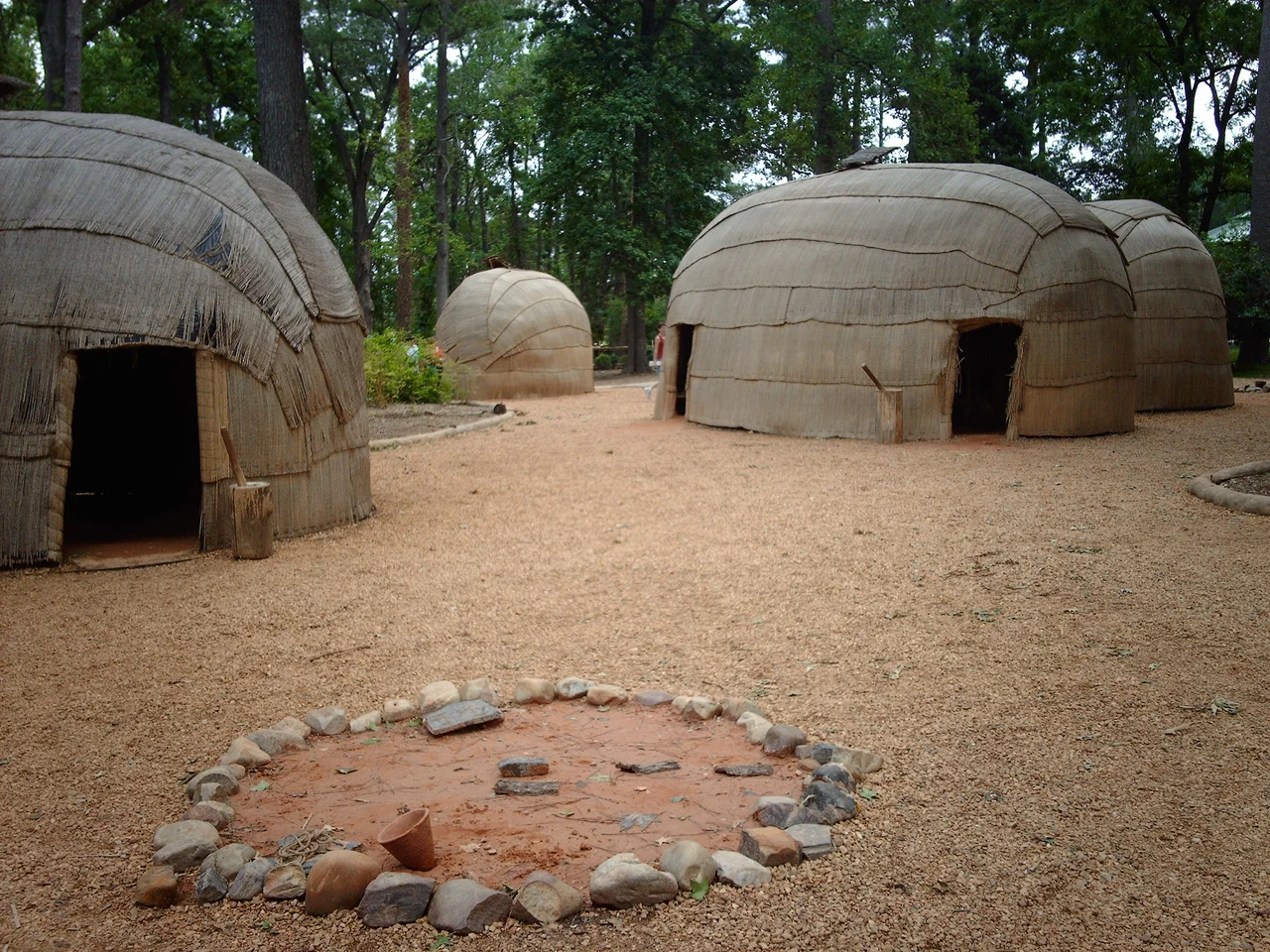
The Living History area lets visitors walk into a re-creation of a Powhatan town and the 1610-14 colonial fort. Costumed interpreters demonstrate seventeenth-century daily life - warehouses, chapels, sentry posts, guardhouses. In the smokehouse, bacon cures over hickory wood, releasing the savory acrid smell of colonial-era food preservation. In the cider cellar, apple cider ferments under natural conditions. The reconstructed Powhatan town shows mat-covered yi-hakans, garden plots, fishing nets, a way of organizing land and family that had worked in the Chesapeake for centuries before contact. The English fort - palisade walls of pointed logs, low buildings inside, soldiers drilling in linen and steel - shows the cramped, hungry place where colonists died by the hundreds in those first years. The 1610-1611 winter, the Starving Time, killed roughly four out of five colonists at Jamestown. The reconstruction does not let visitors forget either fact: the death rate inside the walls, or whose land lay outside them.
The First Enslaved Africans
In August 1619, more than two dozen African people were brought to Point Comfort - at the mouth of the James - aboard the White Lion, an English privateer that had taken them from a Portuguese slave ship in the Caribbean. They were taken from what is now Angola, and the documents call them "twenty and odd Negroes," sold in exchange for food and supplies. The men and women, whose names we mostly do not know, became the first documented Africans in English North America. Some appear in census records and in the names of children who were born in Virginia in the 1620s. The same year saw the establishment of Virginia's first representative legislature and the first English-named plantation granted on the south bank, at Chippokes. Within a few decades, racial slavery as a legal institution would harden around these people and their descendants. The Jamestown Settlement museum tells this part of the story explicitly. The galleries hold more than 500 artifacts at any one time, representing Powhatan, European, and African cultures that converged in seventeenth-century Virginia.
The Fort Was Not Lost
For most of the twentieth century, historians believed the original 1607 James Fort lay under the river - washed away by erosion centuries ago. In 1893, a portion of Jamestown Island was donated to Preservation Virginia, including the ruined Jamestown Church tower, with the intention of saving what was left. In the early 1900s, a seawall went up to protect the site. The 300th anniversary was held at Sewell's Point in Norfolk in 1907 - the Jamestown Exposition - because organizers thought transportation to the island was too difficult. Then, in 1994, archaeologists with the Jamestown Rediscovery project began digging in a corner of the island, and by 1996 had found postholes. The original triangular fort was not under the river. It was right there, just inside the existing seawall. The excavations have continued ever since, recovering tens of thousands of artifacts and rewriting what we know about the colony's first years.
Two Sites, One Island
Today, Jamestown Settlement and Historic Jamestowne are two separate museums on adjacent ground. Jamestown Settlement is the Commonwealth's living-history complex - the ships, the Powhatan town reconstruction, the James Fort recreation, the indoor galleries. Historic Jamestowne, operated by the National Park Service and the Jamestown Rediscovery Foundation (a branch of Preservation Virginia), preserves the actual archaeological site, the church tower, and the Glasshouse. The Colonial Parkway connects both to Williamsburg and Yorktown. In May 2007, Queen Elizabeth II and Prince Philip returned for the 400th anniversary; the New World 1607 special exhibition borrowed artifacts from museums on three continents. Pocahontas Imagined, in 2017, marked the 400th anniversary of Pocahontas's death in England. An American Indian Intertribal Powwow was held that October. The two sites together tell a story neither could carry alone: the artifacts that survived, and the world that surrounded them - English, African, and Powhatan - on the day everything changed.
From the Air
Coordinates 37.2266°N, 76.7863°W. Jamestown Settlement and Historic Jamestowne sit on Jamestown Island, on the north bank of the James River at the western end of the Colonial Parkway. From the air, look for the small island connected to the mainland by a causeway, the church tower visible on the eastern point, and the masts of the three replica ships at their berth on the south side. Best viewed 1,500-3,000 feet AGL. Nearest airports: Williamsburg-Jamestown (KJGG) about 2 nm north, Newport News/Williamsburg International (KPHF) about 14 nm east-southeast.
Nearby Stories
- Siege of Petersburg 5.4 km away
- Battle of Gwynn's Island 7 km away
- Norfolk: The Navy's Capital Where the Fleet Calls Home 7 km away
- Southside (Richmond, Virginia) 11 km away
- Chesapeake Bay Bridge-Tunnel 24 km away
- White House (plantation) 25 km away
- Suffolk, Virginia 27 km away
- Fort Christanna 52 km away