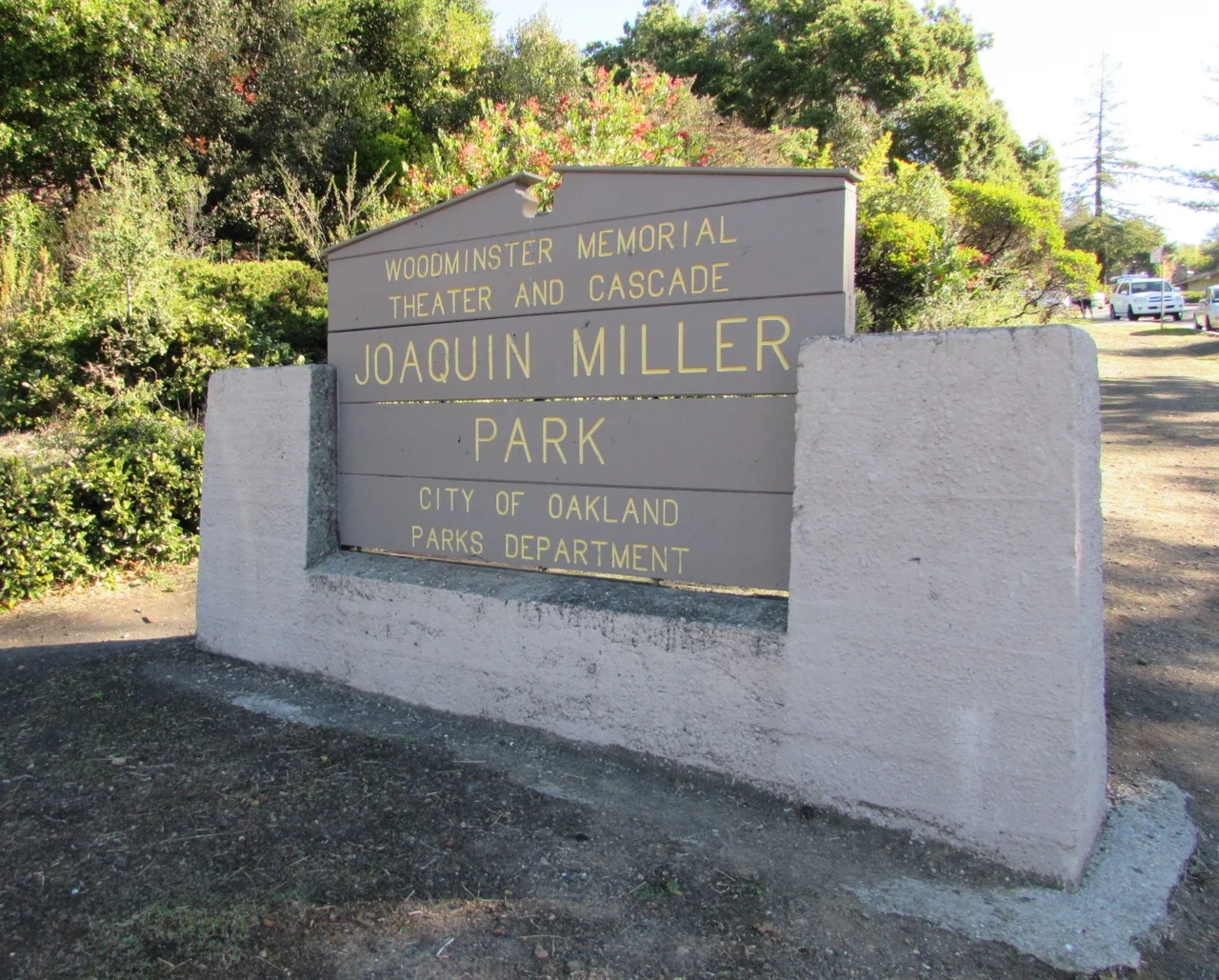

Joaquin Miller Park
Most city parks are designed by landscape architects. This one was planted, tree by tree, by a poet with dirt under his fingernails. Joaquin Miller bought a hundred acres of Oakland hillside in the 1880s, named the property "The Hights" -- the misspelling was intentional -- and set about transforming bare grassland into forest. He planted coast redwoods, pines, and eucalyptus by the hundreds. More than a century later, those trees tower over 500 acres of public parkland in the Oakland Hills, and the man who planted the first of them left behind not just a forest but stone monuments, a preserved house, and a cascading waterfall that still runs with water.
One Man's Forest
Joaquin Miller was already famous when he arrived in Oakland -- a poet celebrated in London drawing rooms for his romantic verses about the American frontier. But on his hilltop he became something closer to a gardener with literary ambitions. He planted trees obsessively, and not just ornamental ones. Coast redwoods, coast live oaks, and pines went into the ground year after year, creating the dense woodland that now defines the park. Many of the oldest trees in Joaquin Miller Park are Miller's own plantings, their roots reaching into soil he turned himself. The poet who wrote about mountains and rivers spent his later decades literally building a landscape, shaping the earth to match the grandeur he put on the page.
Monuments on the Ridge
Miller did more than plant. On the high ground to the north of his home, he erected rough stone monuments to the figures he most admired: Moses, the explorer John C. Fremont, and the poets Robert Browning and Elizabeth Barrett Browning. These were not polished memorials commissioned from sculptors. They were personal, idiosyncratic cairns and pillars, built by Miller's own hands on a hillside overlooking San Francisco Bay. The monuments remain today, weathered by more than a century of coastal fog and winter rain, still standing in the positions Miller chose for them. They are strange objects to encounter on a hiking trail -- part shrine, part folk art -- and they say as much about the man who built them as about the people they honor.
The Cascade and the Amphitheater
Below the Woodminster Amphitheater, water flows down a terraced stone cascade built in 1941 and dedicated to California's writers. Designed by Howard Gilkey -- who also created the now-dry Cleveland Cascade at Lake Merritt -- the Woodminster Cascade is one of the few Depression-era water features in the East Bay that still functions. The stairs flanking the falling water have become a gathering place: fitness enthusiasts run them for exercise, couples get married on the landings, and on summer evenings the amphitheater above hosts outdoor musical theater. Gilkey's design connected the amphitheater to the lower park with a single flowing gesture, turning a hillside into a stage set where gravity does the work.
Trails Through the Canopy
The park's 500 acres hold miles of hiking, biking, and horseback riding trails that wind through redwood groves, oak woodland, and open meadows with panoramic views of San Francisco Bay. On clear mornings, the view from the upper ridges stretches from the Golden Gate Bridge to Mount Diablo. The understory supports pinkflower currant, evergreen huckleberry, creambush, and gooseberry -- a native plant community that thrives in the filtered light beneath the tall trees. An off-leash dog area, a children's playground, and scattered picnic sites draw families on weekends. The trails are quiet enough on weekday mornings that the loudest sound is Steller's jays arguing in the canopy overhead.
Tending the Poet's Legacy
Fire is the great threat in the Oakland Hills, and Joaquin Miller Park sits squarely in the danger zone. The 1991 Oakland Hills firestorm burned nearby neighborhoods and demonstrated what wildfire can do in this terrain. The Friends of Joaquin Miller Park, a volunteer coalition, works with the California Department of Forestry and Fire Protection to manage vegetation, reduce fuel loads, and protect both the park and the surrounding homes. Other volunteer groups, including the Oakland Bike Patrol, help maintain trails and keep the park accessible. It is a fitting arrangement: a park planted by one determined individual is now sustained by a community of them, each contributing labor to preserve a forest that began as one poet's audacious experiment.
From the Air
Located at 37.81N, 122.19W in the Oakland Hills, east of downtown Oakland. The park's 500 acres of dense woodland are clearly visible from 2,000-4,000 feet AGL as a dark green patch on the hillside. Nearest airports: KOAK (Oakland International, 7 nm south-southwest), KHWD (Hayward Executive, 9 nm southeast). The Woodminster Amphitheater and cascade provide a visual reference point, appearing as a light gap in the tree cover. San Francisco Bay and the Golden Gate Bridge are visible to the west from the park's upper elevations.
Nearby Stories
- Isleton: The Half-Square-Mile Town That Made Perry Mason Famous 3.4 km away
- Eden Landing Ecological Reserve 5.1 km away
- Where Salt and Fresh Water Negotiate 10 km away
- The Kilns That Never Burned 13 km away
- Altamont Free Concert 17 km away
- Where Tectonic Plates Go for a Swim 18 km away
- Kesterson National Wildlife Refuge 77 km away
- ʻAkaka Falls State Park 3701 km away